Dog’s confused by seeing the family cat on youtube, checks to see if it’s still in its box. You can see the question marks over her head…
Golden Age comics didn’t do subtlety
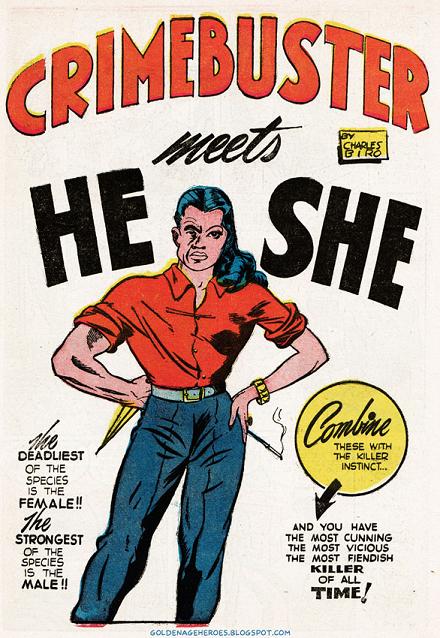
The deadliest of the species is the female!!
The strongest of the species is the male!!
Combine these with the killer instinct…
and you have the most cunning, the most vicious, the most fiendish killer of all time!
Subtlety wasn’t something Golden Age (superhero) comics did particularly well, as shown by this splash page from Boy Comics #9: Crimebuster meets he-she. Yet despite the over the top concept of a literally half male, half female killer, the story itself is actually quite well done. Though played for laughs, “he-she” themselves is not made fun off, but rather how they use their feminine side to trick innocent bystanders into helping them escape from Crimebuster.
The plot is golden age simplistic: “he-she” (who’s never given their real name) applies for a room in a boarding house, flirts with the land lady and marries her for her money. Despite the marriage, the landlady only finds out “he-she” is half male, half female when they fight over money, leaving “he-she” to kill her. The police investigate when one of the tenants is suspicious, Crimebuster tags along with them, is slightly more persistent than the plods, then finds the body of the landlady because her cat, who was bricked up with her, was meowing. Cue fisticuffs and car chases, which ends with justice prevailing as “he-she” gets the chair…
According to the Grand Comics Database this story was written and drawn by Charles Biro, creator of Crimebuster though better known for his Crime Doesn’t Pay work. Crimebuster himself was a bit of an odd duck superhero himself: an ordinary schoolboy whose parents had been killed by a nazi spy called Iron Jaw who became a superhero to bring him to justice. He creates a costume by, as Wikipedia puts it adding “his military school’s cape to the contemporary hockey uniform he is wearing at the time this adventure begins (which conveniently features the school’s initial “C” on the chest). Some time later he ditches the cape when a girl tells him it looks silly, which makes him about the only superhero ever self aware enough to care about how he looks to ordinary folk.
The Crimebuster stories are somewhat of a cult favourite, though never having been reprinted much, not quite fitting the superhero niche and therefore somewhat overlooked in Golden Age revivals. If I remember correctly, even Roy Thomas only brought back Iron Jaw, not CB himself in his eighties Alter Ego homage to the Golden Age. To be fair, Iron Jaw is a much more interesting villain than CB is a hero, unrepentently evil and brutal in a way few other Golden Age villains were.
The whole story can be found here (zip file). I’ve copied it from the brilliant Digital Comic Museum, who have the full issue available. The Digital Comic Museum is a site dedicated to preserving public domain comics by making them available in digital form online; you may need a membership to be able to download files. All files are in either *.cbr or *.cbz format, which are basically renamed *.rar or *.zip files, able to be processed by both dedicated comics reading software or unrarred/zipped so you can look at the images directly.
The end of the wietpas?
One advantage of the collapse of the Dutch government is that the socalled wietpas might just be scrapped, at least nationally. Tomorrow it will be rolled out in the southern provinces, which means foreign socalled drugs tourists will no longer be able to buy dope in a coffee shop in Maastricht or any other southern city. Next year it was supposed to be put in force nation wide, but this still has to be confirmed by parliament and might just be declared “controversial” now that the government has lost its mandate. Which means that it can’t be treated in parliament until after the elections, scheduled for the 12th of September and who knows what will happen after them.
The whole wietpas legislation has been driven by drugs warriors in the CDA and the VVD, though to a somewhat lesser extent there; it’s far from a given that these two parties will return to power, while other parties are less than interested in this subject. If the wietpas quietly disappears into the dustbin of history this will be very good for Amsterdam, as some twentyfive percent of tourists come here especially for the dope…
It still leaves the southern border provinces with it, but I suspect that it will die a quiet death there too if it’s never put into law nationally.
!@#$ IKEA
Plymouth loot

Like me, Sandra was a ferocious reader, one of the few people I’ve known who actually read more and faster than me. Where we differed was in our attitude towards books, as she was far more ruthless in discarding books than I could ever be. For example, before we moved in together she had gotten rid (unasked) of at least a third of her books, while I, well, had not. She always kept trying to limit the spread of books and bookcases through the house somewhat, even though she was aware it was largely a lost battle. Not that she disapproved of buying more books, just that we should be discerning in which books we’d actually keep.
So she might’ve been just a tiny bit disappointed if she’d seen the pile of books I’ve brought home from Plymouth. Not much, just a bit and only because she’d known our bookcases are full to overflowing already and more books won’t help there. But I can’t help it, there was just too much good stuff. What I’ve always liked about going to Plymouth was browsing the charity shops up in Mannamead, near where Sandra lived, as back then you could be certain to pick up a lot of good books for cheap. These days many of the bigger charity chains have long since discovered that it’s easier to put the good stuff up on Ebay, so there’s less gold amongst the dross, but roughly half that pile still came from charity shops anyway.
The rest all comes from one great bookshop right in the middle of the Barbican/harbour, the tourist area of Plymouth, three floors of bookshelves heaving with secondhand gems. Not all that cheap, but I know that if I lived in Plymouth full time I would’ve spent quite a lot of my disposable income there — I found a lot of books there already on my own shelves, which is always a sign of a good shop. If you’re ever in Plymouth and in need of something good to read, the Book Cupboard is your best bet.
What I found there: a pile of Giles annuals, several Nicholas Freeling van der Valk mysteries, several hard to find sf novels (Vance’s Showboat World, Ian Watson’s The Book of the River, Diane Duane’s The Door into Shadow) as well as two history books, of which The Saxon Shore: a Handbook is the most interesting, something I had to buy as I wasn’t sure I’d ever see it again. In general I would’ve liked to spent a day or so browsing the history shelves, but we had other things to do…