Forsa Pro Vercelli

When I first started to get serious about watching football a few years back, Sandra warned me about getting into Football Manager, because she knew that with my tendency to get somewhat …obsessive… about my current interest I could get addicted to this fast. I’ve always liked simulation games, from Sim City to Civilisation and Football Manager certainly is a hardcore football management simulation game, up to the point where Everton uses it in real life to scout players with; this may say more about Everton than the game itself though.

But it does show the nerdy side of football, as for a certain kind of fan it satisfiess both the itch to get really deep into the statistics and the desire to build up grand narratives around their favourite teams. That metanarrative which transforms a loose collective of mercenary multimillionaires into “your team” is what makes football spectators into football fans, who wouldn’t dream over supporting Arsenal over Spurs, or Feijenoord over Ajax, through good times and bad. And nowhere is this desire better shown than in Brian Phillips’ series of posts about Pro Vercelli and how he guided them from the lowest rung of Italian professional football to be the best team in the world.

Pro Vercelli does actually exist, one of those football clubs who did well in the early days of the game, winning the Italian championships seven times between 1908 and 1922, only to slowly slide down as football professionalised and the big city teams got all the money and talent. It’s the ideal choice to use in the game if you want to produce a heroic tale of epic proportions and that’s just what Phillips did. In the process he nailed down just what attracts people to the game and football both:

What the game is astonishingly good at is creating the feeling of realism, dropping you into a world that behaves both consistently and surprisingly, that’s small enough that it’s roughly comprehensible but large enough that it always seems to be vanishing at the edges. And within that world, if you pay attention and play with a little imagination, there is an endlessly unfolding narrative which you are capable of influencing but not of controlling, a story whose fantastic twists and high-stakes conflicts are more engrossing because the outcome hasn’t been planned in advance. And that, I suspect, more than the fact that it gets all of Tottenham’s roster moves down right, is why this series is so beloved. That probably tells us something about the appeal of football, too, though in another sense, the appeal of the game really isn’t about football at all.
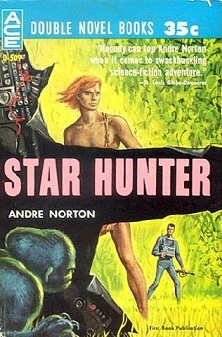
Star Hunter — Andre Norton

Cover of Star Hunter


Star Hunter
Andre Norton
96 pages
published in 1961

For a lot of American science fiction fans my age or older, Andre Norton was the first “real” sf writer they ever read, largely because she was hugely prolific and specialised in what we’d now call young adult novels. For some reason however she was never all that popular in the Netherlands so I’ve read little of her work so far. But that’s changing, thanks to Project Gutenberg, who have a fair few of her books available, those on which the original US copyrights had not been renewed. Star Hunter is one of them, originally published as an Ace Double. I read it during a couple of lunch breaks at work.

Ras Hume is a pilot for the Out-Hunters Guild who on a trip to the newly discovered planet of Jumala has made a discovery that could make him incredibly rich, but to exploit it he needs to make a deal with Wass, the biggest crime boss on Nahuatl. What he found was the lifeboat from the Largo Drift, a space ship which disappeared six years ago, taking with it the heir to the Kogan estate. He also has a plausible candidate to play the part of Rynch Brodie, the teenage heir. What he needs Wazz for is to condition this boy to actually believe he is this heir, then he will be let lose on Jumala for Hume to discover him when he brings over the safari party he’s scheduled to pilot there. It’s an almost foolproof plan, surely nothing can go wrong.

Or can it?

Balancing gender in reviews

For the second year in a row Niall Harrison has looked at the gender balance in science fiction/fantasy reviewing, looking at both which books were reviewed and who reviewed them, for a range of sf and fantasy outlets. A month ago, Renay at Ladybusiness did the same for individual bloggers, which in turn inspired Martin Lewis to take a look at his own output, which prompted me to do the same.

As you know, last year I made an effort to read more female sf writers, both by picking a reading list at the start of the year as by in general paying more attention to female writers. As you may also know, I try and review everything I read, though I don’t always succeed; I’ve read some hundred books last year and wrote only fiftytwo reviews, not all of books finished that year. But of those fiftytwo reviews, it turns out twentyseven, or roughly fifty percent were by female authors. Slightly more than a third of those (twelve) were the books I’d put on my reading list; the rest are not just fantasy and science fiction, but also include a fair few history books.

Why is this important? Because obviously, if you agree that a rough gender balance in science fiction and fantasy is a good thing, just reading more female writers is not enough, you also need to talk more about them too. One of the perennial problems with female writers after all has been that their contributions to the genre have often been overlooked, ignored or minimised. Getting more people to review them is a first step to put this right.

Below is the complete list of reviews:

As for 2012, so far I’ve continued striking the right balance: of the twentyone reviews to date, eleven were of female writers.

I don’t think irony was actually allowed in the seventies


I think Phil Knight is fooling himself if he thinks he was unusual in his unironic love of the Village People:

I used to love The Village People when I was a kid, but in a way that I suppose is fairly unusual, in that I took them entirely literally. Being only eight or so years old when they first appeared (and perhaps naive even for a kid of that age), I didn’t see the gay subtext (or in their case just plain text) at all. Which meant that I viewed them as a peculiarly big-hearted group who liked to write encouraging, optimistic songs about institutions that were normally overlooked by pop (homeless hostels, the U.S. Navy etc.) and to dress up in cool gear for the pleasure of us kids (because who else could they be dressing like that for?)

If you look at the video on its own it’s camp as hell of course and you wonder how the hell people in the seventies didn’t realise these guys might have ulterior motives to “hang out with all the boys”, but now look at them in their natural context, on Top of the Pops, along with all the Showaddywaddies:


And Real Things:


Really, were the Village People that different from their contemporaries? They fit right in that tradition of light entertainment and inoffensive mums & dads pop music: not too complicated, a catchy tune, lines you can easily sing along too and a wacky dance. In all, they’re not too different from these guys:


Books read March

I read a lot this month, but a huge part of that reading was pure pulp, as I read no less than seven of David Weber’s Honor Harrington novels in five days or so, pure as escapism.

The Honor of the Queen, The Short Victorious War, Field of Dishonor, Flag in Exile, Honor Among Enemies, In Enemy Hands, Echoes of Honor — David Weber
I swear, David Weber has found a way to embed crack in his Napoleonic Wars in Space series because after finishing Osama last month on my Android phone, I read all the books above in about five days or so. These are not good books, but they read so fast and Weber does always make me want to read on.

Dawkins vs Gould — Kim Sterelny
A short but interesting book about the scientific feud between the two best known evolutionary theorists of their generation.

Charlemagne — Rosamond McKitterick
A fairly recent re-evaluation of Charlemagne and the Carolingian empire, based on a re-examination of contemporary sources. Heavy going but interesting.

Keeping it Real — Justina Robson
Urban fantasy meets cyberpunk. Nicely written, entertaining fantasy novel by an author I’ve long wanted to read something of.

The Empress Theodora — James Allan Evans
A short biography/history of one of the most important empresses in Byzantine history.

At the Edge of the Solar System — Alain Doressoundiram & Emmanuel Lellouch
A lot has changed in the past ten-fifteen years in our understanding of the outer Solar System. This is an historical overview of how Pluto stopped being a planet, the other “dwarf planets” that have been discovered, as well as how the Kuiper Belt went from a theoretical construct to observed reality.

Laurels Are Poison — Gladys Mitchell
One of Sandra’s favourite novels from one of her favourite detective writers, which is why I read this.

Genius, Isolated — Dean Mullaney & Bruce Canwell
The first of a trilogy of books dedicated to the art, life and career of one of American comics’ greatest geniuses: Alex Toth.

Star Hunter — Andre Norton
Another book read on my phone, one of her classic young adult science fiction stories.

Hellflower — Eluki bes Shahar
Currently better known as Rosemary Edghill, this was her debut science fiction novel, the first in a trilogy of adventure science fiction stories that reminded me a bit of Elizabeth Moon’s similar novels, only much darker.