Rule 34 — Charlie Stross

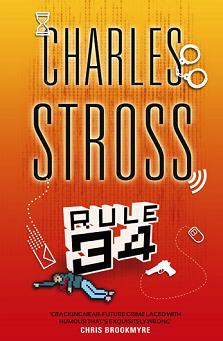
Cover of Rule 34


Rule 34
Charlie Stross
358 pages
published in 2011

It’s only thanks to Christopher Priest’s tirade about this year’s Clarke Award shortlist that you remember that you haven’t reviewed Charlie Stross latest novel, Rule 34 yet. You know that, like Halting State, which it is a sequel to, it’s written in the second person and you briefly toy with the idea to write your review the same way. But then you come to your senses and decide to write the rest of the review in a less irritating way.

Not that I minded the second person point of view in Rule 34, as Charlie Stross made it work and it fit the central metaphor of these books, reality as a massive multiplayer immersive game. At the same time I can see where Christopher Priest is coming from when he writes:

Stross writes like an internet puppy: energetically, egotistically, sometimes amusingly, sometimes affectingly, but always irritatingly, and goes on being energetic and egotistical and amusing for far too long. You wait nervously for the unattractive exhaustion which will lead to a piss-soaked carpet.

Read more…

Let’s leave out the cod psychology shall we?

Let’s talk about Damien G. Walter’s poorly thought out attempt to understand Christopher Priest for a moment. I mentioned it in passing in my last post, but it’s wrong enough for me to want to point this out at greater length. Walter’s core argument is as follows:

Christopher Priest has spent his entire career being close enough to the top table to smell the gravy, but has never quite been invited to sit down. His writing is extremely clever, but even in the ‘literature of ideas’ that is SF, “extremely clever” is really a way of saying rather unemotional, dry, and hard to love. It has all the qualities of someone who has spent decades studying, learning, dedicating every fraction of a considerable intellect to learning the rules and structures of fiction, but never quite managed to get his own soul on the page. Which, in the end, is the only thing we really demand of a novelist.

Walter also characterises Christopher Priest as having spent “most of his professional career not being J G Ballard”, as in driven by jealousy of his contemporaries and envy at their supposedly greater success, sublimated into this magnificent rant against the current generation of sf writers.

In other words, “he’s just jealous”, the most single predictable thing you can say about any critic ever. It’s something you learn on the playground and should stay there. We’re grownups now and we should be able to argue against criticism without subjecting our critics to amateur psychoanalysis.

The other idea, that Christopher Priest never quite made it as a science fiction writer is ridiculous as well. Walter’s portrayal of Priest as somebody who “has spent decades studying, learning, dedicating every fraction of a considerable intellect to learning the rules and structures of fiction, but never quite managed to get his own soul on the page” is a great invention, but not true of the real Priest. Let’s leave out the strange notion that what we all want from a writer is them “getting their own soul on the page” which is a) a meaningless cliche and b) no, not what we want at all; that’s the sort of thing somebody forced to study literature in middle school would think writing was all about, not at all what real writers universally do. Some writers may feast on their own neurosises and personality, others don’t.

If you look at Christopher Priest’s career, he has always existed at the literary end of the sf spectrum and has largely followed his own path. His early 1970ties works were inspired by the New Wave but not of it, he slowly meandered from science fiction into magic realism in the eighties and nineties, returning to more mainstream sfnal themes in the last decade. He’s never really been driven by commercial considerations or any burning desire to be the top dog in science fiction, as far as I can see.

So I don’t see where Walter gets the idea from that this is what drove Priest to write his rant, when he has form for sticking his oar in. Remember the Last Deadloss Visions? Why not just take him at his word rather than invent needless psychobabble theories as to why he was driven to write this?
Priest!

Whether you’re annoyed or amused by Christopher Priest’s broadside against the Clarke Award shortlist depends on how you rate the writers he attacked. For me, it was a mixed bag. On the one hand I loved his description of Sheri “genocide is too a proper tool for solving ecological problem” Tepper’s The Waters Rising:

how can one describe it? For fuck’s sake, it is a quest saga and it has a talking horse. There are puns on the word ‘neigh’.

Which is nicely hateful to a deserving target. But how to take his judgement of Charlie Stross:

Stross writes like an internet puppy: energetically, egotistically, sometimes amusingly, sometimes affectingly, but always irritatingly, and goes on being energetic and egotistical and amusing for far too long. You wait nervously for the unattractive exhaustion which will lead to a piss-soaked carpet.

Charlie decided to take it as a joke and brought out a line of t-shirts to celebrate. Which is probably the best attitude to take as writer. Now you may know that I’m a bit of a Stross fan myself, but I can still see where Priest is coming from. Charlie can be quite enthusiastic about some very geeky things and if you don’t share those interests this might just be a bit wearing at novel length. But this is a question of taste more than of worth. Nobody can like every science fiction novel ever written and unless you want to argue that nobody should write novels like Rule 34, this isn’t a legitimate complaint.

His complaints about “PC Plod characters” and “och-aye dialogue” are more factual, but I find both of them unjustified. If you write a police procedural you’re bound to have coppers while Charlie has lived north of the border long enough to have a good ear for proper Scottish accents; he’s certainly no worse than a true Scotsman like Ian Rankin.

Meanwhile what Charlie Stross has tried to do with Rule 34 and in which for me at least he succeeded for the most part is to write a believable, proper near future science fiction thriller, in a future that we could actually be living in a few years from now. So for example there’s the subplot of exactly what a small time crook is creating with his illegal three-d printer/matter fab: creating highly realistic sex doll facsimiles of five year old girls for pedophiles. That is something you wouldn’t really imagine as an element of your standard near future setting, but you wouldn’t be surprised to be reading about in the newspaper in a decade or so.

So whether or not Rule 34 was the best sf novel published in Britain last year, it is a credible candidate and Priest’s irritation with Charlie’s writing style blinds him to this. Remains to argue why Priest wrote this attack in the first place, which is probably not, as Damien G. Walter wants to argue a belated jealousy of J. G. Ballard. More likely it’s just general irritation with a shortlist that ignores several worthy candidates for far weaker ones, expressed more strongly than other people might’ve done.

Laurels Are Poison — Gladys Mitchell

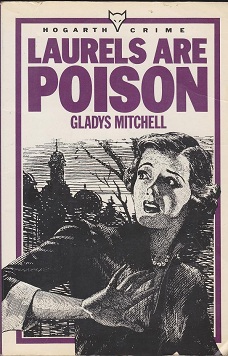
Cover of Laurels Are Poison


Laurels Are Poison
Gladys Mitchell
237 pages
published in 1942

Whereas my fiction reading mostly centers around science fiction and fantasy, Sandra was always more interested in other genres, especially that of the classical cozy detective story. Her alltime favourite was probably Margery Allingham, but Gladys Mitchell was a strong second. Now while Mitchell was as prolific as any of the big name writers, averaging one novel a year, she never was as popular as an Agatha Christie or Ngaoi Marsh and her books weren’t reprinted as often, which meant they’re much harder to find than those of her more famous counterparts. Which is why Sandra had only a small number of Gladys Mitchell novels, but she read and reread them at least once a year. Of that small number, I think Laurels Are Poison was the one she reread the most, certainly the one she had read the most recent before she died. Which is why I decided to read it as well.

Laurels Are Poison stars Mrs Bradley, Mitchell’s version of the noisy old biddy detective ala Miss Marple (Christie) or Miss Silver (Patricia Wentworth). Mrs Bradley has been hired as head warden of one of the houses of a women’s training college. That’s her cover, but she’s really here to investigate the disappearance of the previous year’s warden, Miss Murchan, who was last seen at the end of term dance and never came back. As soon as she arrives at the college, it’s clear somebody doesn’t want her to start her investigation, as amongst a flood of not very funny but innocent practical jokes some not so innocent traps are set for her…

Read more…