First thing to remember is that Israel has the bomb

Arthur Silber is annoyed with a Peter Beinart article that’s supposedly opposed to any war with Iran:

Given the attention it is receiving from those who are nominally opposed to the United States’ foreign policy of criminal, aggressive war and intervention, it is understandable that unwary readers will view Peter Beinart’s article, “The Crazy Rush to Attack Iran,” as strongly opposed to an attack on Iran. And while Beinart’s piece may very superficially appear to oppose such an attack, opposition of this kind is no opposition at all. And it is far worse than that: Beinart accepts the entire framework of those whose warmongering he criticizes, and he thus makes an attack on Iran more likely, not less.

For those of us who paid attention back during the runup to the Wars on Afghanistan and Iraq, this is hardly surprising coming from Beinart, who spent most of it cheerleading for them, as well as policing the bordaries of acceptable dissent. Which is what he’s doing here, as in his very first paragraph he frames in such a way as to concede most of the issue to the supporters of a war:

The debate over whether Israel should attack Iran rests on three basic questions. First, if Iran’s leaders got the bomb, would they use it or give it to people who might? Second, would a strike substantially retard Iran’s nuclear program? Third, if Israel attacks, what will Iran do in response?

This framing is of course completely embraced in the mainstream news media, where the question of whether or not Iran is actually even trying to create a nuclear bomb rarely is asked anymore. Any true opponent of war on Iran therefore needs to go back to this basic question: is Iran actually trying to create nuclear weapons and, as importantly, is this any business of ours as long as Israel, which does have several hundreds nuclear bombs and has had them for decades, isn’t dealt with in the same way? If instead you go by the assumption that Iran is building a bomb and that this is a Matter of Concern, you are already conceding much of the rationale for military action, at best you’re now arguing about tactics. Which is just what Beinart wants of course. Beinart isn’t interested in stopping a war or oposing it, he’s just concerned about seeming to oppose it.

In the meantime the whole issue of an Israeli attack on Iran is as much a giant distraction attempt as it is a real threat. For both Israel and the US having the focus on Iranian misbehaviour and the potential, sadly likely to be disproportionate Israel response, rather than on their own internal problems comes in very handy. It’s a distraction measure and while an attack on Iran can’t be entirely ruled out, it is unlikely to actually happen when the mere threat of it is so useful to both countries. Beinart’s weaselly article is just a small part of it.
Liberal paternalism and the burqa

I want to highlight part of a comment Alex made at a recent post:

Strangely, I’m strongly in favor of the burqa ban, which you referred to as foulness. My philosophical reasoning here is strongly affected by my emotions and the way I was brought up. I was brought up as a strongly conservative Christian, and sent to Christian schools my entire life, including boarding school in high school, and the dress codes were very strict. I look back on my entire childhood as abuse and torture, that affected me absolutely as much as the beatings. Given that most “women” are expected to start wearing these costumes at puberty, when they are not in control of any part of their lives, is giving too much control to parents. I know this raises issues of what an adult woman can choose for herself, but the adult women I know in any kind of conservative religion are mad and usually poor or no education which would enable them to have the economic freedom to choose, and they are kept from making real outside social connections which might offer them the support to make real choices.

As he himself acknowledges, this is a fine example of paternalism in action, where you’re so convinced these women wearing burqas need to be delivered from their oppression that you’re willing to send them to jail for it. This sort of attitude has a not very proud history on the left (*cough*eugenics*cough* and we should be very careful with it. For a start, just because your reason for wanting to ban the burqa is all meant in the best interests of its wearers, it doesn’t mean that the people actively trying to do this are motivated by anything more noble than a spot of Muslim bullying. Modern bigotry often hides behind a phony concern for “western” values and liberties.

Furthermore and quite obviously, a burqa ban denies agency to the very women who we are supposedly trying to liberate from their oppression, by making it clear that they cannot be trusted to make the right choice on their own. A burqa ban also supposed that the view of the burqa as a symbol of male oppression of women is the only correct one and that women cannot choose to wear it for any reason other than that somebody is forcing them. It therefore denies the existence of any woman who has made that choice for religious or other reasons. Finally, it also supposes that “we” know what’s best for “them”, when it may very well be that the burqa is just a minor issue or no issue at all in the lives of most Muslim women living in the Netherlands.

A burqa ban also means that those women who wear them for religious reasons are forced to choose between the law and their religion, never a happy occurrence, while those who are forced into it through social pressure or their evil husbands will have other tensions to worry about…

Let’s not forget also that the number of women who wear the full burqa, rather than just a headscarf, is very low: probably less than twohundred in the entire country. Not really a “problem” we need a law for, in other words.

Shrove Tuesday

As a born and raised protestant in a fairly “heavy” part of the country, I don’t really have carnival traditions, nor knew about Shrove Tuesday until Sandra introduced me to it. Making pancakes that day was an old family tradition of hers, something her father did and she did as well, if she remembered in time. And as with most of her cooking, her pancakes, especially the light crepe like ones we ate with a bit of sugar and lemon, were wonderful. So much better than anything I could make that I didn’t bother to even try, but rather heated up some store bought poffertjes in the oven, the sad single man’s best alternative…

Not feeling too wonderful anyway, as my brain seems intent to slowly leak out of my nose and eyes: either I got someone’s cold, something Cronenbergian is going on in my skulll or hayfever season has started even earlier than normal. All in all I feel like death warmed over, poffertjes the most substantial thing I felt like eating.

Not to end on a bummer, here’s George Benson with Breezin’:


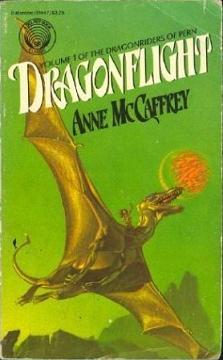
Dragonflight — Anne McCaffrey

Cover of Dragonflight


Dragonflight
Anne McCaffrey
303 pages
published in 1968

Because I’ve been running my booklog since 2001 I know it’s at least a decade or more since I’d last cracked open an Anne McCaffrey novel, yet once upon a time her The Dragonriders of Pern series was very important to me. Like so much science fiction and fantasy I discovered the Pern books through the local library, first reading them in Dutch, then continuing in English after I discovered the later books were only available that way. Over the years I devoured everything of McCaffrey I could lay my hands on, but I got less and less enjoyment out of her later novels, until I stopped reading them all together. Which is why I hadn’t read her in more than a decade and why it took her death to get me to reread the Pern novels. Which is a shame, as rereading them now makes clear how good McCaffrey at her best really was.

And Dragonflight was the best story she ever wrote. The two novellas that form the first twothirds of it, “Weyr Search” and “Dragonflight were rewarded with a Hugo and a Nebula Award respectively and are worth it. I had remembered Dragonflight as a fairly light novel, but it actually starts out quite dark, with Lessa, its heroine being the sole survivor of a coup against her family, plotting revenge as a kitchen drudge against the evil lord Fax who had taken over her hold. She’s not a nice person at all at the start of the story, completely focused on getting her own back and on making the hold as miserable as possible. But she also has a secret, a bond with the watch wher, a telepathic reptile like animal used as a watchdog. Little does she know that this is a hint to a much greater destiny for her…

Read more…

The Captain America of rock


I can’t wait for Bruce Springsteen’s new album:

Indeed, it is as angry a cry from the belly of a wounded America as has been heard since the dustbowl and Woody Guthrie, a thundering blow of New Jersey pig iron down on the heads of Wall Street and all who have sold his country down the swanny. Springsteen has gone to the great American canon for ammunition, borrowing from folk, civil war anthems, Irish rebel songs and gospel. The result is a howl of pain and disbelief as visceral as anything he has ever produced, that segues into a search for redemption: “Hold tight to your anger/ And don’t fall to your fears … Bring on your wrecking ball.”

“I have spent my life judging the distance between American reality and the American dream,” Springsteen told the conference, where the album was aired for the first time. It was written, he claimed, not just out of fury but out of patriotism, a patriotism traduced.

“What was done to our country was wrong and unpatriotic and un-American and nobody has been held to account,” he later told the Guardian. “There is a real patriotism underneath the best of my music but it is a critical, questioning and often angry patriotism.”

A large portion of Springsteen’s appeal for me is the same as Captain America’s: they’re both symbols of the American Dream who aren’t blind for the American Reality. Despite his multimillionaire status, Springsteen never has lost sight of his roots, never forgotten what it’s like to be a working stiff. He still has his heart in the right place.