
Wilders branches out into anti-Polish bigotry

wilders picking his nose

One of the more frustrating aspects of the rise and rise of Geert Wilders and his Freedom (sci) Party has been the general unwillingness of serious people in the media and politics to actually call them what they are: bigots and racists. That the average Dutch person was never as tolerant of foreigners as our reputation of a liberal, tolerant country would imply I long knew, but I assumed that at the very least his leftwing political opponents would have the courage to call him out on his bigotry, rather than hiding behind terms like “populist”. Yet with some honourable exceptions, Wilders and his ideas have been taken seriously by the political establishment, both on the right and the left, in so far as they are not rejected out of hand, but as viewpoints that can be debated and taken seriously into consideration, even if you disagree with them, as normal bits of political thought. Hence such foulness as the upcoming burqa ban, now in parliament, where the bullying of a minority group in Dutch society by forbidding its members their traditional clothing is sold as somehow feminist and serious people debate the merits of this.

But now Wilders may have gone too far. Not content with being an anti-Muslim bigot, where in the past decade he had the political climate with him, he has now branched out into more traditional territory for bigots, by starting hating on Eastern and Middle European migrants — and he doesn’t mean Austrians by that. Polish and other Eastern European migrants have been coming to the Netherlands in large numbers in the past ten years, ever since these countries became part of the EU and they gained the rights of all EU citizens, to work and live in any country in the union. These migrants fit the classical pattern of the labour migrant, first coming over for short term work Dutch workers are hard to find for, slowly branching out into more permanent work, finally bringing over their families and settling in the country for good. There’s the usual exploitation, as Dutch employers under pay or under report their Polish workers, landlords rent them awful flats and charge them a fortune for it, which in turn brings along the usual fallout of social problems any city with a huge influx of unexpected migrants has to deal with: lack of living space, lack of amenities for these people in their own language, culture clashes, heightened visibility of social conflict (petty crime, drunkenness et all) the more noticable because it’s done in a new language, and so on. Nothing new, but the same Wilders voter who dislikes Islam is more than likely not to find these Poles all that attractive either.

Which Wilders has now attempted to cash in on, by opening an online registry for complaints about those people, about how they took your job, they were criminal, they were violent, noisy neighbours, spoke filthy foreign languages, just are not properly Dutch. Classic racist dogwhistling, in other words. Surely now the fiction that Wilders is just a populist, a too strident critic of Islam and certain of its practises but not a bigot or a racist, oh no, can no longer be maintained. Or can it?

I hope I’m right and serious political commentators will finally have the courage to say what is plain to see, that he is a bigot and should be treated as such, but I’m not hopeful. If nobody twigged on three years ago, when he’d said he would like to deport millions of Jews Muslims from Europe, why will they now?
Three months on — it still hurts

Sandra would’ve loved this weather. Not the cold so much, as her kidney troubles and other health problems leaving her vulnerable to colder temperatures just like my more proportioned build left me cursing milder weather. Besides which, she always was nesh, stemming from a childhood when winters were routinely bitter cold and central heating non-existing. But despite this, she’d still rather have cold, crisp, clear winter days like today was, then the endless grey and wet misery that’s the usual Dutch winter, when the country draws into itself from November to long into April if you’re unlucky. She had been spoiled with winters in Plymouth, Devon and Cornwall’s relatively southern latitude and gentle caress of the Gulf Stream ensuring almost sub-tropical winters. I remember being there with her in November one year, still walking around in t-shirt when I had had to wear a wintercoat and gloves in Amsterdam the day before…

She’s beyond such cares now of course, today making it exactly three months since she died. Sometimes I wonder if the prospect of another long, grey Dutch winter didn’t help her make the decision not to fight on anymore. I can’t blame her if true, but I do miss her. Especially when something like the video below happens. Four months ago I would’ve rung her to share its awwness, or shown it to her on Youtube the next day, now there’s nobody to share it with, well, expect all y’all:


Adorable, isn’t it? The kitten that is, not Kenny Dalgliesh.

John Christopher 1922-2012

A bad start to my day this morning, as I read the news that John Christopher had died. Of course, at age 89 it’s hardly a surprise, but still. As Damien Walker explains, for my generation of readers he was oftenan important first introduction to science fiction:

Readers of my 30-something generation are most likely to remember John Christopher for his young adult novels The Tripods and its adaptation for the small screen in the 1980s. The Tripods describes a future Britain where humanity has been enslaved to a race of alien invaders who travel in giant, three-legged walking machines. Fragments of The Tripods are lodged very deeply in my imagination, in particular the horrifying sense of immense and all-powerful authorities looming over life, beyond our control and understanding.

The Tripods Trilogy were not quite the first science fiction books I read in English rather than Dutch (having discovered that the local library was much more lenient in lending out English rather than Dutch adult books), but they were close. Appropriately I discovered them in the high school’s tiny little lending library, where they were some of the few books that appealed to me when I discovered it in my first year there. Having part of the first year of students who’d gotten English in their last year at primary school, I could just about read them, though they were supposedly a few grades about my reading level. They were the perfect sort of book for young teenagers, fitting that classic template of the young boy on the verge of initiation into adulthood rebelling against the strictures of his people, who runs away from home and finds the secret truths of his world, then fights and wins to restore the true order of things, and Christopher told it brilliantly. I must’ve reread them half a dozen times or more.

There was also The Guardians, about a young boy in a future dystopian England growing up to discover the true nature of his country and setting out to right ancient wrongs, which I also read half a dozen times or so. He was a consumate storyteller and could get you so wrapped up in a book you’d barely notice the time, as Jo Walton also experienced:

It was his 1977 novel Empty World that caused me to realise that adolescents were the natural continuing readers of cosy catastrophes. In Empty World all the adults and little children die of flu and the world is left to a handful of teenagers — this is so viscerally adolescent wish fulfillment that reading it (at twenty-two) I failed to get off the train and was carried on to Liverpool.

What greater compliment can any writer wish for?

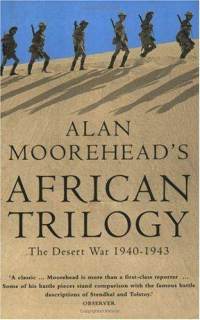
African Trilogy — Alan Moorehead

cover of African Trilogy


Mediterranean Front, A Year of Battle, The End in Africa
Alan Moorehead
642 pages including index
published in 1941, 1943,1943, compilation 1945

If journalism is history as first draft, then these three books, Mediterranean Front, A Year of Battle, The End in Africa; published in one volume as African Trilogy are history as second draft. Written while the Second World War was still ongoing, each of these books tell the story of one year of war in the desert, as seen by one of the preeminent war correspondents of the era. Written largely without the benefit of hindsight, from the notes that Moorehead took at the time, these three books together not only provide an interesting look at an important period in World War II, which England largely had to fight on its own, but also at how people at the time thought about the war, when the outcome was by no means certain yet.

If you’ve heard of Alan Moorehead, it’s probably for his post-war books on the exploration of the Nile, The White Nile (1960) and The Blue Nile (1962). During the Second World War he was a correspondent for the Daily Express, following the war in North Africa, the invasion of Sicily and the war in Italy. As becomes clear from reading these three volumes, Moorehead wasn’t one of those journalists content to stay at headquarters, but went chasing down the front whenever he could. Some of the incidents here certainly read like Boy’s Own Adventures stuff, several times barely escaping running into the enemy at several moments. Moorehead is a born raconteur, aimable, slightly understated, though with some of the attitudes and language use of the time that might seem strange to modern readers.

Read more…