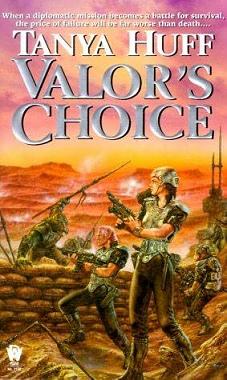
Valor’s Choice — Tanya Huff

Cover of Valor's Choice


Valor’s Choice
Tanya Huff
409 pages
published in 2000

Tanya Huff is one of those science fiction writers I vaguely knew about but never had read anything from, nor to be honest, had heard much about. One of those authors that steadily plods along, has a decent following and career but never quite had a breakthrough novel. I never really had a reason to take a closer look at her work, until I found myself in the English Bookstore last Friday looking for something light to read and Valor’s Choice caught my eye. I’m always on the lookout for good, enjoyable military science fiction and continuously disappointed by what I find on the shelves, when even a cursory glance is enough to show me that yet again my expectations are set too high.

And yet my standards for mil-sf are set so low already; all any story has to be to get me to read it, is to beat the Weber minimum. If the politics are less annoying and rightwing than David Weber‘s, the writing can be just as awkward, as long as there’s something interesting the writer is doing with their story. Literary qualities be damned, just as long as you tell a good story. Tanya Huff, from what I saw in the bookstore seemed capable of delivering at least that much, so I took a gamble on her. You may guess from the fact that I’m reviewing this already that she more than succeeded: I started reading this on the way home from the bookstore and had finished it on Saturday evening.
Read more…

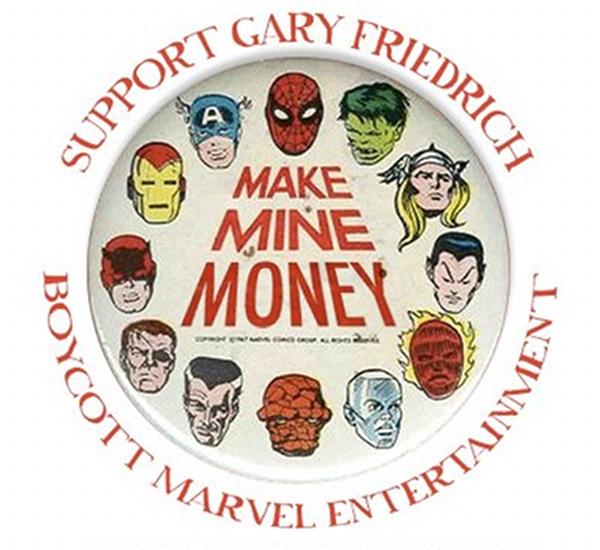
Support Gary Friedrich

support Gary Friedrich

Capitalism is always exploitative, but the American comics industry has always been more aggressive and barefaced about exploiting their talent. The socalled Golden Age of the 1930ties to 1950ties was filled with mobbed-up distributors, shady businessmen and fly by night publishers and while after the fifties comics went respectable, the business methods remained. Sometimes it seems that just because comics are such penny ante operations compared to other media companies, that this explains the petty, spiteful and pennypinching ways in which publishers treat their workers. But then along comes Disney to show it takes a huge company to be truly spiteful.

Gary Friedrich is the creator of Ghostrider, which is a character that has been fairly succesful for Marvel/Disney, having had several series over the decades, as well as several movies in the last few years, the latest having just come out. Friedrich has not shared in this success as Marvel argues that he had signed over the rights to his creation when he signed the paycheck paying him for his writing work — the back of which had a rubberstamp agreement stating that signing it meant the loss of all rights. Friedrich obviously disagreed with this, opened a lawsuit against Marvel to claim his rights back and lost; leaving him having to recover the costs he made pursuing the case somehow. This wasn’t enough for Marvel however and they countersued him, claiming 17,000 dollars in damages for his “illegal” selling of Ghostrider merchandise — selling sketches at comics conventions. Oh, and they also want him to stop calling himself Ghostrider’s creator.

Petty, no? About the only way Friedrich (who can’t get any work for Marvel or another comics company) could make some money was by trading on his stature as the creator of Ghostrider and sell sketches and such of him, something that’s a longstanding perk for comics creators though theoretically is infringement on a Marvel or DC’s copyrights/trademarks. These companies have never sunk so low as to interfere with this trade, often the only way in which elder or retired comics artists can still make some money of their skills, but with Marvel now owned by Disney, a company never caring much for how it treats its workers, there obviously isn’t the same courtesy anymore.

This case should put the fear of god into any comics artists, because now the taboo has been broken, it may only be a matter of time before Marvel and DC go systemically after all “infringers”. Gary Friedrich therefore needs our support, not just out of ordinary human decency, but to stop this further landgrab in its tracks. If you want to help, you can donate a few bucks to him to help pay for his legal and other costs. As Tom Spurgeon put it:

It doesn’t really matter to me at this stage to come to some sort of merit-based appraisal of Gary Friedrich’s recent lawsuit against Marvel, let alone his entire professional life. I frankly never quite understood the former and I think engaging the latter invites madness and an appreciation of the trees when it’s the forest that’s maybe more important. Right now it just sounds to me like the guy could use a hand, and for whatever reason — justice, the timing of history, God’s will, stupidity, a lack of grace, boiling-cauldron evil, gremlins — the way that he was able to do his work in the comics industry was not rewarding to him in a way that would forestall such trouble. I’m willing to risk a few bucks in that I may be eventually proven wrong somehow in extending that very modest hand.

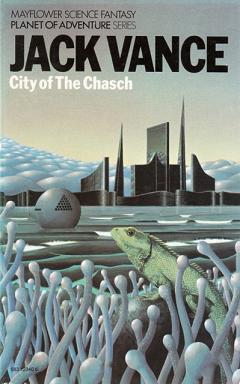
City of the Chasch — Jack Vance

Cover of City of the Chasch


City of the Chasch
Jack Vance
172 pages
published in 1968

When I first started to discover science fiction (longer ago than I care to recall) Jack Vance was one of the more popular writers to be translated into Dutch and the local library therefore had a shitload of his books. I therefore read quite a lot of his work, including the whole Planet of Adventure/Tschai, the Mad Planet (as it was called in Dutch) tetralogy, in one of those big omnibuses Meulenhof specialised in. There’s little I remember off it, to be honest, other than that it was a typical Vancean planetary romance.

Jack Vance is of course the master of this subgenre, effortlessly creating new worlds and societies for his stories, always exotic and strange yet believable and with their own logic. Sometimes the stories he sets in these worlds disappoint, as was the case for me when I reread Big Planet two years ago. For City of the Chasch I had less expectations, just because I remembered less about it, but I was still a bit disappointed with it. Like Big Planet, the worldbuilding here is more sketched in than fleshed out, not as rich and interesting as I had hoped it would be. I had planned to read the next books in the series immediately (I’m still missing the fourth) after I’d finished this one, but now I’ll think I’ll pass.

Read more…

Beer, glorious beer

Meanwhile, last weekend, I was busy drinking beer and watching the rugby. I took some pictures and would like to share them with y’all. All the cool middle aged blokes with beards and hats kids are beerblogging, so why not me?

Coopers Extra Stout

How often do you get the chance to drink an Australian stout? Not often, so I had to try it. Coopers Extra Stout, brewed in South Australia is perfectly drinkable, tastes just like any other stout but lacks a bit of oomph once you get through the initial taste. Decent, not spectacular, would drink again if in the vicinity of where it was brewed.

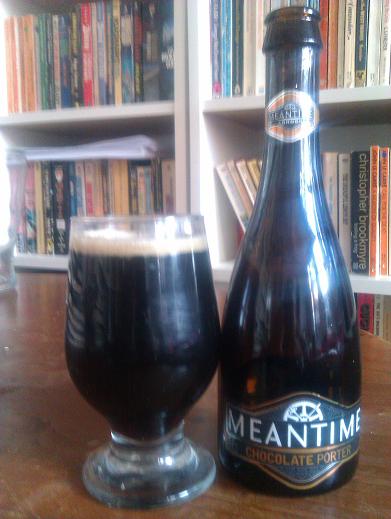
Meantime Chocolate Porter

Gorgeous. I’ve had a few chocolate stouts, but not yet a chocolate porter (if there’s any real difference between a modern stout and a modern porter that is). Unlike many attempts, Meantime‘s porter keeps it’s chocolate undertones throughout the glass, doesn’t overwhelm the beer with the chocolate or vice versa and will be gotten again this weekend if I can.

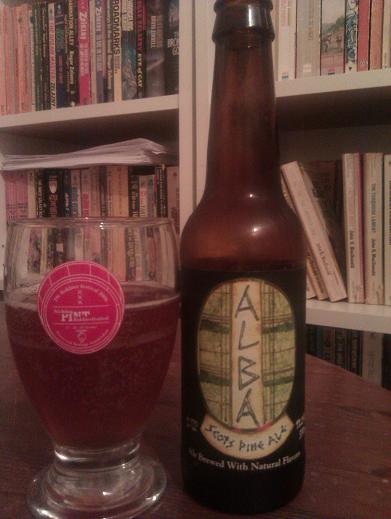
Alba Scots Pine Ale

The first of four different ales I drunk this weekend, this was the best. A pine ale, which I hadn’t heard of before, but which tasted very nice. According to the label, Alba is a “triple style ale, brewed to a traditional Highland recipe using the sprigs of spruce and pine collected every spring”. How traditional this is, is anybody’s guess as IIRC, the Scottish Highlands haven’t had their pine and spruce coverings all that long. Doesn’t matter for the taste, which is nice and beery going in, with a decided aftertaste of swiss roll (!), which sounds strange but works, especially after the slightly more bitter chocolate porter. Will get more from this one as well.

T.E.A. - Traditional English Ale

Hogsback‘s T.E.A., Traditional English Ale, was recommended by one of the Bierkoning‘s staff, but was a disappointment. A run of the mill ale, which started alright but whose flavour didn’t last; might have been better in a smaller bottle.

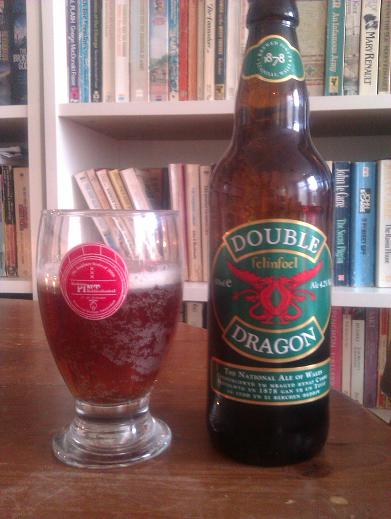
Double Dragon Welsh ale

The Welsh Double Dragon ale, which is the same strength as the T.E.A., 4.2%, I got for the Ireland v Wales Six Nations match and it worked, in so far as the Welsh won. Better than the previous ale, still a bit on the bland side for me. Decent enough, but nothing special. Will drink in Wales, will likely not go out of my way for it.

Sunburst Golden Ale

Darkstar’sSunburst on the other hand, a golden ale from Sussex is brilliant. This tasted like an English ale should, not too bitter, but with a slightly nutty aftertaste and which is sustained throughout my drinking it. Would like to drink more of it.

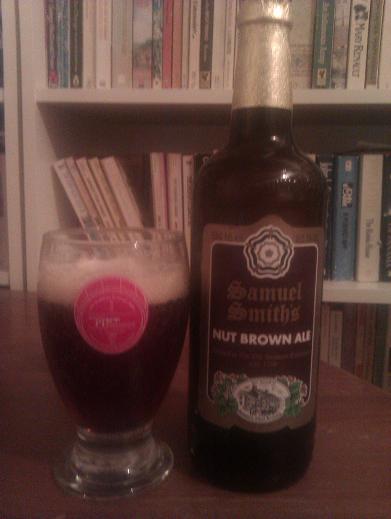
Nut Brown Ale

Speaking of nutty, the last beer of the weekend (actually drunk on a Monday evening) was very nutty, but then this is Samuel Smith‘s nut brown ale, coming all the way from Yorkshire and brewed at what they claim is the oldest brewery there. Lovely taste, eminently drinkable, not very damaging. Will get more of this too.

So in total: seven beers sampled, two or three disappointments, four beers I will shortly get again.