Three months on — it still hurts

Sandra would’ve loved this weather. Not the cold so much, as her kidney troubles and other health problems leaving her vulnerable to colder temperatures just like my more proportioned build left me cursing milder weather. Besides which, she always was nesh, stemming from a childhood when winters were routinely bitter cold and central heating non-existing. But despite this, she’d still rather have cold, crisp, clear winter days like today was, then the endless grey and wet misery that’s the usual Dutch winter, when the country draws into itself from November to long into April if you’re unlucky. She had been spoiled with winters in Plymouth, Devon and Cornwall’s relatively southern latitude and gentle caress of the Gulf Stream ensuring almost sub-tropical winters. I remember being there with her in November one year, still walking around in t-shirt when I had had to wear a wintercoat and gloves in Amsterdam the day before…

She’s beyond such cares now of course, today making it exactly three months since she died. Sometimes I wonder if the prospect of another long, grey Dutch winter didn’t help her make the decision not to fight on anymore. I can’t blame her if true, but I do miss her. Especially when something like the video below happens. Four months ago I would’ve rung her to share its awwness, or shown it to her on Youtube the next day, now there’s nobody to share it with, well, expect all y’all:


Adorable, isn’t it? The kitten that is, not Kenny Dalgliesh.
John Christopher 1922-2012

A bad start to my day this morning, as I read the news that John Christopher had died. Of course, at age 89 it’s hardly a surprise, but still. As Damien Walker explains, for my generation of readers he was oftenan important first introduction to science fiction:

Readers of my 30-something generation are most likely to remember John Christopher for his young adult novels The Tripods and its adaptation for the small screen in the 1980s. The Tripods describes a future Britain where humanity has been enslaved to a race of alien invaders who travel in giant, three-legged walking machines. Fragments of The Tripods are lodged very deeply in my imagination, in particular the horrifying sense of immense and all-powerful authorities looming over life, beyond our control and understanding.

The Tripods Trilogy were not quite the first science fiction books I read in English rather than Dutch (having discovered that the local library was much more lenient in lending out English rather than Dutch adult books), but they were close. Appropriately I discovered them in the high school’s tiny little lending library, where they were some of the few books that appealed to me when I discovered it in my first year there. Having part of the first year of students who’d gotten English in their last year at primary school, I could just about read them, though they were supposedly a few grades about my reading level. They were the perfect sort of book for young teenagers, fitting that classic template of the young boy on the verge of initiation into adulthood rebelling against the strictures of his people, who runs away from home and finds the secret truths of his world, then fights and wins to restore the true order of things, and Christopher told it brilliantly. I must’ve reread them half a dozen times or more.

There was also The Guardians, about a young boy in a future dystopian England growing up to discover the true nature of his country and setting out to right ancient wrongs, which I also read half a dozen times or so. He was a consumate storyteller and could get you so wrapped up in a book you’d barely notice the time, as Jo Walton also experienced:

It was his 1977 novel Empty World that caused me to realise that adolescents were the natural continuing readers of cosy catastrophes. In Empty World all the adults and little children die of flu and the world is left to a handful of teenagers — this is so viscerally adolescent wish fulfillment that reading it (at twenty-two) I failed to get off the train and was carried on to Liverpool.

What greater compliment can any writer wish for?

African Trilogy — Alan Moorehead

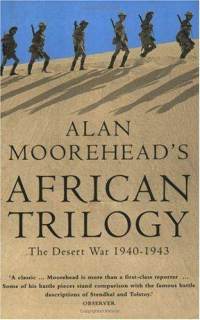
cover of African Trilogy


Mediterranean Front, A Year of Battle, The End in Africa
Alan Moorehead
642 pages including index
published in 1941, 1943,1943, compilation 1945

If journalism is history as first draft, then these three books, Mediterranean Front, A Year of Battle, The End in Africa; published in one volume as African Trilogy are history as second draft. Written while the Second World War was still ongoing, each of these books tell the story of one year of war in the desert, as seen by one of the preeminent war correspondents of the era. Written largely without the benefit of hindsight, from the notes that Moorehead took at the time, these three books together not only provide an interesting look at an important period in World War II, which England largely had to fight on its own, but also at how people at the time thought about the war, when the outcome was by no means certain yet.

If you’ve heard of Alan Moorehead, it’s probably for his post-war books on the exploration of the Nile, The White Nile (1960) and The Blue Nile (1962). During the Second World War he was a correspondent for the Daily Express, following the war in North Africa, the invasion of Sicily and the war in Italy. As becomes clear from reading these three volumes, Moorehead wasn’t one of those journalists content to stay at headquarters, but went chasing down the front whenever he could. Some of the incidents here certainly read like Boy’s Own Adventures stuff, several times barely escaping running into the enemy at several moments. Moorehead is a born raconteur, aimable, slightly understated, though with some of the attitudes and language use of the time that might seem strange to modern readers.

Read more…

Snowmageddon NL

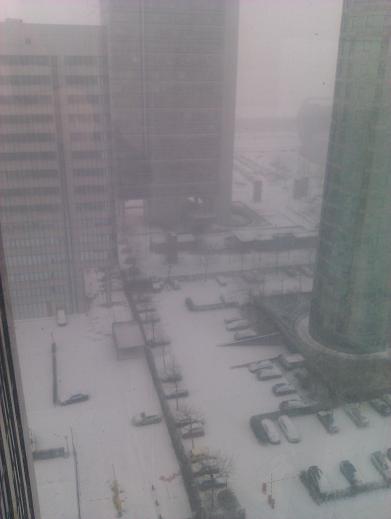
picture of snowy Amsterdam taken at work

I’ve heard it said that in Texas or California, when the first snowflakes start to fall, every car on the road starts skipping. Whether or not that’s true or not I don’t know, but certainly here in good old Holland, where we pride ourselves on our old fashioned Dutch winters, the first day of snow saw eighthundred kilometers of traffic jams and the complete disarray of the railways. Luckily the metro and buses were still running and I got home with no problems, but I wouldn’t have wanted to travel anywhere outside Amsterdam this weekend…

What amused and annoyed me in equal measures was the reporting in the main news broadcast tonight. First we got a look at the chaos on the road, full with cheerful people stoically commenting on how long it would take them to get home, all accepting that snow in the Netherlands means slippery roads, lower speeds and long long traffic jams. Then we went to the railways and there we only got complaining travellers frustrated about the delays and cancelled trains and how badly the railway people were handling things. Granted, when you’re driving a car you still have some illusion of control while it can be incredibly frustrating when you don’t know when you can travel, how you are going to travel and if you can actually travel in the first place, but the tone of the reporting was meaningful. The same weather that was shown as an act of god in the first item, in the second item was blamed on the railways lack of preparation…