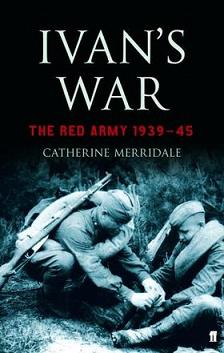
Ivan’s War — Catherine Merridale

Cover of Ivan's War


Ivan’s War
Catherine Merridale
396 pages including index
published in 2005

Though things have improved a lot since the end of the Cold War, the Eastern Front is still underrepresented in western histories of World War II. Quite naturally British and American historians have focused mostly on their own countries’ experiences in the war but even so the Russian experience is still under-represented. And often when the Eastern Front is looked at, it is from a German rather than a Russian perspective. German historians, generals and others were quite quick in putting forward their experiences in order to put the record straight in their favour, German sources were much more available to western historians than Russian sources, stuck behind the Iron Curtain as they were. So we got plenty of Konsalik novels talking about poor, intelligent middle class German officers stuck in the hell of the Ostfront facing the Slavic hordes, not so much about the poor Russian soldiers trying to liberate their homelands. What’s more, Cold War ideology, which presented an outnumbered NATO alliance trying to defend itself against the vast communist tank armies poised to overrun Western Europe at any moment, quite easily identified itself with the German experience and was fed by the same German generals that had been defeated by the Russians on how best to fight the bolshevik menace.

So it’s good to see a book like Ivan’s War be published. It’s the first book I’ve read about the Eastern Front that looks at the war there not just through a Russian perspective, but looks at the ordinary soldier’s experiences, somewhat comparable to e.g. Stud Terkel’s “The Good War” about American experiences of WWII. Catherine Merridale went to Russia not just to look at archives long inaccessible to western scholars, but also to talk to the veterans themselves and get their stories. What’s more, she didn’t just show the stories of the common soldiers, but also those of their officers and political commissars too and does so without editorialising. It’s important to hear those stories, to get an idea of what the Great Patriotic War was really like for those who fought it, without seeing it filtered through American or Western European, let alone German eyes for a change.
Read more…

It’s Charlie’s world, we just live in it

Back when he was writing Halting State Charlie Stross already complained that reality was overtaking his imagined futures and with the sequel, Rule 34 this process only accelerated.

Today The Pirate Bay announced it was going into fab distribution, setting the first steps to making another of Charlie’s predictions come true:

We believe that the next step in copying will be made from digital form into physical form. It will be physical objects. Or as we decided to call them: Physibles. Data objects that are able (and feasible) to become physical. We believe that things like three dimensional printers, scanners and such are just the first step. We believe that in the nearby future you will print your spare sparts for your vehicles. You will download your sneakers within 20 years.

The benefit to society is huge. No more shipping huge amount of products around the world. No more shipping the broken products back. No more child labour. We’ll be able to print food for hungry people. We’ll be able to share not only a recipe, but the full meal. We’ll be able to actually copy that floppy, if we needed one.

Incidently, one of the things Charlie predicted widespread use of 3-d printers/matter fabbers would be used for is the distribution of particularly nasty, highly illegal sex dolls. Hope this doesn’t come true too…

Get it out of your cis-tem

It’s been somewhat depressing to see how fast a Metafilter post on the obstacles put in the way of (young) transgendered people wanting to start transition can dissolve into a food fight about the use of “cisgendered” as the opposite of “transgendered” and how unreasonably angry it makes some people. I expected different from MeFi, which is both fairly liberal and hip and open to all kinds of people.

It all started with a post paying attention to a problem many young transgendered people face: continuous societal pressure not to start transition, to start living life as a member of the gender they feel themselves to be. As one commenter put it, “the entire foundation of transsexual health care is to protect cis people from making a terrible mistake, rather than to help trans people transition with as little added pain as possible”. It is a huge problem, because it means many more trans people are stuck with the wrong gender for longer than necessary, all to avoid the much rare false positives, those cases where somebody believes they are trans, but are wrong, before they’ve made an “irrevocable mistake”. It’s not necessarily done out of malice, more out of a sort of twisted interpretation of the Hippocratic oath of first do no harm.

A nice meaty and important subject for Metafilter, but within a few posts it was disrupted by people annoyed at the use of the terms “cisgendered” and “cis” to mean non-transgendered people. Some just objected because it was supposedly bad English, or because they disliked neologisms, others because they disliked having politicalised language forced on them, or because it “othered” them or they didn’t recognise themselves in the label. It really was derailing 101 in action.

Truth of the matter is that yes, while but “cis” and “trans” are imperfect labels (for starters, they imply a binary opposition between themselves, rather than a spectrum of possibilities between being fully trans or fully cis gendered), they are the closest we have to non judgmental, neutral terms for these conditions. Anything else is either a slur, or unwieldy to use, or both. And of course we’re all special little snowflakes unable to be caught by any label, but it can be very handy in political debates to have these kinds of easy to understand, easy to use, non-insulting terms to use to groups of people that have something in common important in the context of the debate. Nobody should feel insulted by being called cis.

I certainly don’t.

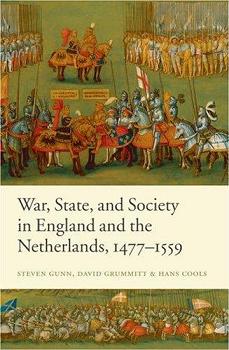
War, State and Society in England and the Netherlands, 1477-1559 — Steven Gunn, David Grummitt & Hans Cools

Cover of War, State and Society in England and the Netherlands, 1477-1559


War, State and Society in England and the Netherlands, 1477-1559
Steven Gunn, David Grummitt & Hans Cools
395 pages including index
published in 2007

Everything the authors tried to achieve with this book is in the title, but whether they succeeded is another question. Based on a massive research project that was carried out between 1999 and 2002, what the book was intended to be was a comparative study of two roughly similar countries in a period critical to Early Modern European history, to determine the impact of war both on society and the (semi-modern) state. As the authors argue, both England and the Netherlands (meaning what we would now call the Low Countries) were sort of outliers in Europe, neither quite fitting in “conventional narratives of the growth of state power”, not as centralised as other countries and with a greater level of democracy. For English historians, an added advantage of this comparison is that it puts England back into an European context by showing the simularities and differences between the two countries’ experiences.

War, State and Society in England and the Netherlands, 1477-1559 is impressive and interesting but what it lacks is that comparative aspect that the title and introduction promises. It’s more a parallel than a comparative history, with developments in the two countries looked at side by side. So you’d have a section on the defence of towns looking first at how English towns dealt with fortifications, then at how Dutch towns did the same, but nothing much on how they differed or why they did. This lack of analysis wasn’t that big a problem for me personally because I found the subject interesting enough already.

Read more…