Moar books

Cannot stop buying books

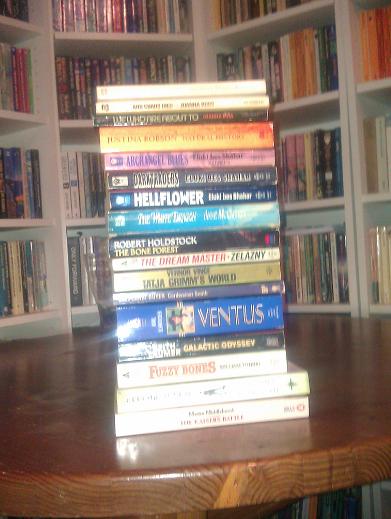
Not the best of pictures, but good enough to show off the books I bought yesterday. And yes, I know I have too many books already, not to mention a fair few library books that need to go back soon. But I can’t help it; every now and then I get the urge and need to get more. What’s nice is when that urge is satisfied, like it was this time. Sometimes you have to let a bookstore lie fallow for a while, not visit for a couple of weeks or months to give it time to surprise you. The secondhand English bookstore near Nieuwmarkt I got all this from certainly did.

From the bottom up: The Kaiser Battle, about the first day of the last German offensive in World War I by Martin Middlebrook, Justina Robson’s Keeping it Real, the William Tuning sequel to H. Beam Piper’s Little Fuzzy novels, a pre stroke Keith Laumer novel I haven’t read yet (Galactic Oddyssey), Karl Schroeder’s debut novel Ventus, Cordwainer Smith’s The Planet Buyers, Tatja Grimm’s World, an early Vernor Vinge novel, a Zelazny novel I didn’t know yet (The Dream Master), Robert Holdstock’s The Bone Forest…

Moving on to the female writers: there’s Ann McCaffrey’s The White Dragon which I foolishly had gotten rid off a few years ago, the first three Eluki Bes Shahar Hellflower space adventure stories and Justina Robson’s debut novel, Natural History which had been on my wishlist for ages.

But the books I’m most happy to have found are at the very top: three Joanna Russ novels: We Who Are About to, And Chaos Died, and The Two of Them. Reading The Female Man last year was a revelation; I hadn’t realised how good Russ was as a writer, rather than as “just” a feminist science fiction writer. Annoyingly, that reputation of being a firebreathing feminist had kept me far too long from trying her novels and then when I did want to read them, I couldn’t find them anywhere. Not anymore.

If you had $500, what science books would you buy for a high school library?

That’s the question Robert left on my review of Kraken:

Here’s a challenge for you, if you want it. Suppose you had $500 to spend on science books for a high school library, what would you buy? I’ve got a small budget, so I want to get the most bang of the buck

Which books I would recommend? Ben Goldacre’s Bad Science to get some inoculation against quackery. Any of Richard Fortey’s books on evolution and geology, particularly Life and The Earth, but also Trilobite, Chad Orzel’s How to Teach Physics to Your Dog which is a popular science book on quantum physics, any of Ian Stewart’s or Martin Gardner’s books of mathematical puzzles, Gabrielle Walker’s Snowball Earth just to show how cool Earth’s long prehistory has been, any of Richard Dawkin’s recent books in which he doesn’t bang on about religion.

Which books would you recommend?

Radical feminism and the transgender woman

Radical feminism is a form of feminism that’s, to put it politely, black and white in its view of the battle of the sexes, black and white enough to be able to use that outdated term with a straight face here. Radical feminism attempts to reject all gender roles and anything that smacks of sexual essentialism — men drive like this, but women drive like that — and argues that all such roles are socially defined, part of an overarching male dominated value system that defines women as inferior and which glorifies those characteristics that are stereotypically male and pillorises those that are stereotypically female. The breakdown of these structures and existentialist gender roles is what radical feminism attempts to do.

And if anything breaks down existentialist gender roles, it should be transgender people, shouldn’t it? What after all shows the idiocity of gender existentialism more than somebody who by their very existence shows that physical sexual characteristics does not a man or woman make, that you can be born and raised a man yet know yourself to be a woman or vice versa, let alone those who know themselves to be neither, or both, or something else entirely?

Yet radical feminism has huge problems with this. On the one hand, it insists that transgendered people are victims of exactly the patriarchial society they’re fighting against, confused by the gender essentialist social roles that insist that if you like pink dresses and My Little Pony you’re a girl, to the point that you’d use dangerous hormonal therapies and even surgery to change your physical gender, yet on the other hand it also insists that there’s no such thing as transgender women, just men masquarading as women (and vice versa). Both views are insulting and repulsive to say the least. Either you’re a duped and confused victim of social brainwashing, or you’re a hideous freak trying to fool real women you’re one of them.

This poisonous attitude is even on display in the writings of more moderate radical feminists, of those who have found that it is no longer possible to ignore or laugh off the “problem” of transgender. Which brings me to what inspired this post, radical feminist Nine Deuce’s sincere attempt to find some way in which transgender can be reconciled with radical feminism. She does this by stating her own position on the issue and seems to believe this should offer some way in which radical feminists can positively engage with transgender “activists”. Yet the bigotry is still palpable:

That there are people who feel so uncomfortable with the difference between their sexed bodies and their socialized conception of themselves that they would choose to risk deformity, death, and disability is to be deplored. Women have been conditioned to harm their own bodies in service of a social gender role grounded in misogyny and male supremacy. Radical feminism seeks an end to this practice. Women seeking surgery in order that their bodies will appear like male bodies, or men who undergo surgery in order that their bodies will present as female bodies, face huge psychological and physical risks and social ostracization. Adamantine gender roles are the source of the demand for these medical procedures and the dangers that attend them. Radical feminism also seeks an end to this practice.

That’s the idea of transgender women –transgender men not being of much interest to radical feminism, other options rejected entirely — as brainless victims having to be saved from themselves.

When trans activists bully radical feminists and attempt to force their way into women-only spaces, women should be angry and should speak up — and should express anger when they do speak up — but should do so responsibly and intelligently, so that the radical feminist perspective won’t be written off.

That’s the idea of transgender women as intruders, as charlatans pretending to be female in order to infiltrate “women-only spaces”. There’s a bit of projecting going on here as well, in an earlier comment Nine Deuce made:

Men absolutely loathe and fear trans people. Transmen are seen as intruders, but transwomen are seen as traitors. Men cannot understand why someone born male would choose to take on what they see as a subordinate position in society. It threatens their sense of order in a fundamental way.

Note that this is men, not some men or many men, but men. In Nine Deuce’s worldview, we all hate and loathe transgender men and women.

Meanwhile, it’s becoming clear that this whole exercise is more about a way to improve radical feminism’s image as an ideology that is bigoted towards transgender people, without actually wanting to lose this bigotry, viz:

What cannot be allowed is for the public face of radical feminist theory to appear reactionary, and right now it does.

I think radical feminism has lost that battle. It was a product of second wave feminism, a separatist ideology that has long outlived any merit it once had. For younger women, who grew up in a world in which the ideals second wave feminists fought for have been largely realised and for whom gender and sexual identity has always been a much more fluid thing than radical feminism thought possible, it’s just not an attractive ideology anymore. It battles the wrong things and seems to have no answers to real problems facing women today, welded as it is to a view of gender that’s just as existentialist as the patriarchial system it tries to overthrow.
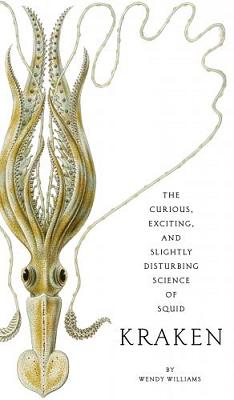
Kraken — Wendy Williams

Cover of Kraken


Kraken
Wendy Williams
223 pages including index
published in 2011

This was a bittersweet pleasure to read. As an homage to Sandra I wanted to read some of her favourite books and writers this year and Weny Williams’ Kraken was one of the last books she was really enthusiastic about. I had gotten it for her as part of an Amazon order in June of last year, when it still looked she was going to beat her illness and to cheer her up in hospital. Once she had read, she was keen on me to read it too to see what I thought, but I never made the time to do so, having so much else to read. It’s something I regret now, as I would’ve liked to discuss this with her, but at the same time it is nice as well to be able to read a book that reminds me so much of her. Sandra loved squids, octopuses and every kind of cephalopods; they were her favourite animals and any book on them that was any good had her favour.

And Kraken is quite good. At some twohundred pages without the index it’s not an indepth treatment of Cephalopoda, but it is a good look at what makes these creatures so fascinating. The cephalopods are invertebrates, part of the molluscs, with octopussies and squid traditionally seen as evil devil beasts that as soon drown a sailor as look at them. Yet the more we learn about them, the more fascinating they’ve become. It’s quite clear that many of them are incredibly smart, well adapted to their surroundings and with some amazing abilities — most possess chromatophores, coloured pigment cells under conscious muscular control which they can use to camouflage themselves or even “speak” with. They’re curious, they’re playful and in short, they remind us a little bit of ourselves.

Read more…

Oh gods I understand it now


Bronies? A positive development to see so many (young) men embrace a cartoon supposed to be watched by five year old girls, or somewhat creepy? MetaFilter is conflicted.

But I do get it. Having watched some episodes/extracts now, My Little Pony: Friendship is Magic does have all the elements that make a cartoon a cult hit for adults: clever writing, strong but not cliched characters, everything just that much better than it needed to be for a cartoon designed to sell toys. Put that together with people old enough to remember the first My Littel Pony and be nostalgic for it and it’s no wonder it does well with an adult audience too. It’s just a surprise that many in that audience are men. After all, weren’t men supposed to reject anything that didn’t star some alpha male, yet here they are voluntarily watching a show with female characters and only a couple of token males. And that has to be a good thing, hasn’t it?

Even if I have my doubts about seeing something meant for little girls taken over by grown men, no matter how benign this takeover is.

And yet…