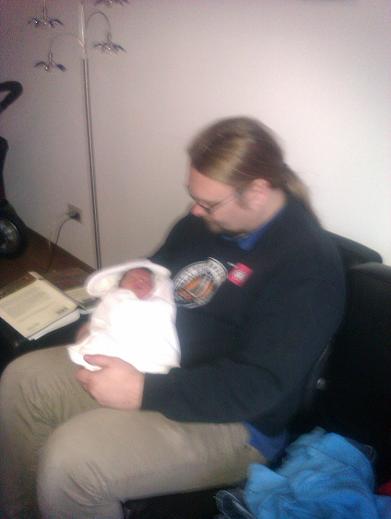
Slightly blurry but very happily asleep on her proud uncle’s lap. I held her for a good ten-fifteen minutes and she never quite woke up, just burbled happily and shifted a bit every now and then.
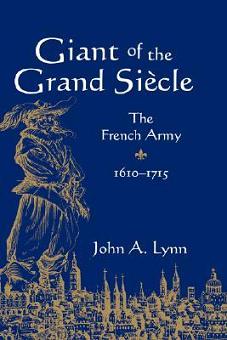
Giant of the Grand Siècle: The French Army 1610-1715
John A. Lynn
652 pages including index
published in 1997
I keep safe the memory of an invisible giant. The Son of kings, this armed colossus once towered above his foes to bestride a continent. He ate an mountain of bread and drank a river of wine at each meal. Yet historians renowned for being the mot forward looking and sophisticated in skill and interpretation, fail to see him; they write as if he never existed. He must be invisible. Otherwie, how could something so big, so costly, and so powerful remain so long unnoticed? This book is a portrait of that giant, the French army of the grand siècle, made visible again.
A historian who opens his book with these words obviously has an axe to grind and once again I had the feeling of coming into an argument without knowing the particulars or the people involved. It’s a feeling I’ve gotten used to in the past few years as I’ve been reading the more serious history books rather than sticking to pop hitory. The more history you need, the more you realise that there are no certainties in history, but many historians can be quite certain about a colleague’s flawed theories…
With bonus appearance of Frank Miller. A surprisingly good Channel Four news item on Moore, V for Vendetta and the way in which V’s Guy Fawkes mask has inspired and informed the Occupy movement. I love Alan Moore because he’s such a sensible, decent chap, no ego whatsoever.
David Lloyd meanwhile, who designed the mask all those years ago, is quietly chuffed everytime he sees it on the news:
How do you feel when you see a V mask or the V graffito at a protest or on a blog?
DL: Happy that a symbol of resistance to tyranny in fiction is being used as a symbol of resistance to any perceived tyranny in real life. The image of Che Guevara – another bearded guerrilla fighter, though in reality – has been used similarly as a badge of resistance to perceived injustices, and V’s just joined the club. Badges and symbols are useful as instant communication devices, though in the case of V, it seems to me that the communication isn’t quite as instant as with figures such as Che because, despite the movie, V For Vendetta, and its trappings, is not well-known to the general public. But then, any puzzlement shown by anyone in ignorance can always be allayed by their investigations of the source of the images – and then, who knows, they might become beneficially educated by the experience!
Luckily for humanity, our potential new sapient overlords turned out to be more interested in clowning around than taking over the world. Found via MeFi
(The funniest thing Sandra ever saw a young jackdaw do was land on a very, very hot and steep slate roof in the middle of summer, then glide down to the ground going ow ow ow in jackdawsian as he burned his claws…)
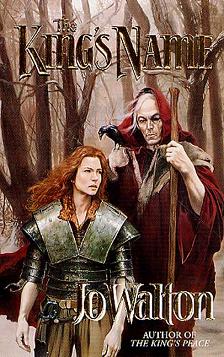
The King’s Name
Jo Walton
320 pages
published in 2001
“The first I knew about the civil war was when my sister Aurien poisoned me.”
As opening sentences go, the one that opens The King’s Name is great, starting off the sequel to Jo Walton’s The King’s Peace with a bang. It’s been five years after the end of the previous book, the peace that Sulien and her lord king Urdo had fought for so hard has held all these years, but there have been some rumblings amongst the kings and rulers of the countries of Tir Tanagiri about the high king’s rule. But for Sulien there was no real indication for danger until her sister poisoned her. Luckily one of her companions was quick enough to recognise it as poison and not a sudden drunkness and manages to get her back to her own lands, which is the only reason she survived. And then she comes home and her own steward tries it too. Something more is going on than just a grudge her sister may have held against her. Clearly she needs to warn Urdo and rejoin him to fight for the peace again…
With The King’s Name Jo Walton’s histoire à clef becomes more explicitely Arthurian, with Urdo as king Arthur, his wife Elenn as Guinever and Sulien as a distaff Lancelot, with the traditional love affair not between the queen and Sulien/Lancelot, but implied between Urdo/Arthur and Sulien. It’s long been supposed that the night Sulien spent with Urdo in his command tent early in her career was one of passion rather than exhaustion, with Sulien’s son Darien as the result. The civil war, started through the manipulations of the Modred equivalent Morthu, is of course also an Arthurian theme, the war that ends the Golden Age, kills the hero-king and restarts history. Not quite what happens here and don’t think that if you know the Arthurian template you know what Jo Walton is doing here.