Air Power and Maneuver Warfare — Martin van Creveld et all

Air Power and Maneuver Warfare


Air Power and Maneuver Warfare
Martin van Creveld, Steve Canby & Ken Brower
268 pages including index
published in 1994

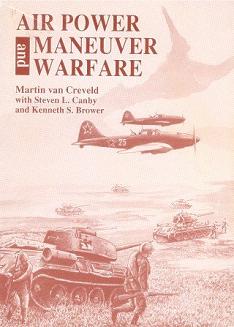
Air Power and Maneuver Warfare is a strange book. At first it seems to be just a theoretical and historical overview of how air power and maneuver warfare fit together, but something seemed off from the start. This book was commissioned by the US Airforce’s Air War College just after the Cold War had ended and more importantly, the US military establishment finally started to be convinced of this. It’s a political document as much as a theoretical one, written for an audience that’s supposed to be familiar with the theory of “maneuver warfare” (sic) but who do needed to be convinced of the argument Creveld and his co-authors are putting forward.

Said argument seems to be that the US Army needs to move away from its historical attrition warfare, linear orientation towards a more flexible maneuver orientated attitude, to be better able to deal with the challenges a post-Cold War world will throw at it. Meanwhile the airforces also need to shift towards a more tactical support role for the army rather than being obsessed with strategic air warfae and air defence suppression. This latter is not a new criticism of course, as ever since the USAF became a seperate arm of the armed forces it has been accused of neglecting tactical air support. The irony of it all is that while van Creveld and his co-authors (politely) argue that the then current strategic orientation of the US Armed Forces is outdated and inadequate to deal with the complexities of a post-Cold War world, their own recommendations are just as much a product of Cold War thinking, assuming that potential opponents will need to be and can be defeated by conventional military operations.

Read more…

Books read December

And so I’ve come to an end of another year of reading books, a year in which I attempted to pay more attention to female writers since it turned out how skewed my ratio of male to female writers read was. I managed to finish the reading list of twelve science fiction/fantasy books written by women I had set up at the end of 2010, though I do still have to review the last novel on that list, which I’ll do this week. It was interesting to have such a self imposed reading project and I’m thinking to put together a similar list for this year, focusing on Charles Dickens, both because Sandra always pushed his writing on me and because it’s the 200th anniversary of his birth this year.

Statistics: I’ve read 101 books this year, same as last year and like then, the bulk of my reading was again done in the last half of the year. Still nowhere near my peak, in 2008 (152) and 2009 (122) though. Most of my reading in fiction was science fiction (39), followed by fantasy (14), detectives (10) and a couple of thrillers (4) for a total of 67. Non-fiction was utterly dominated by history (25 out of 34 books) with 5 military history books, 2 on politics and one each of economics and travel.

Genderwise women dominated the fiction categories, but I also read a lot of non-fiction by women, mainly history. In total it was 43 female versus 57 male, with the Maj Sjowall & Per Wahloo due counting for the females.

December was despite all the distractions quite a good month reading wise: fourteen books in total:

Hellenistic and Roman Sparta — A history of the Sparta that few people know, long after its glory days had ended. Dry, academic but interesting.

Dragonflight — Anne McCaffrey
I reread this because Anne McCaffrey died recently and was glad I did. I’d forgotten how good this was and how influential.

Toast: And Other Rusted Futures — Charlie Stross
An early collection of Charlie Stross short stories, available for free as an e-book. Some of his better stories (“A Colder War” frex) are included, but there are also a lot of not so good early attempts. More for the diehard fans than a casual reader.

Dragonquest — Anne McCaffrey
The second book in the Dragons of Pern series, already getting more sfnal than fantasy.

Procession of the Dead — D. B. Shan
An urban fantasy by an unknown to me writer; alright, but not anything special.

The Crusades 1071 – 1291 — Jean Richard
A good introduction to a complex subject, as Richard attempts to both narrate the history of the crusades themselves as of the crusader states that were the result of them.

Ivan’s War — Catherine Merridale
A look at the experiences of the ordinary Russian soldier in World War II, with a prominent place for the voices of the veterans themselves. Recommended.

The King’s Peace — Jo Walton
A reworking of Arthurian legend in a fantasy Britain loosely based on what happened in Britain when the Romans left. Excellent.

The British Soldier of the First World War — Peter Doyle
Another Shire book on the experiences of British soldiers in WWI. Due to its length, less than 100 pages this is of course just a sketch, but a good introduction.

A Christmas Carol — Charles Dickens
I read this on the way to my parents to celebrate Christmas there and what better time to do so?

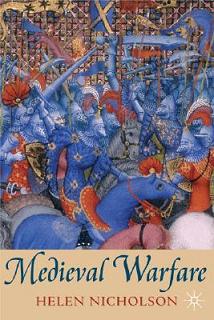
Medieval Warfare — Helen Nicholson
A short overview of the theory and practise of medieval warfare, from 300 to 1500 CE.

Singled Out — Virginia Nicholson
With the First World War killing off the flower of English manhood on the fields of Flanders, it left behind some two million women who would never get the chance to marry and fulfill their traditional duties of wive and mother. Virginian Nicholson shows what they did instead and how important this turned out to be for the further emancipation of British women.

Planet of the Damned — Harry Harrison
An early Harrison novel, read on the Kindle. Fun, but nothing special and some unconscious sexism.

Air Power and Maneuver Warfare — Martin van Creveld & others
The last book of 2011 was a strategic overview of how airpower fits in with maneuver warfare, as illustrated with German, Soviet and Israeli examples, in the context of a post-Cold War US army looking for new strategic choices.
So farewell then, 2011

So here we are at the very last day of a year that turned out to be quite a disaster, if only for me personally. This time last year Sandra was still in hospital but looking forward to going home early in the new year and indeed would be, celebrating Easter at home. She was weak, but finally on the road to recovery, or so I thought. That of course turned out not be the case. She had to go back into hospital a number of times and the last time she had to, she had had enough and decided to stop it all. Her struggle ended on the 7th of November and I’m only slowly coming to grip with it. The simple fact of her death colours everything I do.

Next year will be the first year without her since we met and fell in love back in 2000. With a bit of luck I’ll be able to live another sixy years or so before I die, but they will still be without her and sometimes I worry that i’ll forget her.

And I don’t want to forget her.

UPDATE: it’s 2012 now in Holland. Happy New Year and let’s hope it is a good year for everybody.

We also walk dogs…

So I’ve been reading Virginia Nicholson’s Singled Out, a social history of the post-WWI “surplus women”, the two million women whose (potential) husbands had died at the front and how they coped and had to find their own way in the world since the traditional role of wife and mother was denied them. It has a lot of moving stories of how individual women coped and by doing so, changed Britain. One of those women was Getrude MacLean, who had long been the devoted aunt to her brothers’ and sisters’ children, caring for them when her siblings had been scattered all through the Empire due to the war. But now they were back and if she could no longer be an aunt, what could she be?

One elderly uncle had the answer:

“why not do for others as you have been doing for your family?” Gertie’s reply was instantaneous, “and be a universal aunt?” She decided to offer a personal service with the motto “Anything for anyone at any time.”

Having found a partner, Miss Emily Faulder, she started her business in a little room behind a bootmaker’s in Chelsea. Their lease did not allow them to work in the afternoons, so they went, with their papers in a capacious knitting bag, to Harrods’ Ladies’ Rest Room where they received clients and applicants on a sofa in the corner.

And so Universal Aunts was born and became a huge succes according to Singled Out. I found this interested so I googled it. Guess what? They still exist. That’s a brilliant bit of social history still alive today, like something out of the background to a Heinlein novel, if one co-written by P. G. Wodehouse. But it’s also the sort of consequence of a big historical event that is difficult to get right in science fiction, right up there with Isaac Asimov’s quip about that an intelligent person in 1900 might have foreseen the mass adaptation of the car as the primary transportation of America, even foreseen traffic jams and oil shortage, but that it would’ve taken a genius to have foreseen the drive in movie and backseat romances…

Medieval Warfare — Helen Nicholson

Cover of Medieval Warfare


Medieval Warfare
Helen Nicholson
232 pages including index
published in 2004

Helen Nicholson’s Medieval Warfare is, as she puts it in her introduction, “intended to provide a point of entry tpo the subject of medieval warfare for students and others with an interest in the subject who are perplexed by the rapidly expanding body of scholarship in this area”. Which is just what I needed, as this is indeed a subject I’ve become interested in following on from my earlier readings in Late Antiquity and the Early Middle Ages. Medieval Warfare is an ambitious book for trying to cover this whole period (300 to 1500 CE) even in overview in just 166 pages, excluding index. But Nicholson is a reader in history at Cardiff University who has written extensively on Medieval military matters and therefore is well suited to the task.

As any good historian should, she sets out how she will go about it in her preface. What she attempts to do is to look at the development of the main aspects of medieval warfare from just after the end of the (western) Roman Empire to the end of the Middle Ages, using concrete examples to illustrate these developments. She chose the period 300 to 1500 CE to emphasise the continuity between the military practises of the Late Roman Empire and the Middle Ages, with the latter date providing a convenient cutting off point between them and the Renaissance. The fourth century was chosen as a starting point because it was in the late fourth century that the Roman bureaucrat Vegetius wrote his manual on military strategy, a book that was hugely influential in European warfare until at least the sixteenth century. Geographically, Nicholson limits herself mostly to Europe, particularly France, Italy, England and Germany for her examples, though she does look to Eastern/Byzantine examples as well when appropriate.

Read more.