The origin of fan consciousness in the breakdown of bicameral culture

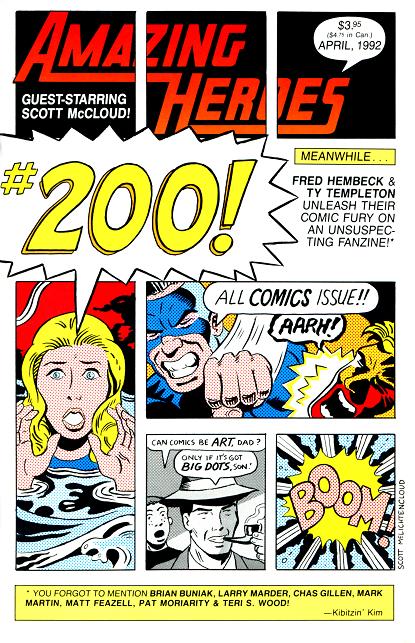
Amazing Heroes 200 cover by Scott McCloud

“Can comics be ART, dad? Only if it’s got BIG DOTS, son!”

That joke Scott McCloud put on the cover of Amazing Heroes #200 neatly shows the attitude of most comics fans to the occasional plundering of comics by the high art world: slightly amused, somewhat defensive but mostly irritated. To see Roy Lichtenstein get the credit, fame and fortune for swiping the work of other, largely anonymous artists is annoying, though I do think we can get a bit too defensive about it as comics fans, not an artform adverse to a bit of creative stealing itself. Nevertheless I can understand Scott Edelman’s annoyance at encountering a modern Lichtenstein repainting comic book pages panel by panel allegedly without crediting the original artists and passing it off as high art:

The intended market of buyers for these works of art would probably assume that the comics depicted in them sprang whole from the mind of the artist, and are a commentary on pop culture in general, rather than being line for line reproductions so close to the original comics that the artist might have been better served taking a photograph of the original comic book pages and framing that. Roy Lichtenstein, who I felt was profiteering on the work of great comics artists, at least altered them to suit his own style, as can be seen by this comparison plucked from David Barsalou’s site Desconstructing Roy Lichtenstein, which shows a Russ Heath panel side by side with Lichtenstein’s recreation.

I never looked at a Lichtenstein without feeling angry on behalf of the unnamed comics artists, because I always felt that a fraud was being perpetrated upon an ignorant audience, one that might assume he was making a commentary on the culture though the tropes of comics in general, as opposed to plundering specific artwork. (I believe any curator of an exhibit of Lichtenstein’s work who fails to include reproductions of the original panels falls down on his or her job.) But again, at least he made alterations to the original works, rather than passing along the unfiltered imagery of Joe Kubert, John Romita, and others as his own.

I’ve always shared Edelman’s feelings about Lichtenstein to some extent, though I do think that his artwork does have an intrisinct worth nonetheless that Shary Moody’s modern equivalent doesn’t have. The difference is one of cultural context.

Roy Lichtenstein’s paintings of blown-up comics panels were mostly made in the early sixties, before 1965. This was a time when comics still was largely anonymously made, mass produced junk culture which even the people making them for the most part didn’t consider art. This was when high and low culture were still taken seriously, before the rise and rise and rise of pop culture. Comics fandom was still in its infancy and there was nobody to champion comic books: Alter Ego started in 1961, the Batman tv series only happened in 1966, it was still a proud and lonely thing to be a comics fan. Comic books for all intents and purposes therefore were mass produced industrial artifacts of the throwaway consumer society, just like Warhol’s soup cans were. There was no way for Lichtenstein to credit the artists he was inspired by because nobody knew who they were. Even somebody like Kingsley Amis, openminded enough to champion science fiction, could only do so by offering it as a superior form of popular culture, rather than as part of literature in its own right.

But since then, with the rise of pop culture, the democratisation of the arts that brought along and the almost complete disappearance of the distinction between “high” and “low” forms of art, comics have become an artform in its own right. What’s more, thanks to the pionering work of those weirdos who always saw something more than disposable entertainment in them, its practitioners, like their counterparts in newspaper strips, magazine and even advertising illustration, have been de-anonymised, been identified and credited for their art. Which means that while Lichtenstein in 1963 could turn a Russ Heath panel from All-American Men of War into a painting and look genuinely innovative and progressive by repropositioning “low art” in a “high art” context, just looks lazy and downright insulting at best when done by Sharon Moody in 2011. It offers nothing new, it’s just passing off somebody else’s creative decisions as your own work by copying it. This is neither low nor high art; it’s bad art.

layaway


Via Metafiler comes a story that restores some of your faith in humanity. In America there’s a tradition of layaways, setting aside something you want to buy but don’t have the money for just yet and pay for it in installments, after which you can pick it up. It’s old enough that the Isley Brothers could make it into a metaphor for delayed love and thanks to the crisis it’s gotten a new lease on life. Layaways are popular, especially this time of year, to pay for Christmas presents.

But of course, if you’re poor enough to need to pay for Christmas this way, you may end up never quite getting all the money you need to pay off your layaways. Which is where an army of secrets santas has come in, as all over America anonymous people have paid off layaway tabs for complete strangers:

— Indiana. “An anonymous woman made a special trip to the Indianapolis Super Kmart and paid off the outstanding layaway balances of several customers, according to ABC affiliate station WRTV-TV6.”

— South Carolina. ” ‘Probably two weeks ago, we started seeing people coming in asking to randomly pay off strangers’ layaways,’ Terry Northcutt, manager of the Mount Pleasant Kmart, told Mount Pleasant Patch. It adds that “so far, eight shoppers have come in to pay off stranger’s layaways, and as similar stories across the country are reported, Northcutt expects to see more.”

— Nebraska. “Dona Bremser, an Omaha nurse, was at work when a Kmart employee called to tell her that someone had paid off the $70 balance of her layaway account, which held nearly $200 in toys for her 4-year-old son,” the AP says. “I was speechless,” Bremser told the wire service. “It made me believe in Christmas again.”

What makes this so good is not so much that this solves anybody’s problems, as that it brings some cheer to people who can use it the most. I’ve never been really poor myself, though I’ve been skint sometimes, but I imagine that one of the most awful bits of being poor is having that feeling that you’re not allowed to have nice things, a feeling that must be even worse at Christmas time. Having some stranger pay for your presents this way, without expecting anything in return or wanting publicity for it, in short without having any of the trappings of charity.

The Crusades c. 1071 – c. 1291 — Jean Richard

The Crusades c. 1071 - c. 1291


The Crusades c. 1071 – c. 1291
Jean Richard
Jean Birrell
516 pages including index
published in 1999

The Crusades are not my favourite subject in Medieval history, as I tend to concentrate my reading on the early Middle Ages, but The Crusades c. 1071 – c. 1291 is part of the Cambridge Medieval Textbooks series which I have good experiences with. The volumes in this series I’ve read so far all have been good introductions to their subjects. Of course, much still depends on the writer and I didn’t know Jean Richard, but he turns out to be a French historian who is well known enough to have an entry on the English language Wikipedia; this book was first published as Histoire des Croisades. The translation is by Jean Birrell and is good enough that you don’t really notice it is a translation.

Because of the American shenanigans in the Middle East in the past decade, the Crusades have been used quite a lot as a metaphor for these adventures, as well as an example for internet jihadists and Keyboard Kommandos both of the War Between Christianity and Islam as an universal war. The crusaders themselves feature as either the heroic defenders of the free west or bloodthirsty invaders of the peaceloving Islamic world. Reading a history like this is the best anecdote to that sort of nonsense. Jean Richard is careful to show that the motivations on both sides were slightly more complex than “Christ v Allah”. Religion obviously played a key role in the Crusades and there were certainly fanatics on both sides, but the realities of the Crusades and life in the Holy Land were more complex than the Crusading myths make out. What Richards contineously emphasises is that the key motivation for the Crusades was not the idea of forcibly converting heathens to Christianity, but rather of safe guarding the Holy land for Christianity, making it safe for pelgrims to visit, keeping the holy places safe for Christian worship.

Read more…

More comix loot

Another comics stack bought

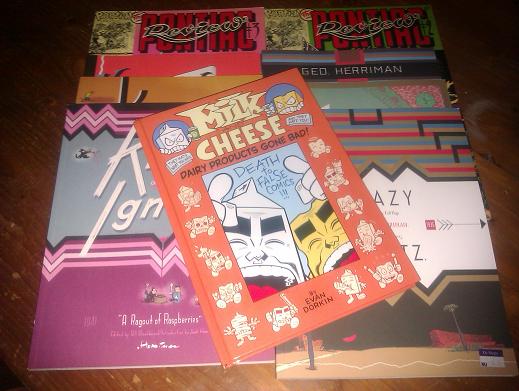
Don’t see it as an opportunity for me to gloat, but for you to get to hear about great shopping opportunities. Which there are, as keen eyed viewers will have spotted the six Krazy Kat collections lurking in that shot, all bought at De Slegte for less than six euros each. Plenty are still available. Also gotten there, two issues of the Pontiac Review I didn’t have yet (Peter Pontiac being the closest Holland has to an underground legend like Crumb or Spain), plus perhaps the best catch of the lot, the new hardcover collection of Evan Dorkin’s Milk & Cheese, which I actually did pay full price for because Dorkin is a god amongst cartoonists and deserves all the succes he can get.

Not pictured: two more Bob Morane issues and the 1986 The Art of George Herriman, as well as a collection of Rian Hughes’ stories that Image for some reason put out last year. Hughes being England’s answer to Yves Chaland or Serge Clerc, working in the same sort of retro-fifties/early sixties art style. You’ll know him, if you do, from being the artist on the early Grant Morrison Dan Dare revisionist series Dare. A brilliant little collection this which should be gotten just for that Dare series, but the rest looks swell as well.

If they give him an enema they can bury him in a shoebox

As Christopher Hitchens himself once said about Jerry Falwell. Which is really all you need to say about Hitchens’ death as well. I’ve been a bit disappointed about the response to the news of his death, far too respectful and admiring of him. He has always been a douchenozzle, a bully boy who was full of his own courage, unsupported by the facts. He was a leftist when everybody was a socialist, then turned rightwing contrarian when fashions changed and finally turning himself in a professional atheist for the American market. But at all times he remained an asshole.

It’s just that this was easier to live with when his targets were a Henry Kissinger then when he used his talents to support the War on Iraq.