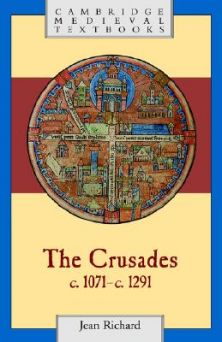
The Crusades c. 1071 – c. 1291 — Jean Richard

The Crusades c. 1071 - c. 1291


The Crusades c. 1071 – c. 1291
Jean Richard
Jean Birrell
516 pages including index
published in 1999

The Crusades are not my favourite subject in Medieval history, as I tend to concentrate my reading on the early Middle Ages, but The Crusades c. 1071 – c. 1291 is part of the Cambridge Medieval Textbooks series which I have good experiences with. The volumes in this series I’ve read so far all have been good introductions to their subjects. Of course, much still depends on the writer and I didn’t know Jean Richard, but he turns out to be a French historian who is well known enough to have an entry on the English language Wikipedia; this book was first published as Histoire des Croisades. The translation is by Jean Birrell and is good enough that you don’t really notice it is a translation.

Because of the American shenanigans in the Middle East in the past decade, the Crusades have been used quite a lot as a metaphor for these adventures, as well as an example for internet jihadists and Keyboard Kommandos both of the War Between Christianity and Islam as an universal war. The crusaders themselves feature as either the heroic defenders of the free west or bloodthirsty invaders of the peaceloving Islamic world. Reading a history like this is the best anecdote to that sort of nonsense. Jean Richard is careful to show that the motivations on both sides were slightly more complex than “Christ v Allah”. Religion obviously played a key role in the Crusades and there were certainly fanatics on both sides, but the realities of the Crusades and life in the Holy Land were more complex than the Crusading myths make out. What Richards contineously emphasises is that the key motivation for the Crusades was not the idea of forcibly converting heathens to Christianity, but rather of safe guarding the Holy land for Christianity, making it safe for pelgrims to visit, keeping the holy places safe for Christian worship.
Read more…

More comix loot

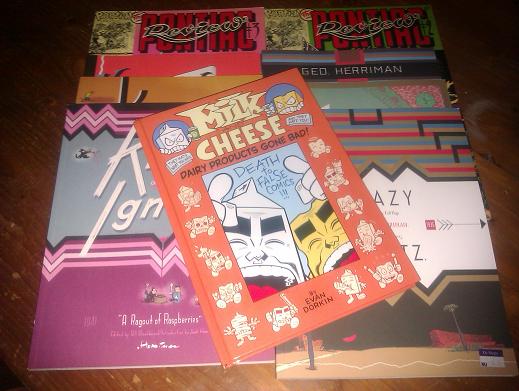
Another comics stack bought

Don’t see it as an opportunity for me to gloat, but for you to get to hear about great shopping opportunities. Which there are, as keen eyed viewers will have spotted the six Krazy Kat collections lurking in that shot, all bought at De Slegte for less than six euros each. Plenty are still available. Also gotten there, two issues of the Pontiac Review I didn’t have yet (Peter Pontiac being the closest Holland has to an underground legend like Crumb or Spain), plus perhaps the best catch of the lot, the new hardcover collection of Evan Dorkin’s Milk & Cheese, which I actually did pay full price for because Dorkin is a god amongst cartoonists and deserves all the succes he can get.

Not pictured: two more Bob Morane issues and the 1986 The Art of George Herriman, as well as a collection of Rian Hughes’ stories that Image for some reason put out last year. Hughes being England’s answer to Yves Chaland or Serge Clerc, working in the same sort of retro-fifties/early sixties art style. You’ll know him, if you do, from being the artist on the early Grant Morrison Dan Dare revisionist series Dare. A brilliant little collection this which should be gotten just for that Dare series, but the rest looks swell as well.

If they give him an enema they can bury him in a shoebox

As Christopher Hitchens himself once said about Jerry Falwell. Which is really all you need to say about Hitchens’ death as well. I’ve been a bit disappointed about the response to the news of his death, far too respectful and admiring of him. He has always been a douchenozzle, a bully boy who was full of his own courage, unsupported by the facts. He was a leftist when everybody was a socialist, then turned rightwing contrarian when fashions changed and finally turning himself in a professional atheist for the American market. But at all times he remained an asshole.

It’s just that this was easier to live with when his targets were a Henry Kissinger then when he used his talents to support the War on Iraq.

Cats in pubs


Cats in bars or restaurants are fairly common in Holland. Not so much in the US apparantly, where even the Algonquin Hotel in New York has to break with an eighty year old tradition and leash its latest lobby cat in order not to get into trouble with health and safety:

For nearly 80 years, a cat has roamed free in the lobby of New York City’s famed Algonquin hotel, but now, the New York City Department of Health and Mental Hygiene has made finding the friendly feline into a bit of a scavenger hunt.

The Algonquin has confined Matilda III, the latest in a line of lobby cats dating back to 1932, primarily to the arrival area and behind the reception desk thanks to a pre-emptive move to prevent crossing the DOH.

Restaurants have been getting tagged with hefty fine and reduced health ratings for minor violations, so the Algonquin made the move to avoid running afoul of the New York City Health Code. In a statement to TODAY.com, a rep for the DOH said: “According to the New York City Health Code, live animals are not allowed in food service establishments (except for edible fish, shellfish, or crustacean) unless a patron needs a service dog.”

I always find it a bit ironic that both the UK and the US, the two most doctrinaire free market countries in the world, also have the worst kind of rigid jobsworth government bureaucracies.

Soviet Storm


In between the reality show nonsense on the History Channel, one of the best documentary series on World War II has been shown recently. Unlike most of these series, Soviet Storm: WW2 in the East focuses exclusively on the Eastern Front and the Russian experiences in the war, which in itself is enough to recommend it to me. But it’s also very good in itself, giving a clear and honest picture of the war in the East, combining the big picture with quick sketches of what the war was like at the sharp end. Especially good is how CGI is used to enhance battle replays. It’s always clear that these are reconstructions, the CGI generated tanks and guns and such slightly plastic looking, probably deliberately, but still fairly realistic and convincing. Also counting in its favour is that it’s not too fetishist about the tanks and other weapons used in the war.

Soviet Storm was originally a Russian production, first broadcast in 2010 and this is noticeable, if only due to the Cyrillic letters shown on the maps. More seriously, it’s the way that the focus remains almost exclusively with the Soviet soldiers, showing the Germans only as the enemy, that shows its origins. Most western documentaries on the Eastern Front are shown from the German point of view, something which can minimise the very real accomplishments of the Red Army. Soviet Storm is a good corrective to this.

A lot of this series is available on Youtube; check it out.