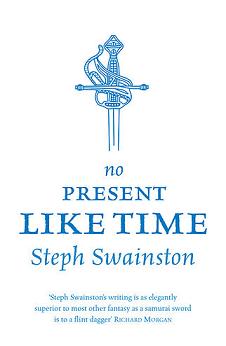
No Present Like Time — Steph Swainston

Cover of No Present Like Time


No Present Like Time
Steph Swainston
294 pages
published in 2005

I was quite taken by Steph Swainston’s debut novel, The Year of Our War, which I read from the library back in 2008. When I was looking over my bookshelves late last year to decide which books I was going to use for my Year of Reading Women project my eye fell on the omnibus edition of Swainston’s Castle series, of which The Year of Our War had been the first and I had the idea to save the second book, No Present Like Time for November as a treat. I knew I was going to like it which I wasn’t sure of with some of the other books I was going to read and I needed some incentive to keep me going.

Steph Swainston is one of the new breed of British science fiction and fantasy writers that rode to prominence under the ill fitting “New Weird” label in the first half of the noughties and one who got a lot of both commercial and critical succes. Unfortunately however she choose to stop writing to pursue her dream of becoming a chemistry teacher, which means that for the moment we’ll have to make do with the four novels she has written so far. A shame, as I quite liked both the novels of her i’ve read.

As said, No Present Like Time is the second novel in the Castle series, but this is not a proper fantasy trilogy and you can read this as a standalone; you’ll just miss a bit of context. It’s set a couple of years after the crisis of the first book, but moves into an entirely new direction. The Year of Our War had a fairly standard fantasy plot of the countries of the Fourlands being threatened by a unending horde of Insects which had already taken over the northern part of the Fourlands and which was only held in check by the powers of the immortal emperor San and his Circle of Immortal warriors only for political intrigue threatening their very existence. In No Present Like Time barely play a role, as a new, insect free island is discovered in the middle of the world ocean and the emperor sends out an expedition to persuade them to join his protection. Things quickly go wrong.

Read more…

Three weeks ago last night

sandra in her wheelchair a few weeks before she died

I don’t sleep well on Sunday nights anyway, leftover anxiety from high school “ohshitit’smondaybacktoschoolnooo!” bubbling up, but since Sandra died it has become even more difficult. It was after all the night from Sunday to Monday that she died and I was woken up with the news. Three weeks on it’s still incredibly weird not to have my life intertwined with hers anymore. This weekend was also the first I was alone since she died, without my family or friends or work to distract me. I like having time on my own, to do what I like and not have to take anybody else into account, but this was different. I’ve never really lived on my own, moving out from my parents almost twenty years ago to move into student flats, moving out from there to live together with Sandra. Even when she was in hospital her presence was here. But now we’re three weeks on and I wonder how strong her presence still will be three weeks from now, three months, three years…


One thing that will keep her spirit alive so to speak is Radio 4. Sandra’s daily routine revolved around it, getting up with the Shipping Forecast, Farming Today, then getting annoyed with the Today Programme and listening to the morning shows while she did her business around the house until You and Yours came on, which like all right thinking people she disliked. Like Stephen Fry admitted to years ago in one of his books, Sandra had always been into Radio 4, a “young fogey”, but she grew to appreciate it even more being in a strange country building a new life. The Beeb was there as a lifeline with the old country.


In the evenings it was PM, the Six O’Clock news and finally the comedy, then we’d switch to the telly and Dutch news at eight. In the weekends was when the best programmes were on: Home Truth with John Peel until he died, Saturday Live and Broadcasting House, more comedy, the Archers omnibus (still the only radio programme to be regularly scheduled at Eastercons). the whole rhythm of the Sunday determined by it: I’d sleep in until the Archers would come on, then she’d made breakfast if I was lucky, I’d do the dishes, then reading blogs and do some chores and coffee when Gardening Question Time came on (which we saw live when it came to Amsterdam). But after news, comedy was what she liked best, ISIHAC (never the same without Humpf), the Now Show, Just a Minute, Dead Ringers, The Day Today, Fist of Fun, the various injokes, Mitch Benn and so on undsoweiter.


Late at night the radio would be switched back on as I went to bed, usually being the first to do so, while Sand still puttered around. If she was feeling poorly she would stay and listen as the programmes ended, the Shipping Forecast came back and finally broadcasts ended with Sailing By before the World Service came on. And I kick myself for not playing that at the funeral because it is the perfect music to say goodbye to.


Dutch Total Football leads American Samoa to first victory


Did you know American Samoa has a national football team? If, like me, you didn’t, you won’t be surprised to learn that it ranks absolutely last on FIFA’s world rankings and regularly does things like lose 31-0 to Australia. Or did, as with the arrival of new Dutch coach Thomas Rongen, they managed to book their first victory ever, against Tonga:

In October they agreed to loan Thomas Rongen, an Ajax-trained disciple of Total Football who had managed four Major League Soccer teams as well as the US Under-20 side for almost 10 years, for the duration of the tournament. The transformation after Rongen’s arrival was, says Brodie, profound. Within a week of the arrival of the “Palagi” – the Samoan word for white off-islanders which translates literally as “cloud-burster” – the improvements in organisation and discipline were extraordinary. Most significantly, though, was the change in mentality his coaching had brought, so much so that when they defeated Tonga 2-1 on Tuesday and drew 1-1 with Cook Islands on Friday there was no complacency – the players were frustrated at not keeping clean sheets.

Rongen has been with the team for less than a month and found the tactical reorganisation easier than the psychological one. “I am steeped in the Dutch football tradition,” he says. “The teachings of Rinus Michels and Johan Cruyff and a technical brand of football is my motivation but what I encountered here was the exact opposite. So I had to adapt. I went from an old-style 4-4-2 to a more modern 4-2-3-1 because since it’s obvious that they give away too many goals, I thought four defenders and two holders would help. It’s easier to teach inexperienced players how to defend than to attack but we’ve made great strides in organisation and communication.

Thomas Rongen is not very well known here, having spent most of his playing career after having been trained at Ajax in the various US/American league. He later became a coach, working e.g. at DC United (did you know Washington DC has a professional soccer team?) and the US national U-21 team. Dutch football coaches in general are very popular for ailing national teams — Guus Hiddink has build his career doing this — and it’s nice to see Rongen do his bit for a national team of a country with a population barely enough for a small town.

Rongen and his coaching is not the only interesting thing about the team though: it must be the only national teams which has an openly transgender person playing:

The other breaker of barriers in the squad is Johnny “Jayiah” Saelua, a fa’afafine, biologically male but identified as a third sex widely accepted in Polynesian culture. She – and she prefers she – is the first transgender player to compete in a World Cup match and has formed a centre-half partnership with the Arizona-based Rawlston Masaniai, who along with other team-mates, calls her “sister”. “There is no discrimination,” she says. “I put aside whether I’m a girl or a boy and just concentrate on playing. I think I add a third dimension to the team, collect my energies and keep the team together, that’s my responsibility as the fa’afafine, the feminine.”

Sepp Blatter has reassured us that racism in football is non-existent, but homophobia is still rampant, with few openly gay players and fewer openly gay players still actively playing, even in supposedly enlightened countries like the Netherlands. And homosexuality is much more accepted (or so it seems) than transgender/genderqueer people still are, so it’s nice to see how matter of fact the American Samoan team is about their team mate’s gender.

A month in music

I couldn’t do this:

“There are 10,513 MP3s on my hard disk. According to iTunes, that’s nearly 30 days worth of music. It has taken half my life – 15 years – to build this collection but I decided to listen to them all in one go. One continuous concert, playing songs 24 hours a day, seven days a week. I wanted to revist all the songs I’d once loved, and the memories and places they called up. The only choice I made was the first track. After that, the computer randomly decided what was going to play. No stopping. No skipping. No changing the volume. Music, all the time, for a whole month. The Month In Music blog charts the progress of the playback project, updated once a day with original writing and photography.”

First off, I just suck at writing about music, for the most part barely able to even say why I like a given song, album or artist other then “I like it”. (I leave that to Kasper the funky ghost and his chums. )But a bigger obstacle would be putting my music on random because I just can’t listen to music that way, other than when I got the radio on. When I’m listening to music I tend to be in the mood for a particular kind of music: a particular artist or genre or period and I tend to listen to complete albums — I loathe shuffle.

Also, if you play your music 24/7 it gets annoying fast and you can’t do anything like watching tv or anything else that interferes with the music. Not to mention that you’d be playing a lot to empty rooms, or in my case, the cats — and they’d rather have Radio 4 because that’s what they grew up with.

But it does demonstrate an important aspect of music that’s far less true of other media like television, videogames, books or movies: it takes much less time to gain some fluency and insight into a given musical genre than it does to gain the same sort of mastery in most other media. To put it in raw numbers: I got about 2500 books in my personal library. To read them all would take me at least, if I did nothing else and could finish one in two days, some 5000 days or thirteen years. My library at the moment holds almost thirtythousand songs, which would cost me almost 881/2 days to listen to if I can believe Itunes.

Found via Metafilter (yes, I’m on Metafilter now.) Check out the thread; it’s quite good if only for seeing all the other obsessive compulsives waxing on about their cataloquing strategies…