Sandra: two weeks on.


Neither Sandra nor I believe in an afterlife, but if her ghost is floating nearby somewhere right now she would be so pissed. Because if there’s one song guaranteed to drive her nuts it was the Wu Tang’s Gravel Pit. Just mentioning it would give her an earworm. So if ectoplasm starts to drip from the walls tonight I’ll know ghosts are real…

Meanwhile it’s been almost two weeks since she died — it’ll be exactly two weeks at 2:30 tonight. Last week was mostly a blur, this week I went back to work and “normal” life but it has been strange. Strange to not live a life revolving around hospital visits. One of the things that helped, but last week and this week has been to immerse myself in a bit of archive binging, first reading through the entire Something Positive archive while I was sitting next to Sandra’s body, then continuing with Sluggy Freelance when Something Positive had run out of archive…

I don’t want to dwell on her death; rather I would like to use my Sundays to remember Sandra with a new blog feature. So for the next few Sundays or more I’ll be writing about her and her interests.

Because I don’t want to wake up one morning and realise I’ve forgotten her.
If the Twilight series is your idea of a feminist text…

So somebody at The Hairpin thinks she’s at Slate and writes a contrarian article that praises the Twilight series for its supposed insight into what teenage girls are “really like”. In the process she let’s out the following sneer towards the Stieg Larsson Girl Who… novels:

Lisbeth Salander, the heroine of the popular The Girl With a Dragon Tattoo series, is emotionally stunted but, damn it, she actualizes herself! She punishes the people who hurt her, she sleeps with whomever she wishes, she zips around on a motorcycle, and she’s a master computer hacker. In other words, our actualized female heroine might as well be a tiny man.

It’s a weird sort of feminist critique that sees revenge, an active sex life, computer hacking and riding a bike (!) as inherently male and a woman engaging in them as “a tiny man”. Wasn’t the whole idea of feminism that women should be able to do the same things as men, should be able to seek revenge, have sex, play with computers and even feel a throbbing engine between their legs if they want to? Sure, there has been a backlash agains the idea that this is all feminism should be, that women should turn themselves into surrogate men to be taken seriously (something Joanna Russ already addressed back in 1975), that traditionally female-coded activities are unimportant and engaging in them is unfeminist. There’s even a point to make about how male-written action girls/heroines can sometimes become men with breasts.

But.

This article isn’t the way to do that, considering it’s written to praise the Twilight series for its supposedly true to life portrayal of what it feels like to be a teenage girl, when for all intents and purposes this series actually offers a reactionary view of what womanhood should be about, viz that a girl is only fulfilled if she’s married and preggers weeks after finishing high school. No need for motorcycles, computers or revenge, though some room for properly married but somewhat creepy sex.

In short: before you can argue about the relative worth of “feminine” and “masculine” pursuits, you have to have people who agree that these are not inherent to your gender.

is this commercial racist?


I saw this commercial for the first time on tv tonight and I thought, hang on, is this, if not quite racist, at least a bit dodgy? Beheaded male and female Black bodies and stereotypical African imagery, all very sensual to sell a brand of chocolate called Afrodisiac? When the reality of chocolate production even in 2011 still depends for a frighteningly large extent on slave labour, including child labour in cocoa production in West Africa? To be fair Kraft foods, the owner of Cote d’Or, has signed the socalled Cocoa protocol which aims to child labour in cocoa production altogether, but as the Wikipedia article says, “ten years after implementation, it is unclear if the protocol had any effect in reducing child labor”.

So yeah, it makes me a bit uncomfortable watching this.

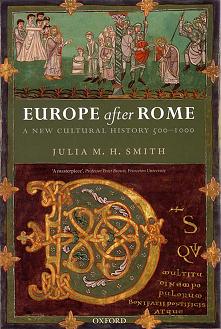
Europe after Rome — Julia M. H. Smith

Cover of Europe after Rome


Europe after Rome
Julia M. H. Smith
384 pages including index
published in 2005

To be honest I only took this book out of the library because there was little else in the way of good history books that day. Europe after Rome was a bit of a safe choice, on a subject I’d already read a lot about and if perhaps it would offer little new knowledge, I knew I would at least enjoy the refresher. I had no high hopes for this book, but sometimes gambles pay off — this was one of these cases. Because Europe after Rome is, as the subtitle makes clear, A New Cultural History of the period between 500 and 1000 CE, between the “fall” of the Roman Empire and the start of the “true” Middle Ages.

Traditionally historians have treated this period as a transitional one between this two high points of civilisation, as a story of collapse and rebound, when the seeds were laid for what would become the familiar nations of modern Europe: France, Germany, England. Europe after Rome abandons this teleological view deliberately in favour of an approach that follows three interpretative threads: the role of the Roman heritage in the formation of Early Medieval cultures/policies, the diversity of experience for these cultures — this is not a book about European culture, but about the cultures of Europe — and finally, the dynamism of these cultures, all changing a lot over this period, which Smith is careful never to imply as meaning that these were evolving towards a set goal. To help her with this approach, she takes care to look at a wide range of European experiences, both geographically by looking at a region that reaches from Spain to Scandinavia and from Italy to Hungary and by crosscutting between cultures within each chapter for her examples.

Read more…

Dutch police use minors to spy for them

According to an article in De Pers, Dutch police intelligence services attempt to recruit minors to serve as informers. In at least some cases, this was even done without their parents knowing. A lawyer quoted in the article spoke of “stasi-like methods”, which sounds about right to me.

In the Netherlands only the socalled CIE or Criminal Intelligence Unit is allowed to use informers, with information gathered through their use not legal to use in criminal prosecutions, though some lawyers do complain that such information does end up in public prosecutor files and is hard to check up on. Rules about the use of minors are non-existent, so the situation seems rife for abuse. Certainly any such approach of a minor should be done with the permission of their parents. Sneaking around behind their backs is just wrong.