Beeldverhaal: new Dutch tv documentary series about comics


Though the Dutch public broadcasters do occasionally pay attention to comics, any sustained interest in them has been lacking for a long time. This changed last Saturday, with the premiere of the new documentary series Beeldverhaal. It’s intended as an introduction to the wonderful world of comics, each of the eight episodes looking at a different aspect. The episodes themselves are only thirty minutes long, but judging from the first episode the creators manage to fit a lot of information in, without overlaoding the viewer. Much of the credit for this must go to the presenter Jean-Marc van Tol, one part of the team behind the hugely succesful Fokke & Sukke cartoon, who turns out to be a natural interviewer with whom other cartoonists feel comfortable.

But the way the programme is structured is also important. In the first episode the subject was (auto)biographical comics, both a genre that has become huge in the Netherlands in the past decade and a genre that’s easy to get for non-comics readers. The programme started by interviewing Jan Kruis, a cartoonist many people would know from his decades long weekly family strip in Libelle magazine, Jan, Jans en de Kinderen. Jean-Marc van Tol talks with him on how he used his own family as inspiration for the strip, even if the family in the strip is never intended to be his own. From there the programme moves on to Gerrit de Jager, creator of the slightly more edgy but almost as long running Familie Doorzon. This from the start was a comic that was more willing and able to talk about sex and drugs and sausage rolls, though still is a classic gag comic, again partially inspired by de Jager’s own life.

From there on it’s a small step to the autobiographical strip proper, as various creators talk to Jean-Marc about how much of their comics is their own life and how much their representation in the strip has become a separate character. Especially interesting was the interview with Maaike Hartjes, who often uses her partner Mark Hendriks in her comics. Hendriks himself is also a cartoonist and tells how this does not bother him, as he knows the difference between himself and the character “Mark Hendriks”. The only time he really had a problem with the way he was portrayed was when Maaike Hartjes did a radio interview and everything that looked innocent in the strip suddenly seemed very personal when he heard it on the radio…

All in all, a good first episode that promised much for the whole series. Future episodes will tackle superheroes, Dutch comics classic Ollie B. Bommel, Tintin, manga, the underground, Suske & Wiske and the Belgian comics scene and finally the modern newspaper strip. The only problem I’ve had with it so far is that the series is broadcasted late on Saturday night, just when the football is on….
Books read October

Ten books read this month, but almost all finished in the first two weeks. Because of everything that happened this month I didn’t seem to have enough energy to read much. Hence also the five undemanding mysteries…

Carthage Must Be Destroyed — Richard Miles
A history of Carthage that attempts to escape the biased view of it we have gotten from the Romans and their later admirers. Sadly Richard Miles does not escape having to put Carthage’s later history in Roman context, simply because that history was dominated by wars with the Roman Empire, which ultimately of course destroyed it. Because I knew this outcome, it was difficult to keep on reading…

Omnitopia Dawn — Diane Duane
This is the science fiction equivalent of an Arthur Hailey business novel, but since this is the twentyfirst century, this is set in and around a MMORPG rather than a hotel or car plant…

A Wreath for Rivera — Ngaoi Marsh
Also known as Swing Buddy Swing, the better title in my opinion, this is another competent mystery revolving around the murder of a jazz musician.

The Mysterious Affair of Styles — Agatha Christie
The first Hercule Poirot story. It has been literally decades since I last read any Agatha Christie murder mystery, but what with everything that happened this month and me cataloguing Sandra’s books, I thought I’d give them a try again.

Mrs McGinty’s Dead — Agatha Christie
A 1950ties Poirot story, which starts with him depressed about “modern times” but revitalised when an old acquaintance asks him to investigate the murder of an old woman. even though her lodger has already been condemned for it.

Snuff — Terry Pratchett
His latest Discworld novel, starring Sam Vines out of his element and depth, as he’s out of Ankh-Morpork and has to play the laird on his wife’s estate somewhere in the country. Quality as always, but not the best novel he has ever written.

Troy and Homer — Joachim Latacz
An attempt at determining how much of The Illiad is based in fact, whether Homer’s Troy was real and the city Schliemann found was indeed the same city.

The Murder of Roger Ackroyd — Agatha Christie
Another early Poirot, the first of many in which Poirot has gone into retirement and not liked it. Best remembered for a twist ending, somewhat cheating.

Hickory Dickory Dock — Agatha Christie
Poirot is asked to investigate an outbreak of petty thefts in the lodging house of his secretary’s sister, but this of course soon turns into a murder investigation…

Trouble and her Friends — Melissa Scott
It took me ages to read this book, which had more to do with me than the book. As a second generation cyberpunk novel (published in 1994) this is quite dated in its ideas about what cyberspace would look like, but is saved by its politics. It’s the only cyberpunk novel I’ve read so far that comes close to imagining the attractions and dangers cyberspace and hacker culture can have for women and LGBT people.

Stumbling over comics

Tom Spurgeon wonders:

Martin Wisse writes about a reader’s suggestion that Love & Rockets is the kind of book you hand people to get them to read comics, which soon moves into that thing I never understand about how the series lacks a natural jumping-on point. I’m beginning to wonder if the old way of encountering TV shows and comics right in the middle of their narratives and then working one’s way backward or not depending if it’s interesting or not has all but gone away. It could be the stumble-upon approach was simply the default method of those that grew up without access to DVD series season collections and comics trades.

It wasn’t so much the lack of a clear jumping on point that stopped me getting into Love & Rockets as just not seeing the original comics anywhere and the collected editions only rarely. And usually when I already had my eye on other comics. Besides which, I am anal enough not to want to read books out of sequence if I can’t help it.

When I were a lad I did get into superhero comics just diving into the deep end. The first American comics I can remember reading were Dutch reprints my uncle had lying around in his small collection. One was a reprint of the start of the Korvac saga in Avengers, which in half an issue introduced some dozen heroes or so, then puts them into space to meet yet another half dozen heroes, with copious allusion to earlier stories. The other one I remember is a Lee-Buscema Fantastic Four story, the Coming of the Over-Mind, again with a lot of characters you’re supposed to know and references to stories you’re supposed to have read. That was enough to intrigue me and once I started buying my own comics, it was yet another guest star filled Avengers spectacular, that crossover with Thor when Surtur’s demons threaten New York.

But all of that was at a time when I could buy one or two comics each week even on the meagre pocket money I got. That’s a bit more difficult if you’re buying comics at three-four dollars a pop, let alone want to buy trade paperback collections or gods forbid, hardcover reprints. Then it is a bit more risky to take a chance at a new title and you do want to get something you are already pretty sure of you’ll enjoy and understand. The more expensive comics become, the less easy it is to stumble over new stuff.

Nothing changes

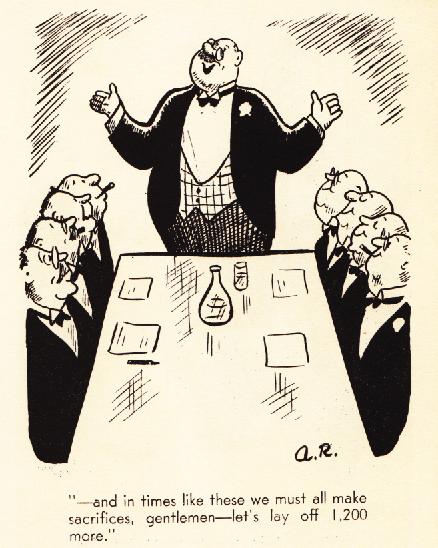
Cartoon from The Ruling Clawss by A. Redfield

From the heart of the first Great Depression comes this cartoon from A. Redfield’s The Ruling Clawss, a collection of cartoons he did for the communist newspaper The Daily Worker. Excerpts from this book have been uploaded to Flickr by Michael Kupperman. Redfield was a pseudonym for Syd Hoff, a New Yorker cartoonist. Philip Nel has a short profile of Hoff and his work as Redfield up on his blog.

All found via Metafilter.

It neatly shows how little has changed in the past seventyfive years, doesn’t it? You can find the same attitudes Redfield documents only thinly disguised in government policy and “market” attitudes all over.