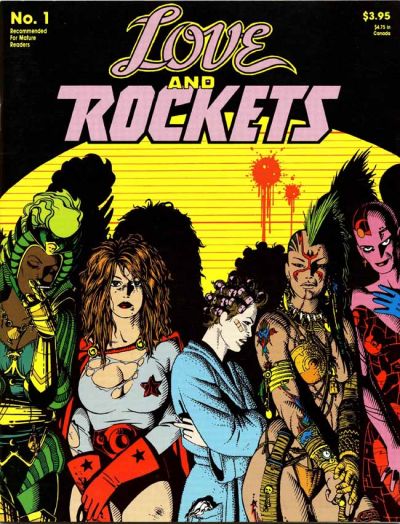
The best ‘entry drug’ for civilians is Love & Rockets – very hip in the 80s, but still as brilliant as ever (best comic of past 30 years IMO).
Confession time: I’ve never really gotten into Love & Rockets. At first I was too engrossed with superheroes, then when I did start looking into other sort of comics, I could never find anything in the local comics shops, unlike with e.g. Cerebus, which I discovered through flipping through the High Society phonebook in my then local. I was aware of it of course, because it was, as Kasper says a serious candidate for being one of the best comics of the past three decades, but I never found a good jumping on point.
To be honest, there didn’t seem to be any. These days, Fantagraphics a nice line of L&R collections, but back in the nineties, when I was a serious comics collector, Love & Rockets was one of those series that it seemed you’ve had to have read from issue one to be able to understand it. Which sort of reinforces my point from two days ago, that continued availability is key for any comic to become part of the canon.
Below is the list of the twentyfive books chosen for World Book Night 2012. According to the site, these books “were selected partly by a public vote for the World Book Night top 100, with an editorial committee whittling down the list”, which may explain some of the odd nature of the list. I thought I’ll keep it simple for this meme: everything I’ve read is in italics, everything I’m not planning to ever read is struck out.
Pride and Prejudice by Jane Austen
The Player of Games by Iain M Banks
Sleepyhead by Mark Billingham
Notes from a Small Island by Bill Bryson
The Alchemist by Paulo Coelho
The Take by Martina Cole
Harlequin by Bernard Cornwell
Someone Like You by Roald Dahl
A Tale of Two Cities by Charles Dickens
Room by Emma Donoghue
Rebecca by Daphne Du Maurier
The Remains of the Day by Kazuo Ishiguro
Misery by Stephen King
The Secret Dreamworld of a Shopaholic by Sophie Kinsella
Small Island by Andrea Levy
Let the Right One In by John Ajvde Lindqvist
The Road by Cormac McCarthy
The Time Traveler’s Wife by Audrey Niffenegger
The Vanishing Act of Esme Lennox by Maggie O’Farrell
The Damned Utd by David Peace
Good Omens by Terry Pratchett & Neil Gaiman
How I Live Now by Meg Rosoff
Touching the Void by Joe Simpson
I Capture the Castle by Dodie Smith
The Book Thief by Markus Zuzak
Only four out of twentyfive read means this is not the list for me. A weird mixture of genres, established classics and recent blockbusters, yet not very diverse considering this is supposed to be for World Book Night. It’s certainly not all Dead White Males, but as far as I can tell these are all authors writing for/firmly established in the UK/US book markets.
To be honest, I never like this sort of list and if anything makes me less inclined to read a book, it’s when it’s being promoted as part of something like this.
Watchman and The Dark Knight Returns. The first step in converting the heathen was always obvious and straightforward once the bliss-was-it-in-that-dawn year of 1986 had been and gone. But the problem was always, always, what next? What other comparably excellent super-people gospels were there, what other beguiling and compelling examples of the fantastical comicbook tradition to be thumped into the wavering novice’s hand in order to seal the proselytisation?
A quarter of a century has passed and the problem persists.
Colin states the question in his first post on the subject as follows:
If the duopoly are still so greatly admired even as the briefly cheering circumstances which accompanied their first appearance at the time are long forgotten, it would seem that both comics have an appeal which transcends any one generation and any specific historical context. Given that few would defend either book as being a flawless expression of genius, and given the quality of a great deal of what’s followed in their wake, what is it that lends these comics their considerable reputation?
Then sets out to answer it in his nextthreeposts on “Why The Commonly-Held Comic-Book Canon Is Absolutely Correct”. He makes a good case for justifiying their place at the top of the superhero canon and I’m not going to argue against it, but I do want to argue that there’s more than just their inherent qualities that got them to the top and more importantly, kept them there.
Because there is a bit of luck there as well, especially in the case of The Dark Knight Returns. Which is a good Frank Miller superhero story, but not obviously better than e.g. his work on Daredevil: Born Again or even Ronin. As with Shakespeare yesterday, Watchmen and The Dark Knight Returns look more important, more special because they’ve been set adrift from their context. Because they’ve have been continuously in print for a quarter century, they’ve become important, while those comics which appeared at the same time and were just as good or better (e.g. American Flagg!), but which for some reason or another didn’t and so never had the chance to gain the same reputation.
This bit in Stephen Fry’s excellent series on language, Planet Word piqued my interest, as he goes into the standard spiel about the marvels of Shakespeare’s vocabulary. It continues with Stephen Fry making the case for him as not just the greatest writer in English, but arguably in any language, a not uncommon view. It annoyed me a bit, this unquestioned image of Shakespeare as a towering genius no other writer can be compared to.
The tendency to discuss Shakespeare in isolation from other dramatists (if not in isolation from his cultural surrounds) is one feature of mainstream scholarship that mirrors a similarly exclusive focus on the part of the self-proclaimed skeptics. This parallel is partly what I had in mind when I called Bardolatry anti-Stratfordianism’s twin in my last post. It’s no coincidence that historically, the authorship controversy only came into being once Shakespeare had been elevated to the status of unparalleled genius, and it certainly seems to me that people writing in praise of Shakespeare have done almost as much damage as those out to undermine his authorial identity.
Because the standard view of Shakespeare sees him as standing apart and above his contemporaries, it becomes more plausible to assume that therefore he cannot have been the simple actor-poet he appeared to be, ergo somebody more elevated must’ve written his plays for him, be it Francis Bacon or the17th earl of Oxford. But once you do put him back into the context in which he lived and worked, it turns out that actually, Shakespeare was not that special and his achievements become more understandable:
Two things stand out to me in Craig’s analysis. The obvious one is how directly his arguments contradict the notion that Shakespeare was exceptionally knowledgeable. As Craig and others suggest, Shakespeare’s artistry lies in the inventive ways he uses his words — his knack for putting simple words in the service of a complex thought, or for arranging usual terms in an unusual way; his ability to connect images and ideas, to use words to bring thought, things, and people to an imaginary life. That, however, seems to me much closer to a talent than to a skill.
[…]
In other words, there appears to be no direct connection between levels of formal education and verbal prodigiousness: Fletcher, as a bishop’s son surely the most culturally elevated of the thirteen, barely ranks above obscure Robert Wilson in vocabulary. It may seem predictable that university wits like Greene, Marlowe, or Peele should be fonder of verbal variety than Shakespeare, but that Dekker uses over 100 more distinct words per play than him may come as a surprise. Webster and his more Baroque register, Jonson and his ambition to display his autodidactically acquired learning — it makes sense that such writers made use of more words than the man who supposedly had a larger vocabulary than anyone, ever, once one steps outside the echo-chamber of Bardolatry. And of course not a single person on Craig’s list can boast an aristocratic background. The most prodigious of them all, John Webster, may even have continued to run his father’s coach-making business at the same time as he was writing the most verbally rich plays of his age.
Crudely summarised: because we know more of Shakespeare’s work, as he wrote more and/or more of his work survived, not to mention because we pay more attention to it, he seems to be much more extraordinary than he actually is. Once restored to his proper context, his achievements are still spectacular but not inhumanly so.
Last week Sandra stopped her treatment, she’s now getting only pain relief and the bare minimum of medication necessary to prevent nasty complications. She’s not eating much anymore and also drinking less, getting more tired and weak each day. Even so, it’s hard to say when it will all be over. Her doctors cannot say with any certainty how long it will take for her to die this way: it could be within the coming, it could take several more. This uncertainty is the worst aspect of the whole process, both for her, waking up each day still alive and in pain and for me too as, crude as it may seem, I would like it all to be over too. Every moment with her I’ll treasure, but the waiting and uncertainty is eating at me too. We’ve done what we can to deal with the aftermath, we’re as ready as we’ll ever be.