NuDC = old Wildstorm

Tim O’Neil explains the real reason for the NuDC:

The post-Flashpoint DC Universe was created as a means of streamlining the company’s staggeringly diverse array of IP into forms more easily amenable to bookstore channels and especially digital distribution services. The goal – successfully achieved so far – has been to make DC resemble something less than an eclectically diverse publishing line and something more along the lines of a streamlined television network.

Given that, its not hard to see that many of the more controversial creative decisions have been made with an eye towards developing a ruthlessly efficient commercial applicability. Hence the explicit T&A books, hence the multiple attempts to ape existing popular Young Adult book franchises (you should be able to spot them yourself with no trouble), hence the multiple attempts to reframe existing properties as potential basic cable drama programming. The goal is to create stories that can be easily packaged and sold by genre to casual readers using digital devices whose size and visual capabilities have now synched up almost completely with the technical demands of displaying comic books.
All that's missing is the knee pouches and spit threads

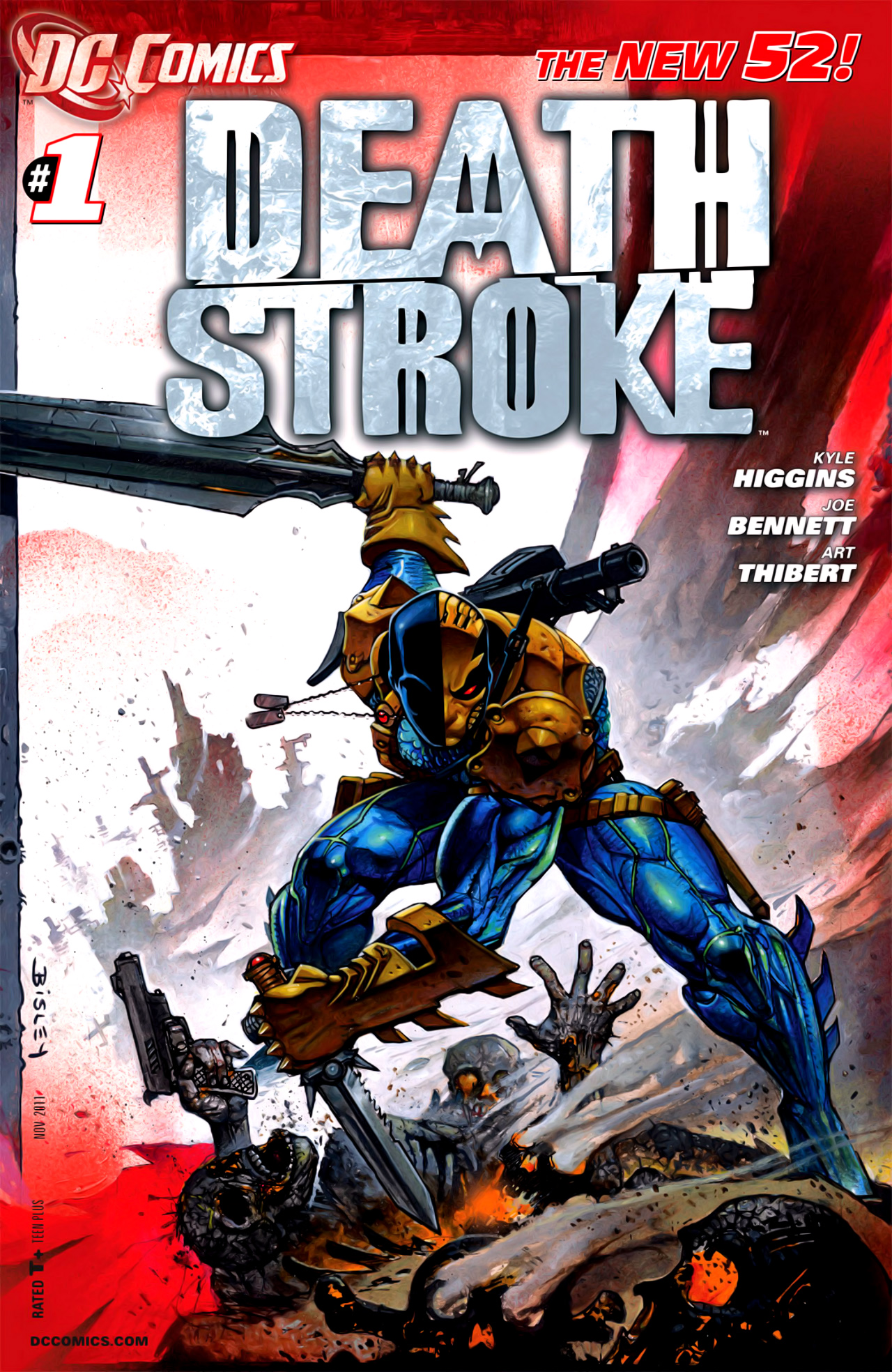
Though I think he’s got a point, I think it may be too much honour to assume that DC was this calculated about the reboot. The end product is just not good enough. Seen as a whole, the NuDC line is actually not commercial enough, not even half as cleverly exploitative as it could’ve been. There are the various continuity carry-overs Tim mentioned, like the Batman and Green Lantern titles which just continue to do what they would’ve done without the reboot, there are also a couple of titles, like e.g. Static Shock or Resurrection Man where you suspect somebody is using the reboot as an excuse to bring back an old favourite, or to get some offbeat new concept approved (Justice League Dark, Demon Knights), not to mention te series that are basically duplicates of each other (Deathstroke, Grifter or Blackhawks and Men of War). In sort, it’s all a bit of a mess if you want to believe in Tim O’Neil’s hypothese.

Where he is probably right is in the motivation behind the reboot, to make it more easier to stripmine the DC universe for new succesful media properties as motivated by the success Marvel has had in the past decade doing the same to their universe. Ironically, as with the original Crisis on Infinite Earths, published out of a desire to streamline the then existing DC universe to make it easier to lure Marvel readers because people who read the Claremont X-Men would’ve had trouble with the complicated concept of multiple earths, they once again got it arse backwards. Marvel has been succesful with its movies by being smart about picking the best parts of a decades long publishing history for their titles and not worry too much about if they mirror proper continuity. These films then naturally filter back into the original comics, but that’s just a side effect. It’s not necessary, as DC’s own successes with the various animated Batman series have shown.

But the powers that be at DC must’ve thought otherwise and put through this halfbaked revamp, which basically amounted to Wildstormising the DC universe. You got your asshole heroes not that different from the villains, lots and lots of shadowy governmenty conspiracies (who should be tripping over each other so many there are), gratitious sex (well, almost nudity) and “hey kids comics” violence, plots that don’t make no sense, both because they all seem have to start in the damn middle and because they all feature off brand characters who can’t care about yet because we don’t know them. It’s not a new development of course, DC has been moving in this direction for years, but with the reboot it’s become official.

It’s all not very good, not really thought out well and as original as a not very original thing, another dip in the well of failed ideas, but if it makes DC happy. Just don’t expect me to like it.

Wanna feel old?


The Ipod is ten years old this month. Metafilter remembers.

I only got an Ipod in 2007, a freebie I got at an ultimately failed job interview. With 2gb of storage it had enough room for a dozen or so albums, i.e. enough variety to last a medium length commute. Loved that thing, even if I’m no great Apple fan — something about them presenting locked down computer products as tools of freedom rubs me the wrong way — but sadly I lost it when it slipped out of a pocked while biking one day. Progress being what it is, that specialised piece of consumer electronics has been replaced by a more generalised bit of kit, my mobile phone which has the same amount of space and which cannot just hold music, but also books and movies undsoweiter.

Also ten years old today: Grand Theft Auto III. The first Grand Theft Auto was cool enough already, in all its old skool topdown 2d glory and controversial enough with its antisocial, crime glorifying violent gameplay, but once it all became 3d and the violence became up close and personal, whoa boy… Brilliant though.

Make booze boring for a safer Britain: support CAMRA

Social anthropologist Kate Fox thinks the British are wrong in blaming alcohol for antisocial behaviour and that it’s in fact a cultural thing:

In high doses, alcohol impairs our reaction times, muscle control, co-ordination, short-term memory, perceptual field, cognitive abilities and ability to speak clearly. But it does not cause us selectively to break specific social rules. It does not cause us to say, “Oi, what you lookin’ at?” and start punching each other. Nor does it cause us to say, “Hey babe, fancy a shag?” and start groping each other.

[…]

We become more outspoken, more physically demonstrative, more flirtatious, and, given enough provocation, some (young males in particular) become aggressive. Quite specifically, those who most strongly believe that alcohol causes aggression are the most likely to become aggressive when they think that they have consumed alcohol.

Which means that any attempt to limit booze related antisocial behaviour that focuses on alcohol as the evil spirit motivating this is counterproductive:

The drinkaware website, for example, warns young people that a mere three pints of beer (ie a perfectly normal evening out) “can lead to anti-social, aggressive and violent behaviour”, that “you might start saying things you don’t mean and behaving out of character”, that alcohol is implicated in a high percentage of sexual offences and street crimes, and that the morning after “you may wonder what you did the night before”.

Instead, booze should be made into something a bit boring and stop being used as an excuse for people to be assholes:

I would like to see a complete change of focus, with all alcohol-education and awareness campaigns designed specifically to challenge these beliefs – to get across the message that a) alcohol does not cause disinhibition (aggressive, sexual or otherwise) and that b) even when you are drunk, you are in control of and have total responsibility for your actions and behaviour.

Alcohol education will have achieved its ultimate goal not when young people in this country are afraid of alcohol and avoid it because it is toxic and dangerous, but when they are frankly just a little bit bored by it, when they don’t need to be told not to binge-drink vodka shots, any more than they now need to be told not to swig down 15 double espressos in quick succession.

Which is why we should support CAMRA, the Campaign for Real Ale, because how much more boring can booze be than if it’s drunk by middle aged, science fiction reading bearded folkies?

When America still read comics

Here are some statistics to make any modern American comics publisher weep with envy. Coming from the transcripts of the 1954 Senate Subcommittee Hearings into Juvenile Delinquency, which under the influence of Wertham and other moral crusaders looked at the evil influence comics supposedly had on the youth of America, this is part of the testimony of Mrs. Helen Meyer, vice president of the Dell Publishing Co:

Dell’s average comic sale is 800,000 copies per issue. Most crime and horror comic sales are under 250,000 copies.

Of the first 25 largest selling magazines on newsstands – this includes Ladies Home Journal, Saturday Evening Post, Life, and so forth ─ 11 titles are Dell comics, with Walt Disney’s Donald Duck the leading newsstand seller. Some of these titles are: “Walt Disney’s Comics”; “Warner Bros. Bugs Bunny”; “Walt Disney’s Mickey Mouse”; “Warner Bros. Looney Tunes and Merrie Melodies, Porky Pigs”; “Walter Lantz Woody Woodpecker”; “Margie’s Little Lulu”; “Mom’s Tom and Jerry.”

The newsstand sales range from 950,000 to 1,996,570 on each of the above mentioned titles. I mean newsstands only and I am not including any subscriptions, and we have hundreds of thousands of subscriptions.

With the least amount of titles, or 15 percent of all titles published by the entire industry; Dell can account for a sale of approximately 32 percent, and we don’t publish a crime or horror comic.

[…]

We print approximately 30 million comics a month. We sell over 25 million.

I found this site following a long breadcrumb trail of blogs, which I won’t tire y’all with. The story of how Wertham destroyed comics is well known, if perhaps as much myth as fact by now, but every history I’ve read of this focuses on the artistic impact this had on the American comics scene, with the economic impacts only of secondary importance. So these histories do mention that many publishers folded in the aftermath of the Wertham controversies and adaptation of the Comics Code, but I haven’t yet found any that really goes into detail in the ways comics published itself changed, let alone a history that put this in the wider context of the changes in (magazine) publishing in the fifties. As show above, Dell, at the time America’s biggest comics publisher could expect to sell some 800,000 copies of any given title, but how and how much did Wertham influence these nubmers? Did the comics code really do in so many publishers or was there more going on? How does all this tie in with the collapse of the independent distribution system that also took place at the time, iirc?

Anybody can recommend any good book/website that attempts to answer these sort of questions?