The Watchmen problem

Colin Smith, one of our smartest comics bloggers, has been thinking about why it is that a quarter century after their publication, both Watchmen and The Dark Knight Returns are still the first superhero comics you think of when trying to convert a civilian to comics:

Watchman and The Dark Knight Returns. The first step in converting the heathen was always obvious and straightforward once the bliss-was-it-in-that-dawn year of 1986 had been and gone. But the problem was always, always, what next? What other comparably excellent super-people gospels were there, what other beguiling and compelling examples of the fantastical comicbook tradition to be thumped into the wavering novice’s hand in order to seal the proselytisation?

A quarter of a century has passed and the problem persists.

Colin states the question in his first post on the subject as follows:

If the duopoly are still so greatly admired even as the briefly cheering circumstances which accompanied their first appearance at the time are long forgotten, it would seem that both comics have an appeal which transcends any one generation and any specific historical context. Given that few would defend either book as being a flawless expression of genius, and given the quality of a great deal of what’s followed in their wake, what is it that lends these comics their considerable reputation?

Then sets out to answer it in his next three posts on “Why The Commonly-Held Comic-Book Canon Is Absolutely Correct”. He makes a good case for justifiying their place at the top of the superhero canon and I’m not going to argue against it, but I do want to argue that there’s more than just their inherent qualities that got them to the top and more importantly, kept them there.

Because there is a bit of luck there as well, especially in the case of The Dark Knight Returns. Which is a good Frank Miller superhero story, but not obviously better than e.g. his work on Daredevil: Born Again or even Ronin. As with Shakespeare yesterday, Watchmen and The Dark Knight Returns look more important, more special because they’ve been set adrift from their context. Because they’ve have been continuously in print for a quarter century, they’ve become important, while those comics which appeared at the same time and were just as good or better (e.g. American Flagg!), but which for some reason or another didn’t and so never had the chance to gain the same reputation.
Shakespeare: not that special after all


This bit in Stephen Fry’s excellent series on language, Planet Word piqued my interest, as he goes into the standard spiel about the marvels of Shakespeare’s vocabulary. It continues with Stephen Fry making the case for him as not just the greatest writer in English, but arguably in any language, a not uncommon view. It annoyed me a bit, this unquestioned image of Shakespeare as a towering genius no other writer can be compared to.

And it turns out I’m not the only one who gets annoyed by this myth making. As Shakespeare scholar Holger Syme argues, this sort of inflated view of Shakespeare plays right in the hands of those who would deny the very existence of him but as a mask for someone they’d think more suited for the role of world’s best writer:

The tendency to discuss Shakespeare in isolation from other dramatists (if not in isolation from his cultural surrounds) is one feature of mainstream scholarship that mirrors a similarly exclusive focus on the part of the self-proclaimed skeptics. This parallel is partly what I had in mind when I called Bardolatry anti-Stratfordianism’s twin in my last post. It’s no coincidence that historically, the authorship controversy only came into being once Shakespeare had been elevated to the status of unparalleled genius, and it certainly seems to me that people writing in praise of Shakespeare have done almost as much damage as those out to undermine his authorial identity.

Because the standard view of Shakespeare sees him as standing apart and above his contemporaries, it becomes more plausible to assume that therefore he cannot have been the simple actor-poet he appeared to be, ergo somebody more elevated must’ve written his plays for him, be it Francis Bacon or the17th earl of Oxford. But once you do put him back into the context in which he lived and worked, it turns out that actually, Shakespeare was not that special and his achievements become more understandable:

Two things stand out to me in Craig’s analysis. The obvious one is how directly his arguments contradict the notion that Shakespeare was exceptionally knowledgeable. As Craig and others suggest, Shakespeare’s artistry lies in the inventive ways he uses his words — his knack for putting simple words in the service of a complex thought, or for arranging usual terms in an unusual way; his ability to connect images and ideas, to use words to bring thought, things, and people to an imaginary life. That, however, seems to me much closer to a talent than to a skill.

[…]

In other words, there appears to be no direct connection between levels of formal education and verbal prodigiousness: Fletcher, as a bishop’s son surely the most culturally elevated of the thirteen, barely ranks above obscure Robert Wilson in vocabulary. It may seem predictable that university wits like Greene, Marlowe, or Peele should be fonder of verbal variety than Shakespeare, but that Dekker uses over 100 more distinct words per play than him may come as a surprise. Webster and his more Baroque register, Jonson and his ambition to display his autodidactically acquired learning — it makes sense that such writers made use of more words than the man who supposedly had a larger vocabulary than anyone, ever, once one steps outside the echo-chamber of Bardolatry. And of course not a single person on Craig’s list can boast an aristocratic background. The most prodigious of them all, John Webster, may even have continued to run his father’s coach-making business at the same time as he was writing the most verbally rich plays of his age.

Crudely summarised: because we know more of Shakespeare’s work, as he wrote more and/or more of his work survived, not to mention because we pay more attention to it, he seems to be much more extraordinary than he actually is. Once restored to his proper context, his achievements are still spectacular but not inhumanly so.

Sandra update

Last week Sandra stopped her treatment, she’s now getting only pain relief and the bare minimum of medication necessary to prevent nasty complications. She’s not eating much anymore and also drinking less, getting more tired and weak each day. Even so, it’s hard to say when it will all be over. Her doctors cannot say with any certainty how long it will take for her to die this way: it could be within the coming, it could take several more. This uncertainty is the worst aspect of the whole process, both for her, waking up each day still alive and in pain and for me too as, crude as it may seem, I would like it all to be over too. Every moment with her I’ll treasure, but the waiting and uncertainty is eating at me too. We’ve done what we can to deal with the aftermath, we’re as ready as we’ll ever be.

NuDC = old Wildstorm

Tim O’Neil explains the real reason for the NuDC:

The post-Flashpoint DC Universe was created as a means of streamlining the company’s staggeringly diverse array of IP into forms more easily amenable to bookstore channels and especially digital distribution services. The goal – successfully achieved so far – has been to make DC resemble something less than an eclectically diverse publishing line and something more along the lines of a streamlined television network.

Given that, its not hard to see that many of the more controversial creative decisions have been made with an eye towards developing a ruthlessly efficient commercial applicability. Hence the explicit T&A books, hence the multiple attempts to ape existing popular Young Adult book franchises (you should be able to spot them yourself with no trouble), hence the multiple attempts to reframe existing properties as potential basic cable drama programming. The goal is to create stories that can be easily packaged and sold by genre to casual readers using digital devices whose size and visual capabilities have now synched up almost completely with the technical demands of displaying comic books.

All that's missing is the knee pouches and spit threads

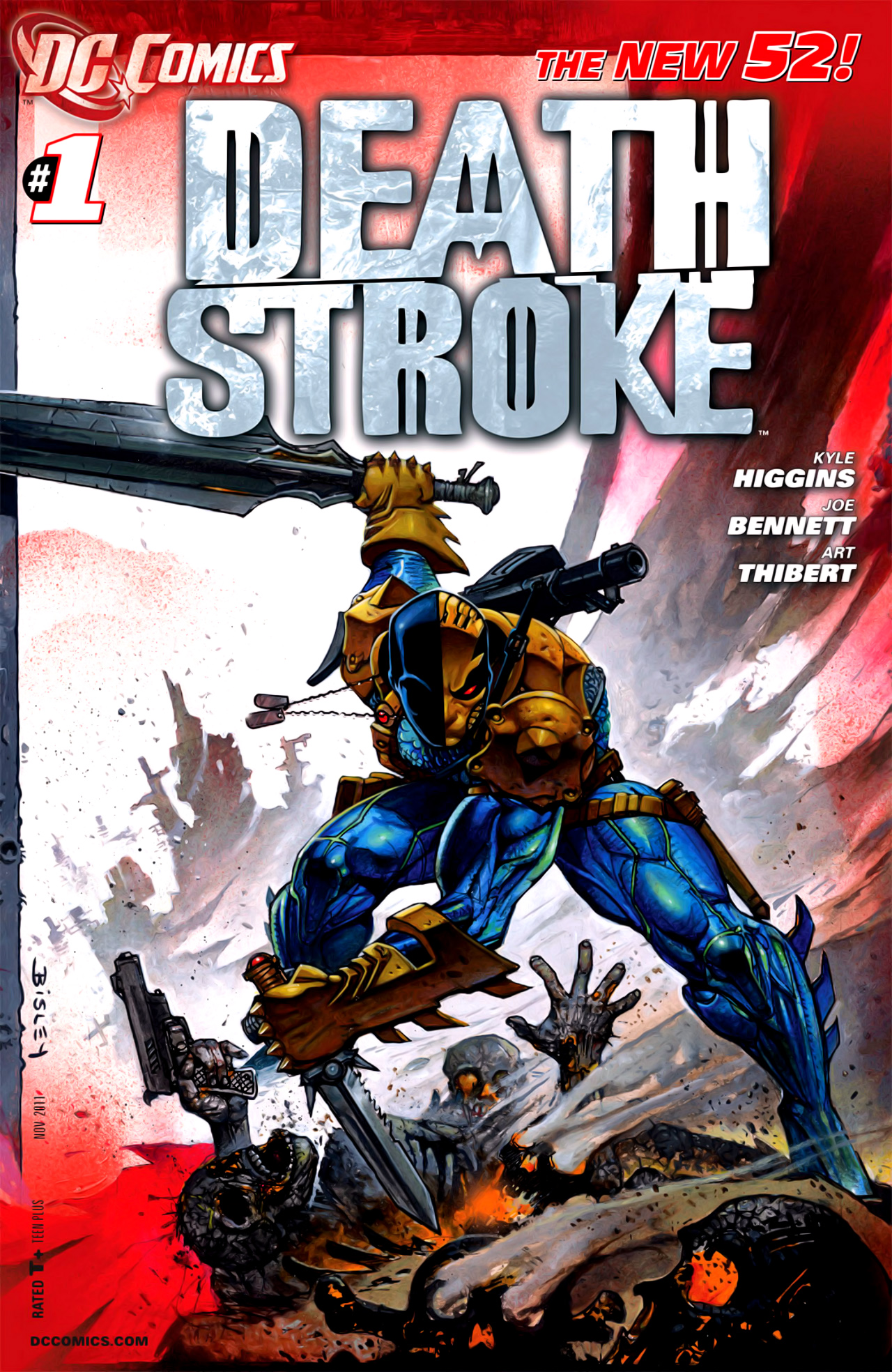
Though I think he’s got a point, I think it may be too much honour to assume that DC was this calculated about the reboot. The end product is just not good enough. Seen as a whole, the NuDC line is actually not commercial enough, not even half as cleverly exploitative as it could’ve been. There are the various continuity carry-overs Tim mentioned, like the Batman and Green Lantern titles which just continue to do what they would’ve done without the reboot, there are also a couple of titles, like e.g. Static Shock or Resurrection Man where you suspect somebody is using the reboot as an excuse to bring back an old favourite, or to get some offbeat new concept approved (Justice League Dark, Demon Knights), not to mention te series that are basically duplicates of each other (Deathstroke, Grifter or Blackhawks and Men of War). In sort, it’s all a bit of a mess if you want to believe in Tim O’Neil’s hypothese.

Where he is probably right is in the motivation behind the reboot, to make it more easier to stripmine the DC universe for new succesful media properties as motivated by the success Marvel has had in the past decade doing the same to their universe. Ironically, as with the original Crisis on Infinite Earths, published out of a desire to streamline the then existing DC universe to make it easier to lure Marvel readers because people who read the Claremont X-Men would’ve had trouble with the complicated concept of multiple earths, they once again got it arse backwards. Marvel has been succesful with its movies by being smart about picking the best parts of a decades long publishing history for their titles and not worry too much about if they mirror proper continuity. These films then naturally filter back into the original comics, but that’s just a side effect. It’s not necessary, as DC’s own successes with the various animated Batman series have shown.

But the powers that be at DC must’ve thought otherwise and put through this halfbaked revamp, which basically amounted to Wildstormising the DC universe. You got your asshole heroes not that different from the villains, lots and lots of shadowy governmenty conspiracies (who should be tripping over each other so many there are), gratitious sex (well, almost nudity) and “hey kids comics” violence, plots that don’t make no sense, both because they all seem have to start in the damn middle and because they all feature off brand characters who can’t care about yet because we don’t know them. It’s not a new development of course, DC has been moving in this direction for years, but with the reboot it’s become official.

It’s all not very good, not really thought out well and as original as a not very original thing, another dip in the well of failed ideas, but if it makes DC happy. Just don’t expect me to like it.

Wanna feel old?


The Ipod is ten years old this month. Metafilter remembers.

I only got an Ipod in 2007, a freebie I got at an ultimately failed job interview. With 2gb of storage it had enough room for a dozen or so albums, i.e. enough variety to last a medium length commute. Loved that thing, even if I’m no great Apple fan — something about them presenting locked down computer products as tools of freedom rubs me the wrong way — but sadly I lost it when it slipped out of a pocked while biking one day. Progress being what it is, that specialised piece of consumer electronics has been replaced by a more generalised bit of kit, my mobile phone which has the same amount of space and which cannot just hold music, but also books and movies undsoweiter.

Also ten years old today: Grand Theft Auto III. The first Grand Theft Auto was cool enough already, in all its old skool topdown 2d glory and controversial enough with its antisocial, crime glorifying violent gameplay, but once it all became 3d and the violence became up close and personal, whoa boy… Brilliant though.