Dutch cartoonist Minck Oosterveer has died

Minck Oosterveer

Via Michael Minneboo comes the news that Dutch cartoonist Minck Oosterveer has died in a motorcycle accident at age fifty. A sad enough death for anybody, but even sadder as it came just at a point in Oosterveer’s career when he had recieved the critical acclaim of his peers in the Netherlands, if not the commercial succes he wanted. At the same time however, after several years of effort it seemed that he had finally broken through in America, getting assignments from Boom! Studios as well as Marvel Comics. He had recently done the artwork on Mark Waid’s Victorian detective series Ruse as well as an issue of Spider Island: Deadliest Foes.

That latter was something of a dream come true for Oosterveer, one of whose earliest professional pieces had been a newspaper style Spider-Man strip for a dayplanner published by the then Dutch license holder for Marvel Comics, way back in 1989. Oosterveer had been trying to break into the American comics market for a couple of years now, as possibilities for the kind of comics he drew were drying up fast in the Dutch markets. As he had put it earlier this year:

Spider-Man and the Black Cat drawn by Minck Oosterveer

Marvel pays royalties and the money you start with there is more than you could earn here. The only ones still paying a page rate is Eppo strip magazine. But there you get half of what I’m going to earn at Marvel per page. In the Netherlands I really can’t ake a living from comics anymore. You can’t blame Dutch publishers for it, because album sales here are just too low.

The lack of commercial succes in the last few years in the Netherlands, which also included the loss of his daily adventure newspaper strips in De Telegraaf did not mean Oosterveer wasn’t appreciated by his colleagues and readers. Only this year he won the Stripschapsprijs’ lifetime achievement award, the highest award his peers could give him. He was praised for the very qualities that made his work uncommercial in the current market place, his focus on doing realistic strips in a country that was always more into the cartoonesque and funny side of comics.

Artwise, Minck Oosterveer had always been influenced by the classic American adventure strip cartoonists, people like Milton Caniff, Alex Raymond and Will Eisner. His style was loose and fluid, with a strong feel for black and white contrasts, just as you’d expect from somebody with those influences. He managed to be recognisable and interesting even in the severly limited space of the daily newspaper strip, where he’d be lucky to have three small, cramped and badly reproduced panels. His work may have been taken for granted and not always been appreciated by the general audience, but his peers knew his worth.

I didn’t know him personally and it’s only been recently that I realised how good he actually was. I regret not getting the chance to tell him in person.
On writing book reviews

Andrew Wheeler writes about how his old job at the SFBC taught him how to review books:

I started off in “book reviewing” by writing internal book reports for the SFBC; I did six of them my first week at the club, back in April of 1991. I was very eager, and incredibly willing to read almost anything my boss put in front of me — I recognize that same eagerness and enthusiasm in a lot of young bloggers now, and wince to remember when I was like that. I was lucky in two ways: those reports had a clear structure (one phrase to define a book in genre and style, several paragraphs of plot description, and then a short personal evaluation at the end), and they were internal; no one outside the company ever read them.

I wrote hundreds of those over the next few years, learning to boil down complicated plots to their essences, to take good notes on books as I read them, to keep track of characters, and lots of other mechanical skills. More importantly, I learned to read actively, to think about a book as I was reading it and to start making hypotheses and guesses about the shape and course of a book while in the middle of it. That’s one of the core necessities for a critic of any kind: you need to engage with the work directly, to think about where it seems to be going (rather than where you want it to go, or where it does eventually go) and get a sense for the shape of those works.

That actively reading of a book, to read it with one eye on what you’re going to write about it is the essence of critical reading. You’re not just looking at the story itself, but also at why the author might have made the choices they made in telling the story, or at the deep structures of the plot and how the need to end the story in another hunderd pages or so limits what can happen now. It’s the same for non-fiction, where you’re looking at how the author structures their arguments and how you’ll be able to quickly summarise the key points of it in your review later. It does sort of inhibits your ability to lose yourself in a book…

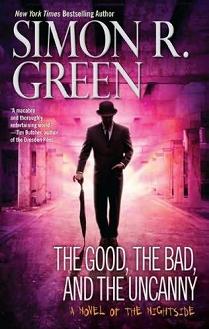
The Good, the Bad, and the Uncanny — Simon R. Green

Cover of The Good, the Bad, and the Uncanny


The Good, the Bad, and the Uncanny
Simon R. Green
275 pages
published in 2010

Simon R. Green is, in the best possible meaning of the word, a cheerful hack writer. He’s been writing professionally since the mid seventies and specialises in long series of easily digestable, fun adventure science fiction and fantasy, in commercially interesting subgenres. The Good, the Bad, and the Uncanny is a good example of this, the tenth novel in the Nightside series of urban fantasy. Which I didn’t know when I got it from the library, or I probably would’ve left it on the shelves. In the event it turned out not to matter fortunately; you needn’t have read the previous novels to understand this one, even if there are a lot of references to earlier adventures. It reminded me of when I first started to read Marvel comics way back in the eighties, trying to figure out a complex backstory that’s only hinted at.

The Nightside is the hidden part of London, where it’s always three a.m., magic is real, but so is super technology, demons and angels and nightmares cloaked in flesh roam the streets, time travel of one sort or another and all other sorts of crazy shit is commonplace. This is the world John Taylor works in, a private investigator in a pristine white suit, not quite a knight in shining armour but the closest equivalent. He’s cursed with awesome, having a magical gift that can get him out of trouble but which costs him to use it, not to mention can be a beacon to his enemies. He has powerful friends, but equally powerful enemies and the difference between the two is not always clear. The job he gets at the beginning of The Good, the Bad, and the Uncanny is simple but dangerous: escort a envoy from one side in the Elven civil war through the Nightside on his way to the court of the other side. There’s only one small problem, which is that Walker, the most powerful man in the Nightside, the one appointed by the Authorities to keep some sort of order, doesn’t want this envoy to reach his destination, as the civil war suits The Authorities fine…

Read more…

Should we worry about science fiction’s denial of climate change?

Mark Charan Newton worries about the cult of science fiction and how this influences the debate on climate change:

There’s so little time to hold back anthropogenic climate change (assuming you accept the unequivocal science in the first place). Leave it too long, and it will be too late to bring back CO2 concentrations to the necessary levels, causing a huge variety of issues that I’ve gone on about many times before. Dreaming up science fiction, Big Ideas, will not address the actual problems of dumping huge amounts of greenhouses gasses into the atmosphere in the first place. Moreover, this SF is diverting attention, political and financial resources away from urgent action. What this also does is play right into the hands of corporate lobbyists who will use it as an argument to delay such urgent action even further, usually to the benefit of [insert polluting organisation here].

I do agree with Mark on his broader point, that it is pointless and counterproductive to look for a quick technofix as the solution to climate change, but worrying about the pernicious influence of science fiction in this is worrying about the tail wagging the dog. Yes, science fiction readers and writers alike are constitutionally more keen on technowizardry as the solution to all our woes than the normal run of the population, but we’re not the ones driving the debate. It’s the ExxonMobil and Philip Morris sponsored think thanks we have to worry about, these are the ones that are fueling the deniers.

In fact, what’s so disappointing about those science fiction writers who are in the denial camp is how much they follow the recieved wisdom there, rather than come up with original ideas of their own. See for example Mark’s criticism of Neal Asher’s ideas about climate change and it’s clear Asher has nothing new to add to the debate. It’s all hockey sticks, cherry picking and (deliberate) misunderstandings of what certain scientists mean with “tricks” in the context of statistical analysis. (I’m glad that Asher for the most part doesn’t feel the need to pollute his fiction with such long debunked nonsense. Love his fiction, don’t agree with his politics on climate change, don’t mind at all if these two are kept separate.)

So unlike Mark, I think most prominent climate change deniers in science fiction like Asher are followers rather than leaders, a symptom rather than the disease. We do need to worry about misplaced faith in technological solutions to climate change so that we don’t remain passive while waiting for a cost free, pain free solution, but science fiction is the wrong place to combat it.

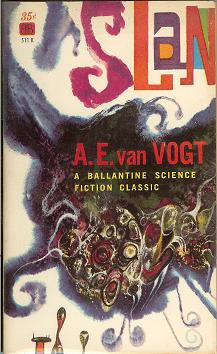
Slan — A. E. van Vogt

Cover of Slan


Slan
A. E. van Vogt
159 pages
published in 1940

“His mother’s hand felt cold, clutching his. Her fear as they walked hurriedly along the street was a quiet, swift pulsation that throbbed from her mind to his. A hundred other thoughts beat against his mind, from the crowds that swarmed by on either side, and from inside the buildings they passed. But only his mother’s thought were clear and coherent–and afraid.”

The opening sentences of Slan show why A. E. van Vogt was the most popular writer of science fiction’s Golden Age, somebody who in 1940 could not only be compared to an Asimov or Heinlein, but compared favourably. Van Vogt had honed his craft on writing “true confession” stories for the pulp market, then got into science fiction with a big bang in John Campbell’s Astounding Science Fiction with “Black Destroyer” — the story that would decades later inspire the Alien movie. For about a decade or so he was incredibly prolific, inventive and with an almost instinctive understanding of how to push his readers’ buttons, learned while writing sob stories for the romance pulps. All these qualities come together in Slan and if you want to understand van Vogt’s appeal, this is the best novel to try: short, focused and tense.

Slan is the story of Jommy Cross, a mutant, a slan, like all slans stronger and smarter than ordinary humans and equipped with two golden tendrils on his forehead which gives him the ability to read minds — but he’s only nine years old. And he and his mother are caught in the very centre of Centropolis, she sacrifising her own life to enable him to escape from the slan hunters, the secret police that shoots slans on sight, because slans are too dangerous to be allowed to life. Those slans who haven’t been murdered yet have to live in secret, hiding their abilities and their tendrils. Jommy does not know how many of them are still or if he’s the only one, but he knows that he is their last hope, that he has to survive to one day take on the might of the dictator of Earth, Kier Gray, as well as the chief of the secret police, the head slan hunter, John Petty. And then there’s the captive slan girl, Kathleen Layton, subject of a power struggle between the two men…

Read more…