A skinny Wall? Really DC? Really?

new Amanda Waller, left and the real one on the right

What made the original Suicide Squad series not just a good, but an excellent series can be summed up in two words: Amanda Waller. Here you had an ordinary, middle aged, somewhat overweight woman who could dominate a room full of supervillains, who had a vision of what she wanted the ‘squad to be and was ruthless in the pursuit of her goals, with an inner nobility but who never stopped being the amoral political hack she started out as, never turned into yet another pseudohero. She was a character you’d either loved or hated and many readers of suicide Squad came back month after month to hate her. In short, she was one of the most fully realised, three dimensional characters in any comic — and now she seems to have been replaced by some sort of bimbo with shirt unbuttoned, tits trust out and fifty kilos lighter..

Seems, because the woman on the last page of the first issue of the new Suicide Squad is never quite introduced as the Wall and it could all be a switcheroo. But I don’t think so. It fits in with the mentality that turns the wheelchair bound Oracle (another Suicide Squad creation) back into Batgirl, losing one of DC’s few disabled heroes, or that puts Harvey Quinn into fetish gear or –less seriously but just as dumb — let’s Floyd “Deadshot” Lawton lose his moustache. It’s change for the sake of it, where it’s not needed, going for some lowest common denominator idea of cool, just like all those stupid costume changes in Justice League.

The rest of this first issue of Suicide Squad is not much better, as it’s basically a long torture scene interrupted by flashbacks that’s ultimately revealed to be a danger room session, a test by the ‘squad’s backers to see who’d stay loyal. It’s only in the last three pages that the Squad go on their first mission, to kill 60,000 people in a football stadium. Why? No idea yet, but so far it all reads like a Hollywood idea of what a government conspiracy would look like, all very over the top. What misses is the original series sense of realism, where of course you are dealing with a world in which there are superheroes and supervillains and alien invasions and magic is real and all that, but the way John Ostrander and Kim Yale handled the idea of how the American government would use an undercover squad of supervillains worked. This however is just one big action movie cliche.
Rawagede: Holland’s very own Srebrenica

Survivors of the Dutch massacre in Rawagede, Indonesia, have gotten some justice from the Dutch courts as the Den Haag civil court ruled the statue of limitations did not apply to them:

A Dutch court has ordered the government to compensate the widows of seven villagers who were summarily executed and a man shot and wounded in a notorious massacre during Indonesia’s bloody battle for independence from colonial rule.

The Hague Civil Court ruled on Wednesday it was “unreasonable” for the government to argue that the widows were not entitled to compensation because the statute of limitations had expired.

According to Indonesian researchers, Dutch troops wiped out almost the entire male population of Rawagede, a village in West Java, two years before the former colony declared independence in 1949.

[…]

The only living witnesses are now in their 80s, and illiterate, after having to fend for themselves following the deaths of their husbands.

“There were dead bodies everywhere, many of which we found in the river after the shooting stopped,” said Cawi, a survivor.

[…]

The court’s judgement paves the way for a case to establish the level of indemnities to be paid to the relatives.

However, Zegveld said its narrow focus on widows of massacre victims means it is unclear whether it will expose the Dutch state to a flood of compensation claims from other relatives of people killed during the Dutch fight to retain control over the Dutch East Indies, which became Indonesia in 1949.

Authorities in the Netherlands say 150 people died while a victims’ association claims 431 lost their lives during an operation to root out a suspected independence fighter hiding in the village, known today as Balongsari.

Every western colonial power has skeletons like this in its closet and would rather they stay there. Yet I can’t help that the Dutch are particularly good at only remembering the history they want to remember. While World War II, in which the Netherlands was a victim of German and Japanese aggression is now an integral part of the Dutch self image, the dirty colonial wars that took place in Indonesia almost from the moment the Japanese had left have been largely erased from our collective memory. In fact, in some respect WWII offers cover for what we did in Indonesia afterwards. It’s only now, when many of the people directly involved (including the victims) are dead that we’re finally getting some recognition of what we did there. We were outraged at what Bosnian Serbs did in Srebrenica and justifiably so, but this means that we should recognise our own atrocities as well.

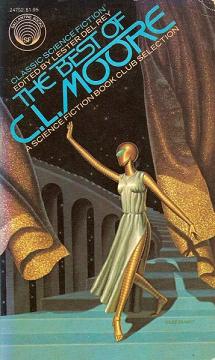
The Best of C. L. Moore — C. L. Moore

Cover of The Best of C. L. Moore


The Best of C. L. Moore
C L. Moore
372 pages
published in 1975

In the mid seventies Ballantine Books, just before it renamed itself into Del Rey, launched a “Best of” series of short story collections by classic science fiction and fantasy authors which I personally think is perhaps the best such series ever produced. Just at a time when science fiction was switching from being a short story, magazine orientated genre to one in which the novel is supreme, here were collections by all the old masters who had made their name in the pulp magazines of the thirties, forties and fifties. The series offered a sense of history to the genre just when science fiction was in danger of losing touch with its roots. It offered both a reminder to old fans of what had attracted them to the genre in the first place and to new fans a sampling of authors they may have thought oldfashioned or perhaps never had the chance to read in the first place.

One of such authors must have been C. L. Moore, who had made her reputation writing science fantasy stories for Weird Tales in the 1930ties. In the 1940ties, after she met and married Henry Kuttner she almost completely stopped writing on her own, instead collaborating with him (often under the Lewis Padgett pseudonym) on a series of classic sf stories, then moving on to writing crime stories and for television, both of which unfortunately paid better, in the late fifties. By the time The Best of C. L. Moore was published it had been the better part of two decades that she had written much new science fiction. Now that more than twice as much time has passed, this collection is still a great introduction to what C. L. Moore had to offer when not collaborating with her husband.

Read more…

Joost Swarte — more than just a pencil pusher

Joost Swarte may arguably be Holland’s most important modern cartoonist — he’s certainly the best known outside of the Netherlands — but that’s just one of his talents. He’s an artist working in the tradition of say a Rietveld as much as a Marten Toonder; multidisciplinary, but with a signature visual style that’s noticable in all his art. The following three videos showcase this neatly.

First up, a short impression of 6 sculptures Swarte created for the Palace of Justice in Arnhem in 2004. You may want to turn down the sound to avoid the annoying background music.


Second, (social) building society Ymere had asked Swarte, working together with the architect Sytze Visser, to design four showcase rental appartments to “pep up” the Willemsstraat in Amsterdam, in the Jordaan area. This was done as part of a social regeneration project, to stimulate some interest in a neighbourhood that had been somewhat neglected in recent years. These appartments were opened in February of last year, with Swarte and his family having lived there for month as a trial of his own design. Video is in Dutch obviously, made by Ymere to promote the project (and not doing very well considering the less than fifty views it has had so far..)


Finally, there’s the multifunctional children’s chair, as explained and demonstrated by Swarte himself:


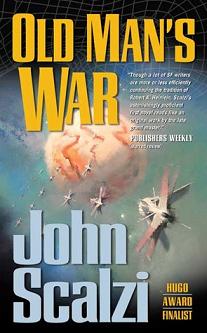
Old Man’s War — John Scalzi

Cover of Old Man's War


Old Man’s War
John Scalzi
311 pages
published in 2005

John Scalzi’s debts to Heinlein in Old Man’s War are indeed obvious as he says in his afterword. Even without what looks to be a shootout to the opening scenes of Starship Troopers halfway through the novel it’s pretty obvious where Scalzi got his inspiration from. In structure, plot and protagonist Old Man’s War could fit in neatly with any of Heinlein’s coming of age stories like Space Cadet or The Tunnel in the Sky in which a young man is forced to grow up quickly to confront a hostile universe. The only difference is that John Perry is not a young man, but a seventyfive years old widower when he signs up for his stint with the Colonial Defence Forces.

Apart from that, John fulfills the same role as Rico in Starship Troopers, that of the new recruit who we’ll follow through basis training and combat, somebody who needs to be educated in the true nature of the world he lives in and who can function as a stand in for the reader. Where the two differ is that John obviously is not a callow teenager, but somebody who lived a long and fulfilling life, who saw a chance to regain his youth and took it, without knowing or caring too much about what he’s getting himself into.

Read more…