Why the Euro’s in trouble

Paul de Grauwe examines how participing in the Euro makes countries that much more vulnerable to assault in the financial markets,
because they now lack control of their own money:

When entering a monetary union, member-countries change the nature of their sovereign debt in a fundamental way, i.e. they cease to have control over the currency in which their debt is issued. As a result, financial markets can force these countries’ sovereigns into default. In this sense member countries of a monetary union are downgraded to the status of emerging economies. This makes the monetary union fragile and vulnerable to changing market sentiments. It also makes it possible that self-fulfilling multiple equilibria arise.

What he doesn’t examine in his paper, but what’s clearly is happing as well is that in a monetary union like the Eurozone, such crisises are vulnerable to cascades. The rescue of Ireland and Greece makes Spain and Portugal weak, which means they need to be bailed out which made Italy look worse and France a bit wobbly… Before you know it even very safe countries like Holland or Germany are brought down. Which makes it all that much more important that the Eurozone learns to deal properly with these crisises.
Run, run, run

Just came back from the Making Light meetup, which was fun, if totally bib or tucker free. Before that I spent the whole day on a training course, so I haven’t had any time to read the interwebs, let alone come up with something to post about. Instead, have a video of a seventies rock band now only remembered for one song, one of the countless bands that put out some records, had some limited success, then vanished, never to even make it to cult favourite. Jo Jo Gunne managed four albums before they had to quit, had only one hit, never got much of a presence on the AOR channels either, didn’t do much other bands didn’t do earlier or better, but they still had a certain charm.


The point of seventies rock like this is not that it’s original or innovative, but exactly that you get what you thought you would get.

The internet has not been kind to me today

First up, can we please stop it with the 9/11 hysteria already. Yes, it’s the tenth anniversary, yes it’s an important turning point in recent world history and a raw wound for a great many people still, but can’t it all be done a little bit more dignified and restrained? Every television channel seems the need to come up with its own unique 9/11 spin and it’s getting sick making. I can’t imagine how bad the family and friends of those who died that day must feel right now, having this shoved in their faces 24/7 this week…

Second, this is the week that Michael S. Hart died. Who he? Just the founder of Project Gutenberg, who had a simple vision: make public domain books freely available on the internet. For all your Google Books or Internet Archives, Hart thought of it first, back in 1971. He was an avatar of the old skool, not for profit internet, seeing it as something that would enrich people’s lives, not something to make himself rich. He’ll be missed.

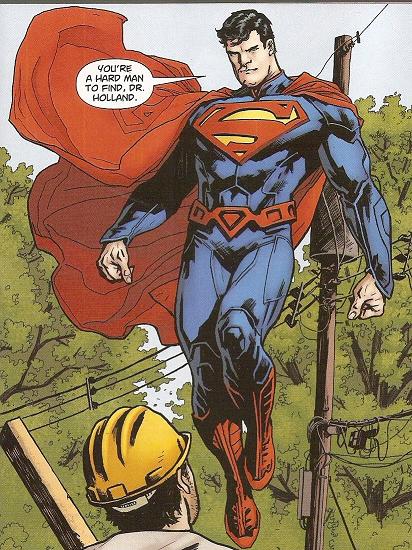
Superman in his new costume

Third, you should never tug on Superman’s cape, but that hasn’t stopped Jim Lee and DC comics from “improving” it. It’s not just that it now looks like a thirteen year old’s idea of what a cool costume should look like, but that it looks like what a thirteen year old twenty years ago would think was cool. All it misses is some goddamn ankle pouches. DC should know better than to try for the hip, edgy look: it’s constitutionally incapable of doing so. Superman’s costume is a design classic, something that has been able to stay iconic and classy for decades with only little tweaks. It doesn’t need to be chucked just because some nerd can’t live with the underpants over his trousers jokes anymore.

Fourth, well, this:

Horatio brought him his sword. “Laertes is looking for you,” he said.
“I don’t have time for Laertes. He must know I didn’t mean to kill his father,” Hamlet said.
“It’s not his father,” said Horatio. “It’s his sister.”
“Ophelia? I didn’t touch her.”
“She killed herself. Walked out into the sea, dressed in her heaviest gown. A funeral gown. Two soldiers went in after her, and a boat was launched, but when they brought her body back, she was dead.”
“And for that he wants to kill me?”

Orson Scott Card “improves” Hamlet and makes it all about teh gay menace. The homophobia is expected and you can feel some pity for Card being so messed up in the head by his church, as by now it should be quite clear that he himself is the biggest old queer to ever force himself into the closet, but the sheer arrogance of wanting to adapt Shakespeare for our times? Ugh. Have some antidote:


That’s better.

Courtiers in royal flattery shock

In the most surprising development ever, a group of twenty rightwing economics claimed that the poor starving masses of the UK superrich are paying too much tax and will throw their toys out of the pram and move to Switzerland if this doesn’t change. Serious journalists call this news, sensible people the inevitable result of not having strung up some of the more cheeky bankers and foolish economists way back when the crisis first started. The crisis never really scared the rich once it became clear public anger would limit itself to angry muttering, but their courtiers in the media had been a bit more circumspect for a few years. That they’re now back in force means they think it’s business as usual again.

They’ll be surprised.

Books read August

Bit late again this month with the list. Nine books read, six of which were science fiction.

The Last Valley — Martin Windrow
A very thorough history of the battle of Dien Bien Phu, which meant the end of any serious French attempts to defeat the Vietmin and keep control of Vietnam.

Golden Witchbreed — Mary Gentle
Another book read in my Year of Reading Women project, this was as good as I remembered it as.

A Sporting Chance — Elizabeth Moon
Another lightweight Elizabeth Moon space adventure, entertaining as everything else I read of her recently.

At All Costs — David Weber
More Honor Harrington read as ebook on my Android phone.

An Investigation of Murder — Maj Sjowall & Per Wahloo
A BBC4 documentary on Nordic Noir mentioned the Sjowall and Wahloo novels which made me want to read them. This was the only one we had on our shelves. A terrible, terrible translation, done by somebody who has only a limited grasp on either English or Swedish, or perhaps both. The written equivalent of one of those text to speech translators.

Mission of Honor — David Weber
And even more Honor Harrington. Weber is by all objective measures not a very good writer, but these books are like chewing gum, more enjoyable than not reading them in those circumstances where any other book would be difficult.

The Wars of the Roses — Christine Carpenter
Full subtitle: Politics and the Constitution in England, c. 1437-1509, which gives you a flavour of the focus of this book. I don’t know that much about the War of the Roses and this isn’t really a proper introduction to the period, but it worked for me.

The Deep State — Walter John Williams
Sequel to This Is Not a Game, about bringing down the military junta in Turkey through the power of the internet and alternate reality games.

Old Man’s War — John Scalzi
Scalzi’s breakthrough novel, very Heinleinian in its structure, plot and concerns but without Heinlein’s more annoying habits.