Rambling on about Sim (with a side order of Dick)

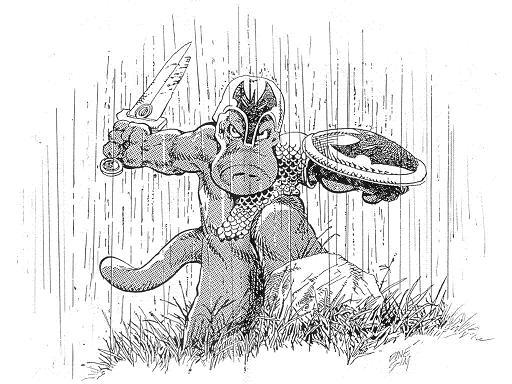
Cerebus

Tim O’Neil continues his exploration of Dave Sim and Cerebus with a summing up of essential facts you need to know about Dave Sim:

Dave Sim does not see the world the same way that you or I do.

This fact is a consequence of the first three. Sim rejects modernity on an almost wholesale basis, an abjuration that extends all the way to having a disinclination for computers (his internet presence often takes the form of transcripts uploaded from his electric typewriter). His religious turn – a turn which was preceded by and followed perhaps as an inevitable consequence of his conservative turn – recasts almost the entirety of modern existence in negative terms. He dislikes Picasso and dislikes Freud and dislikes Marx and (although I can’t remember specifically if it’s come up) probably dislikes Nietzsche as well.

What this means in practice is that he explicitly rejects the language and collective metaphors that we – many of us, at least, of the leftist, liberal or conservative persuasions – use to discuss the contemporary world. Although he has little patience for narrow-minded congregationalists, he has cast his rhetorical lot in with the forces of anti-modernity who insist on using the language of scripture to diagnose the sins of the present. He outright dismisses the language of contemporary (and by “contemporary” in this instance I mean at least the last 250-300 years) philosophy and social theory as meaningless “bafflegab.”

You know who that reminded me off? Philip K. Dick, another autodidact with an idiosyncratic personal religious worldview very much out of step with modern society, whose work is inseparable from these beliefs, especially his later novels. Both reject contemporary America as wrong and false, both make for uncomfortable reading to the point where you are tempted to question their sanity.

Where they differ, if Tim is right in his assumptions, is that whereas Dick has only become more popular since his death in 1982, has been embraced by the literary mainstream as well as remained popular by his original genre audience, Sim’s magnus opus may die unmourned and unloved with him, save for those in academia who will read Cerebus out of intellectual curiosity or as an artifact of a specific period in the evolution of the American comics artform. Certainly the critical and reader attention Cerebus gets right now is considerably less than you’d expect from a comic that was for decades one of the automatic standard bearers of the idea that comics = art, so it’s quite possible Tim is right.
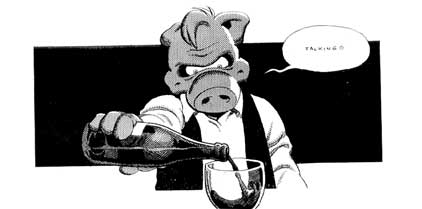
Cerebus

What Tim has not yet looked at is whether or not the idea that few if any people will ever tackle the whole of Cerebus ever again is a bad thing. In other words, how much of Cerebus is worth reading for somebody who isn’t an academic or critic looking for dissertation material. Perhaps only the “good parts” version of Cerebus — High Society, Church and State, maybe Jaka’s Story — deserves to be read. There’s too much focus in comics criticism on complete runs of a given series or creator anyway, as e.g. the recent Hooded Utilitarian comics poll showed, where of the top ten entries, only two were for discrete stories, the rest for full runs of iconic comics. Which is cheating, as even in the best run there are weaker and stronger issues, stories worthy of inclusion on a Top 115 list and stories that aren’t. It’s also lazy, as you don’t have to think or argue for what Fantastic Four story to include…. The whole of Cerebus is not worth reading, but parts of it are excellent.

But there is a larger problem with Cerebus, as commenter moose n squirrel argues:

You reduce Sim’s views to a highly idiosyncratic and eccentric religious conservatism, and just shrug them off, as if he’s a harmless old crank because nobody’s going to slog through “Chasing YHWH” and convert to his one-man version of Gnosticism.

But the core of Sim’s worldview is not mere “religious conservatism” – it’s hatred of women, which is hardly eccentric or idiosyncratic. Indeed, Sim’s ideas about women are all too sadly common – again, I ask you to look at the numbers of women who are subject to domestic and sexual violence in the United States, at the percentage of women who’ve been raped, at the number of women who, once raped, don’t bother reporting that rape because they see such an action as futile. Hatred of women is not some sad curiosity limited to one obscure Canadian cartoonist. And as much as Sim attempts to dress his hatred of women up with a bunch of bullshit religious cosmology, the core of his message is the same vicious misogynistic bullshit women have been getting from assholes like him for the last six thousand years.

Again: if Sim’s target was black people instead of women, if people from Africa were the soul-sucking voids that corrupted pure, rational white men, would it be so easy to dismiss? If he built a vast cosmology explaining how white men of Northern European descent have all been enslaved by Jews, would we be hearing any arguments about how “well, obviously he’s a little crazy, but you’ve really got to appreciate what he did with his lettering”? And if not, what makes the hatred and oppression of women more acceptable than the hatred and oppression of these other groups?

It’s a bit too pat to say that you should separate the art from the artist’s politics. With some you can, but with Dave Sim this is of course impossible as his worldview informs everything he did with Cerebus. I can well understand people who want to stay clear of this, or who do not want to support such views by buying Sim’s books. On the other hand, to take Sim to tasks for all the oppression women have suffered and do suffer in the world is a bit too much. In the end Sim is a harmless old crank, with disgusting views but neither in a position of power to enforce those views nor likely to seduce anybody to his side through his artwork. Enjoying his art while rejecting his politics is much easier to do than it is even with somebody like Jack Chick, whose worldview is of a similar nastiness yet whose comics have been studied and even enjoyed by the very same people his pamphlets condemn to hell.

Rerouting around censorship

Found in Yahoo Answers: a private school starts banning books. One student takes the law in her own hands and starts her own library:

I go to a private school that is rather strict. Recently, the principal and school teacher council released a (very long) list of books we’re not allowed to read. I was absolutely appalled, because a large number of the books were classics and others that are my favorites. One of my personal favorites, The Catcher in the Rye, was on the list, so I decided to bring it to school to see if I would really get in trouble. Well… I did but not too much. Then (surprise!) a boy in my English class asked if he could borrow the book, because he heard it was very good AND it was banned! This happened a lot and my locker got to overflowing with the banned books, so I decided to put the unoccupied locker next to me to a good use. I now have 62 books in that locker, about half of what was on the list. I took care only to bring the books with literary quality.

The story is three years old, but still inspiring to see somebody involved enough not to take censorship laying down. If the school library refuses to stock certain books because they’re anti-Christian, start your own library. Pretty cool.

100 years of Fokker airplanes


Last Wednesday it was exactly 100 years ago that Anthony Fokker flew his first self build aircraft, De Spin or Spider around the St. Bavo church. A modest start, but a few years later Fokker would be the scourge of the Allied fighter pilots in World War I, the first to find out how to synchronise a machinegun with the engine to enable it to shoot through the propellor in the Fokker Eindecker. A slew of other fighter planes followed, including the famous triple decker Fokker Dr. I as used by the Red Baron.

After World War I Fokker would become one of the biggest manufacturers of civil airplanes, leading the way for companies like Boeing or Douglas who’d ultimately take over. The Fokker Trimotor, as used by Richard Byrd to fly over the North Pole, is probably the best known. Fokkers were often used in record attempts, including various races from Europe to Asia. On the military side of things, Fokker had modest successes building aircraft for the Dutch airforce, as well as various other European forces. The DXXI’s equiping the Finnish Airforce in the Winter War against the Soviet Union did the best out of all Fokker fighters, gaining impressive victories over planes both superior in number and capabilities…

Postwar Fokker was specialised in providing intermediate range transport planes and airliners, the turboprop F27 Friendship and jet powered F28 Fellowship, both very succesfull, followed a few decades later by the F50 and F100 respectively. However, too small to survive on its own and unlucky in having been taken over by DASA/Daimler Benz, Fokker declared bankrupcy in 1996. There are still quite a few Fokker planes flying however and plans to start production again and it all started with those three rounds around the church in Haarlem by Anthony Fokker in his Spin one hundred years ago.

That was the mother Fokker.

Somebody pulled the drama tag…

Cheryl Morgan has a rather strange response to the criticism of this year’s Hugo Awards winners

The reaction to this year’s results, however, has been the worst I can remember. Depressingly much of this has come, not just from outraged fans, but also from professionals in the field. And some of those people, accidentally or otherwise, have said things that can be taken to imply they think the process is corrupt.

[…]

I guess this sort of thing is inevitable. The higher profile a set of awards, the more carping there will be. But I’m tired of having to worry about it. In particular I’m tired of worrying that projects I’m involved in, which I care deeply about, will suffer through their association with whatever mud-slinging is affecting me. And I have to face up to the fact that for a large segment of the community I will never be anything more than a fan who won fan Hugos in controversial circumstances.

So I am bowing out.

Honestly, this all seems a bit over the top, especially the idea that the bogstandard complaints of the Hugos being a popularity contest has anything to do with Cheryl Morgan herself; that’s rating yourself far too highly. In fact, the first time I’ve heard Cheryl Morgan mentioned in the context of Hugo controversies is erm, here. It is of course Cheryl’s right to get away from fandom, but to blame unnamed Hugo bashing critics for her own decision is absurd.

Being less than truthful about what those supposed critics said is not helping either. There’s enough drama in fandom without making more up.

Justice League: rebooted as more of the same

Justice League #1 cover

When did Jim Lee get so awful? I mean, I haven’t seen anything drawn by him in a long time, back before he gave up on WildC.A.T.S., but I thought his art was more exciting than that. This is all kinda dull, not outrageously bad, certainly nowhere near Liefeld levels of badness, but it wasn’t good either. Far too bland for a comic that’s supposed to launch a new era of greatness for DC Comics. Jim Lee art should be exciting, but here he just seems to be going through the motions.

The plot certainly is. There’s nothing new here, with the second panel telling us that this story takes place five years earlier and instead of seeing the full Justice League promised in the cover, we get GrimDark Batman being chased by Gotham’s finest meeting Cocky Green Lantern for the first time as some Darkseid minion attacks both of them, a subplot involving pre-Cyborg Vic Stone and how his daddy doesn’t love him, before we head to Metropolis and a last page reveal of Superman in his new godawful costume punching out poor old G. L. and asking Batman what he can do.

In other words, it’s a bleeding origin story. And only half of one at that as it still leaves three of the seven Justice League members promised unused. There’s literally nothing in this that’s new or original in this comic. This is not your dad’s Justice League, but this plot would be tired and hackneyed to your grandfather. A world not used to superheroes viewing them with fear and suspicion? A Big Bad Villain in the background possibly doing his best to stoke this fear? Various heroes meeting each other for the first time and not liking each other very much but reluctantly forced to work together?

How is any of this new?