Scalzi is being wrong on the internet

In which I overanalyse some throwaway remarks made by John Scalzi on his blog:

There’s always post-Hugo kvetching, for the same reason there’s pre-Hugo kvetching, which is, people like to kvetch, and/or they have a hard time internalizing that their own tastes are not in fact an objective standard of quality. I do think there’s a core of commenters whose problem internalizing that other people have other tastes is overlaid with a more-than-mild contempt for fandom, i.e., “Oh, fandom. You’ve shown again why you can’t be trusted to pick awards, you smelly, chunky people of common tastes, you.” Fandom does what fandom does with folks like that: it ignores them, which I think is generally the correct response to such wholly unwarranted condescension.

Apart from the slight defensiveness, which Damien Walter also noted, the mistake made here is to believe the Hugo Award voters equalise fandom. Once upon a time this was true, but that time is at least four decades ago. Even within print sf, there no longer is fandom, there are fandoms. The Hugo Awards and the Worldcon are the legacy of the arguably oldest still existing strand of fandom, but cannot be said to represent fandom as a whole. Hence the criticism aimed at the Hugos in general and this years abysmal winner(s) in particular is not that of outsiders condemning fandom, but an argument within fandom itself.

And the real problem with the Hugos is not that the voters have inferior tastes, or even so much that they keep rewarding the wrong books or people, but that they’re still seen as representative for the tastes of the whole of fandom, rather than a smallish subset of fandom. You could see that very well with this year’s Hugos, where the tastes of “online fandom” (or a sizeable subset of it anyway) differed so much from what the Hugo voters in the end awarded. Not just with the Best Novel Hugo, but also with the Best Fan award — which would’ve probably gone to James Nicoll if online fandom had had its say.

But no other subset of fandom has such a prestige outside of fandom as the Hugo voters do, as the Hugo Award is one of the two science fiction/fantasy awards well know to sf&f readers and other “civilians”. If the general taste of the Hugo voters is mediocre it reflects on science fiction and fantasy fandom as a whole, in a way e.g. the Clarke Awards do not. And since it’s only a small and distinct group of people voting on the Hugos, chances are they’ll get it wrong…

Howard Jacobson’s pathological need to be persecuted

There’s a disease that strikes English novelists of a certain age and fame, that makes them think whatever small talent they have at creating Times reviewed stories means they have an unique insight into human nature and the political realities of 21st century Britain. This usually manifest in rightwing babble about the problems of the day, as exclusively revealed to whichever newspaper with spare column inches to fill, as well as through novels that suddenly tackle big political issues in the way literary writers normally reserve for dabbling in science fiction: naively and ploddingly reinventing cliches better writers had long since abandoned and being proud of it. Martin Amis and Ian McEwan are the best examples of this disease, but Howard Jacobson seems determined to join them.

Jacobson is “best known for writing comic novels that often revolve around the dilemmas of British Jewish characters” as Wikipedia puts it. Not one to hide his Jewishness under a bushell and keen to let you know how his background makes him uniquely able to provide insights into the Israel/Palestinian conflict, he has been making a nuisance of himself for years in opinion pieces. As with Amis and McEwan, his politics also infected his fiction, metastasising in The Finkler Question, made unreadable by his politics.

So it comes as no surprise that when he saw the images of Asian shopkeepers defending their communities against the riots in London two weeks ago he saw something quite different from the rest of us:

The good thing that came out of the riots was a renewed sense of community. “How does one put this without sounding gross … it was terrific to see the Asian communities on telly and not to have to think about terrorism, and not to have to think about the thing I’m always thinking about… do they want to kill Jews?”

A remark on par with Amis’ similar ones on wanting to make Muslims suffer for 9/11. But there seems to be more going on with Jacobson, he seems convinced that pogroms could break out in London any minute and that like any good Jew he needs to be prepared. It’s not a mindset that’s not unique to him; I’ve stopped being surprised at the number of middleclass Jewish people living in England or America, never having suffered any discrimination in their lifetimes, convinced that it’s only a matter of time before the killings start again. If the most important event in your history is the Holocaust, it’s not surprising some people get a bit paranoid.

With Jacobson however it almost seems as if he would welcome persecution, that he feels agrieved that there are no pogroms in England and the number of real anti-semitic incidents (as opposed to people being accused of anti-semitism because they disagree with Israeli policies) is low and has remained low for decades. Hence remarks like the above, as to him it’s inconcievable that Asian people would not want to oppress him. Call it victim envy.

Real names and other dangers

On the subject of Google’s childish insistence on “real names” for its new Google+ service, jwz is scathing, but it’s this comment that gets it right on what mature online communities need to remain civil:

In 20+ years of online communication (much of it with people I either have never met, or only later met) I’d have to say the only reliable predictor of civil discussion is stability of identity, which allows reputation to work. You want people to use the same identity by which they are regularly known, so you can recognise it’s the same person again. As you note this worked just fine for most of USENET’s existence, through most of LJ’s existence, and across a wide range of BBSes prior to that. It even works across a diverse, but loosely related by theme, set of blogs, and their comments, providing there’s a general understanding that people will continue to use the same identity on all of them.

It’s not the only thing you need for a decent online community — you also need a good system to block the numpties, either through active but fair moderation or on the user side ala Usenet’s kill lists — but what you really don’t need and what’s in fact counterproductive is to insist on “real names”. Insisting on that is just another unnecessary hoop for people to jump through to start participating and only an idiot won’t realise that for very many people for very good reasons this is one hoop too far.

But of course Google and Facebook and all the other socalled social media sites are not interested in creating a proper online community, but rather an exploitable resource to sell to advertisers, for which purpose “real names” are much more valuable….

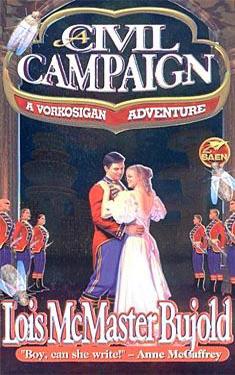
A Civil Campaign – Lois Mc Master Bujold

Cover of A Civil Campaign


A Civil Campaign
Lois McMaster Bujold
534 pages
published in 1999

A Civil Campaign should have been the last novel in the Vorkosigan series. Starting with Brothers in Arms and continuing through Mirror Dance, Memory and Komarr Lois McMaster Bujold had constantly upped the ante for Miles, not just by giving him bigger challenges to overcome, but by forcing him to grow up and become mature, putting him in situations where his character strengths are useless or even counterproductive. A Civil Campaign is the culmination of that process, as Miles crashes hard against the realisation that his usual crisis management tactics are not suitable for trying to win the hand of the woman he fell in love with the first time he saw her. At the same time Bujold also ties up all the loose ends from the earlier novels, providing a proper ending for the series. It’s not a book for people new to the series.

In the previous book, Komarr, Miles had met Ekaterin, a duty bound Vor woman trapped in a loveless marriage, and fallen hard for her from the first moment. With Ekaterin now a widow, Miles sets out to court her, but with the best of intentions decides to do so without her knowning or telling her that this is what he’s doing. Surely the same tactics of deception that worked so well in his career as a galactic man of mystery will be good enough to win him a wife? Of course there’s also the small matter of the imperial wedding to prepare for, the return of his clone brother Mark with his Escobarian business partner and their somewhat too biological startup they’ve set up in Vorkosigan House, the blossoming relationship of Mark with Kareen, the daughter of one of Miles’ father’s — count Vorkosigan — oldest friends and various other minor complications and side issues Miless will have to deal with, but how hard can it all be?

Read more…

Trading in Danger — Elizabeth Moon

cover of Trading in Danger


Trading in Danger
Elizabeth Moon
506 pages
published in 2003

Reading Sheepfarmer’s Daughter gave me a taste for more Elizabeth Moon. Trading in Danger, the first book in the Vatta’s War series was what the local library had available. It’s science fiction rather than fantasy, but it’ll do. It’s still the same sort of adventure story even if the genre has changed. The other thing they have in common is familiarity, both are coming of age stories with few surprises, but sometimes familiarity is just what you want in a story.

Ky Vatta is a cadet at the naval Academy, an unusual career choice for a child of one of the great trading families. She’s an examplary cadet, but this doesn’t save her when an impulse to help a fellow cadet lands her in the shit. Expelled from the academy, she now has to face her family. Worse, because it’s a highly politicised mess she found herself in, she also has to leave Slotter Key, her home planet. Worst of all, the reputation she has in her family as a sucker for anybody with a sob story is once again confirmed, in the worst possible way. The solution to all her problems lies in an old Vatta family tradition, that sends any child wanting to join the family trade on a shakedown cruise first. She will captain the Glennys Jones, an old trading ship on its last voyage which will be sold as salvage at the end of it, as it’s too expensive to bring up to modern standards. This trading trip will take a couple of months and at the end of it Ky will be able to come home, having proven herself as a captain. As importantly, it will also get her away from her own humiliation.

Read more…