Trading in Danger — Elizabeth Moon

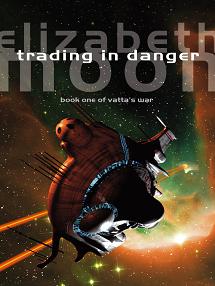
cover of Trading in Danger


Trading in Danger
Elizabeth Moon
506 pages
published in 2003

Reading Sheepfarmer’s Daughter gave me a taste for more Elizabeth Moon. Trading in Danger, the first book in the Vatta’s War series was what the local library had available. It’s science fiction rather than fantasy, but it’ll do. It’s still the same sort of adventure story even if the genre has changed. The other thing they have in common is familiarity, both are coming of age stories with few surprises, but sometimes familiarity is just what you want in a story.

Ky Vatta is a cadet at the naval Academy, an unusual career choice for a child of one of the great trading families. She’s an examplary cadet, but this doesn’t save her when an impulse to help a fellow cadet lands her in the shit. Expelled from the academy, she now has to face her family. Worse, because it’s a highly politicised mess she found herself in, she also has to leave Slotter Key, her home planet. Worst of all, the reputation she has in her family as a sucker for anybody with a sob story is once again confirmed, in the worst possible way. The solution to all her problems lies in an old Vatta family tradition, that sends any child wanting to join the family trade on a shakedown cruise first. She will captain the Glennys Jones, an old trading ship on its last voyage which will be sold as salvage at the end of it, as it’s too expensive to bring up to modern standards. This trading trip will take a couple of months and at the end of it Ky will be able to come home, having proven herself as a captain. As importantly, it will also get her away from her own humiliation.

Read more…

Striptember in Amsterdam

Striptember

The current Dutch government may have decided to slash all cultural funding, yet this so far hasn’t stopped the official art world from increasingly embracing comics as an artform worth subsidising and promoting. This is not necessarily a new development — the Joost Swarte spearheaded Haarlem Stripdagen has always had the support of the city council and corporate sponsors — but it has been increasingly prominent in the past few years. Which is a good thing, especially when it leads to initiatives like Striptember, a month long celebration of comics organised in Amsterdam. From the description on IAmsterdam (sic), the official Amsterdam tourist site:

Amsterdam dedicates the entire month of September to the art of cartoons and comic strips. Taking place in various locations across town and encompassing a large variety of exhibitions and events, Striptember is a perfect month for lovers of cartoon art.

And there’s good reason for highlighting the genre in Amsterdam. The city has long been associated with the best of comic illustrators and artists and the art form has a diverse and rich history here – stressed by the fact that Amsterdam boasts the oldest cartoon shop/gallery in the world: Lambiek, open since 1968.

Iconic international comic illustrators such as Peter Pontiac, Peter Kuper (USA), Edmond Baudoin (France) and Daniel Bueno (Brazil) take part in this year’s edition of the festival. Expect the best in comic art strips, fanzines and associated paraphernalia!

(There’s more information at the official Striptember site, but it’s written in not very good English.)

Having an annual, month long festival is a very ambitious project and it’ll be interesting to see how well this works. The events lined up are impressive and the organisors have managed to rope in quite a few institutions you’d not normally see involved in a comics festival. There is e.g. the Maison Descartes (the French cultural embassy comparable to the British Council) holding an Edmond Baudoin exhibition, as well as exhibitions in city hall itself.

A great initiative and I hope it will be succesful.

Can’t see this happen for any Dutch politician

messages of tribute to Jack Layton

The tribute Jack Layton got, with hundreds of people chalking down enough messages of support and remembrance to cover a whole square, is not something that I’ll ever suspect to see for a Dutch politician. There are no Jack Laytons in Holland, nobody on the left with the charisma and honesty to inspire such outbursts of solidarity. The closest who had was Jan Marijnissen, but he retired from active politics a few years ago. Instead we mostly seem to generate third rate Blair clones, media trained non-entities with no soul and no ideology fully bought into capitalist realism.

What I did last year today

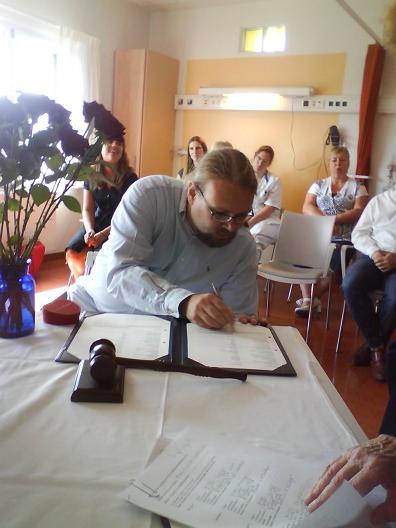
Martin signs the wedding certificate

Getting married. Last year we promised ourselves that we’d have the one year anniversary as our “real” wedding party because surely by then S. would’ve been out of hospital for ages and things would’ve returned to normal. Which didn’t turn out quite to be what happened, but she’s home again and we are having a small celebration tonight… Hopefully things will get better from here on.

The one thing more predictable than dreadful Hugo Award winners…

…is the griping afterwards. Yes, I know, I know, I do it too. Nothing more fun for an old fashioned science fiction fan than having an old fashioned grumble, especially if you’re a British fan and can cast aspersions at the abysmal taste of the yanks. It doesn’t solve anything of course, but it gets rid of some frustration.

In defence of the Hugos is the idea that, if you want to change them, you can, if you’re prepared to pay to play. To vote for the Hugos you need to be at least a supporting member of this year’s Worldcon, which is a fifty dollar or so outlay, a small price to pay for people so upset by the bland mediocrity of the main Hugo awards, isn’t it?

A bit unfair perhaps and I’m not found of the idea that you can’t criticise anything if you’re not prepared to help make things better — else I would’ve been obligated to help make the War on Iraq better too. But I can’t help but think that some of the complaints are more sour grapes than constructive criticism.

What we need to keep in mind and I’ll keep repeating until everybody is sick of it, is that the sort of fans who do faithfully vote for the Hugos are a distinct subset of fandom, less likely to be involved online, more interested in old skool fanac like conventions and zines than blogging or twittering. They have their own standards and tastes and they don’t necessarily overlap with the tastes of bloggers. Had that been the case, Connie Willis would not have won the Best Novel Hugo again and James Nicoll had won the best fan writer award.

The tragedy of the Hugos is that once upon a time the type of fandom that it represents was all of fandom, therefore the kind of people voting for the Hugos was the same as the kind of people who read science fiction, their tastes fairly well representative of fandom as a whole. But fandom got bigger while the Hugos stagnated, which in my opinion started to happen from the mid-eighties. The end result three decades later is an award that still got its prestige, but lost its relevance.

Don’t worry too much about it therefore, unless you like to restore it to its former glory. In which case buy that membership and start campaigning.