Just heard S. won’t be out of hospital tomorrow, as they want to keep her a few days longer to make sure she’s allright, which is … a bit annoying … It put me in the mood for a bit of schlock metal to get rid of some of my frustration — what better than Manowar’s Battle Hymn? The video shows all past and present members of the band rehearsing for their German tour back in 2007 iirc. Naff as fuck, but I’ve always liked this song, first hearing it at the same time as I discovered David Gemmel’s equally shock fantasy novels, especially Legend and Waylander, which it fit perfectly with.
2018: updated with a different live video because some fucker had to get the original video removed from Youtube.
As I see it, the skills of an historian, when confronted by a complex phenomenon like this, ought (and this is neither original nor controversial) to include at least the following:
The evasion of a simple catch-all explanation, of whichever ‘political’ narrative, particularly a doctrinaire explanation
The avoidance of reliance on untestable notions like ‘innate human nature’
The avoidance of sweeping generalisation
The ability to disentangle different elements within the phenomenon; to tease out geographical and other variables
An aversion to reducing a complex phenomenon to simple cause and effect
If only the various talking heads on the BBC radio and television pontificating on the riots this past week had been using those rules. For example, the fools who I heard on Broadcasting House yesterday morning, who dismissed the idea that the riots could’ve been political in nature because some of the rioters didn’t even know which party was in government — as if politics end outside of the Westminster bubble. There seems to be a deliberate refusal to engage the questions of how and why the riots started, why they persisted so long and why they spread on a more than superficial level, at least in the mainstream media and especially at the BBC. If reporting is the first draft of history, this particular one will be unreadable.
Barbarian Migrations and the Roman West 376-568
Guy Halsall
591 pages including index
published in 2007
I spent the week between Christmas and New Year’s Eve with my parents in Middelburg and took advantage of this visit to check out the town’s library, which used to supply most of my reading back before I moved to Amsterdam. It turned out to be an wise decision as less than an hour browsing found half a dozen excellent history books to read, including this one. Guy Halsall is an author I had just seen slagged off by Peter Heather in his book Empires and Barbarians for being Completely Wrong about the impact of barbarian migrations on the late Roman Empire. This piqued my interest to see how exactly Halsall’s interpretation of the end of the Roman Empire differed from Heather’s views and if Halsall’s explanations make any sense on their own.
To my not inconsiderable surprise, it turned out that the story Halsall puts forward in Barbarian Migrations and the Roman West 376-568 does not differ quite so much as Heather made it seem. They don’t so much disagree on what happened as on why it happened and on where the emphasis should be placed. To keep it simple, Heather believes barbarian invasions are the cause the collapse of the Roman Empire in the west, while Halsall argues they are an effect of the collapse. It was the weakness of the western empire that made possible the barbarian takeover of various provinces. Another major point of disagreement is on the composition of the “barbarian hordes”: Heather has argued that the more classical image of entire population groups invading the empire is largely correct, with caveats, while Halsall sees them more as proper armies rather than tribes. Ultimately these differences in intepretation however for me were less important than the sheer quality of Halsall’s history.
Good news for everybody who was hoping for a nice, easy, racist explenation for the riots in Britain, “historian” David Starkey has come to your aid. Yes, the rioters were multiracial, Black, white and Muslim, while the victims and defenders of various communities in turn were also multiracial, Black, white, Sikh, Turkish and so on and it seemed that all the simplistic ideas about how those minorities just cannot help their criminal natures were clearly wrong, but Starkey knew the truth. It was the white man that had gone Black, had abandoned its superior nature, that it had been infected by the “gangster culture”, probably through that newfangled hippity-hop music. This is not racist of course, it’s just common sense. And hence Starkey is listened to politely, not interrupted and taken seriously as a commentator even if the other guests disagree with him.
Compare and contrast the treatment of Darcus Howe, who is clearly a dangerous loony who has to be chided and can’t be trusted to be sensible. Howe needs to be handled aggressively, he’s almost a rioter himself and his waffle about root causes to explain the riots need to be attacked immediately as excuse mongering.
As with every unexpected, natural crisis when the news media are caught unawares, the raw edges of approved reality become a bit more visible. On the one hand, the manipulation of news and acceptable opinion becomes more blatant — one very obvious example being the whitewashing of the spontaneous cleanup operations in the days after the first riots, as noted and ripped apart by W. Kasper. On the other hand, even more blatant is how unacceptable opinions like Howe’s are handled, attacked, shouted down. This by and large is not a conscious process, but something journalists and the news media pick up by osmosis. It’s no surprise that it’s the BBC, supposedly independent but in practise always hypersensitive to how the political winds are blowing, that is the most hardline in this. We saw the same thing with the War on Iraq, where it was the commercial news channels that were more skeptical than the BBC, other than you’d expect at first.
Starkey might just well be trying to move the acceptable discourse to the right, to make his racist ideas respectable as Lenny argues, but the BBC is more culpable by giving him a platform and treating him with respect, making his ideas more respectable by that. Howe’s views on the other hand, the idea that some of the responsibility for the riots may just have to lie with the police for their treatment of (young) Black people in general and the murder of Mark Duggan in particular, are still beyond the pale, as shown by how he is treated. In short, the BBC is actively shifting the borders of acceptable, mainstream opinion rightwards.
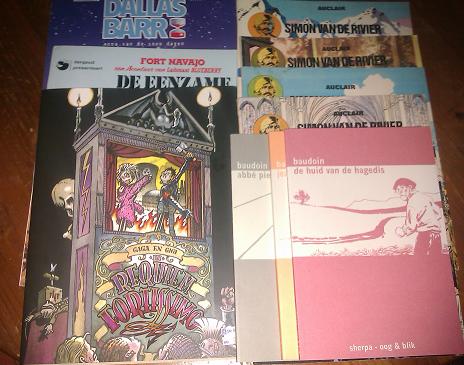
Apart from books, I also bought a bunch of comics yesterday, so me show you them. What you see above is:
Dallas Bar 5 — Marvano and Joe Haldeman: comics series loosely based on Haldeman’s The Long Habit of Living done by the same Belgian cartoonist who also adapted The Forever War.
A Jean Giraud/Jean Michael Charlier Blueberry album I still needed.
The first four albums in the Simon du Fleuve (“Simon of the River”) series by Auclair. Seventies hippy post-apocalypse sci-fi, these is the sort of series I buy as much out of (pseudo) nostalgia as for its intrisic qualities. These are not the comics I grew up with, but they are like the comics I did grew up with.
Three Baudoin comics, published by Oog & Blik/Sherpa a few years ago and now in the sales at De Slegte, Holland’s largest remainders/second hand bookstore chain. De Slegte Amsterdam actually has quite a few Oog & Blik comics available, including books by Mattotti, Loustal and Dupuy/Berbarian, all for four to eight euros. Cheap as chips.
The piece de resistance, Peter Pontiac’s first long form work, Requiem Fortissimo, a punk rock apocalypse, pure eighties underground comix.