Guy Halsall has a blog

Bully for him, you might think, and just who is Guy Halsall anyway? Well, he’s an historian specialising in the period I’m most interested in myself at the moment, Late Antiquity/Early Middle Ages, who I first heard of being slagged off gently corrected by Peter Heather in his latest 1,000 page history, Empires and Barbarians for getting the impact of barbarian invasions on the Roman Empire All Wrong. So I had to read this fellow Halsall’s work for himself and found Barbarian Migrations and the Roman West 376-568 one of the better one volume explorations of how the Western Roman Empire came to an end, his differences with Heather being one of degree rather than kind, as far as I could make out. In our always on, 24/7 wireless mobile internet connected world it should not come as a surprise a professional historian like Guy Halsall has a blog, but I still can’t take this for granted, especially not when it leads to posts like this, where Halsall examines why we are so wedded to barbarian invasions as explenation for the “Fall of Rome”:

The barbarian is the classic ‘subject presumed to’. The barbarian can change the world; he can bring down empires; he can create kingdoms. The barbarian dominates history. ‘He’ is not like ‘us’, enmeshed in our laws, our little lives and petty responsibilities. The barbarians in the vision of Peter Heather, are peoples with ‘coherent aims’, which they set out single-mindedly to achieve. No people in the whole of recorded human history have ever had single coherent sets of aims. Well – none other than the barbarians anyway.

And finding Halsall’s blog (through a post from Nicola Griffith I should add) led inevitably to discovering a whole slew of likeminded blogs, now listed under “Science” in my blogroll. There are days when the internet looks small and dreary and all your usual blog friends are silent, not saying anything of interest. And then there are days when you cut around a corner and find whole vistas opening up. This is one of those days. It’s not any day I find four new brilliant blogs: Guy Halsall’s, Blogenspiel, Medieval History Geek and last but certainly not least, A Corner of Tenth Century History, where posts like this one make me very jealous and slightly in awe — why can’t I write like this?
Lee and Kirby didn’t know it was the sixties

Tom Spurgeon worries at one of his artistic preferences:

for all that the Fantastic Four comics worked in the 1960s, I’m somehow not a big fan of placing the characters in the 1960s. That’s a nice picture and everything, I just don’t get a thrill out of seeing those characters “in their time” the way someone could surmise I might from my affection for the original Lee-Kirby run. What can I say? I’m complicated.

Actually, this makes perfect sense. There’s a huge difference between Lee and Kirby working on Fantastic Fourback in the sixties and somebody coming along forty-fifty years later and doing a pastiche or homage, drawing explicitily on our shared cultural conception of “the sixties”, like Alex Ross did with Marvels. In the latter case the pastichist is working in an aesthetic formula that has been retroactively defined as “sixties” and tries to adhere to this as best they can, working with a limited amount of both visual and storytelling cliches, at all times conscious of the desired impact on their readers. You can see that in the end product too: you get either the Leave it to Beaver/JFK Camelot, the Hippies and Summer of Love or the Vietnam/race riots/RFK version of the sixties.

Lee and Kirby had their own constraints of course, both unconscious and conscious ones (the comics code not being the least of them) but they lacked that creative straightjacket their modern day emulators willingly subject themselves to. They could evolve, while of necessity somebody like Alex Ross or Darwyn Cooke trying to place the Fantastic Four or the Silver Age DC characters in their own time has to remain static, consistent, recognisable.

For the reader, it’s the thrill of the familiar rather than the thrill of the new. Hence always disappointing and empty.

Those who forget their past are doomed to bullshit endlessly about it

Stormie Normie Geras is one of the last of the Decent Left deadenders, still a true believer in The War Against Terror. It’s a given that when presented with an article in The Guardian calling for spending cuts in the ministry of defence he’ll won’t be totally honest in his refutation, shall we say? Misrepresenting and misreading it in the worst possible way is all very much to be expected here, but what struck me was how good Normie is at not remembering recent history when it’s inconvenient to his arguments:

Do not do anything like invading Afghanistan again. Or, as he puts it, ‘Are we, pliant planters of the Nato flag anywhere in the world the Pentagon prescribes, going to get involved in another Iraq – or, worse, another Afghanistan? Of course not, says bitter experience.’ So, were Britain ever to be on the receiving end of a 9/11-type of attack, prepared from a country hosting an organization dedicated to carrying out such attacks against it, and resulting in the deaths of thousands of people in London, Birmingham, Manchester, Edinburgh or some other British city, the government of the day should just ‘pass’ on the idea of a military response.

What actually happened was that the UK invaded Afghanistan and Iraq and then the “9/11-type of attack” took place, with the people responsible explicitely stating that it was these invasions that motivated them. Something war supporters like him having been trying to wish away ever since, but the truth remains that invading “a country hosting an organization dedicated to carrying out such attacks” did not make Britain safer but instead made it a target for people who before these invasions had no reason to attack Britain. Note also that the UK never found it necessary to invade the Irish Republic to end IRA terrorism or attack the main source of its funding, a certain terrorist loving country called America…

three five things make a linkpost

This was made just for me:

The Digital Atlas of Roman and Medieval Civilization (DARMC) makes freely available on the internet the best available materials for a Geographic Information Systems (GIS) approach to mapping and spatial analysis of the Roman and medieval worlds. DARMC allows innovative spatial and temporal analyses of all aspects of the civilizations of western Eurasia in the first 1500 years of our era, as well as the generation of original maps illustrating differing aspects of ancient and medieval civilization. A work in progress with no claim to definitiveness, it has been built in less than three years by a dedicated team of Harvard undergraduates, graduate students, research scholars and one professor, with some valuable contributions from younger and more senior scholars at other institutions. For more details on who we are, please see the People page.

DARMC’s coverage begins under the Roman empire and extends nearly a thousand years toward the present by encompassing the medieval world. Although the initial post-Roman focus has been on medieval Europe, Byzantium and the Crusades have not been neglected, and we have begun to include the essential third leg of the tripod of medieval civilization, the Islamic world.

““If you’re going to do a piece of work in three days, you have to have everything properly prepared.” Michael Moorcock on how to write a novel in three days. Patrick Nielsen Hayden comments that a lot of aspiring writers could learn from this, to just get going and write rather than fiddle until everything’s perfect.

Way to make me feel old Amanda — Nirvana’s Nevermind twenty years old this year. This wasn’t the life changing record to me that it was for other people, but if there’s any album that marks the spot where the nineties begun and the eighties ended, this was it.

The Justice League goes to Hogwarts and a duller idea I cannot imagine. If this ever happened it would be the perfect spiritual heir to those stupid X-Men/Star Trek crossovers Marvel put out in the nineties.

Speaking of rather pointless Marvel titles, the latest installment of Nobody’s Favorites is another one. I actually have this series, bought out of back issue bins on the “this looks interesting and different and is only fifty cents” theory. Never read it.

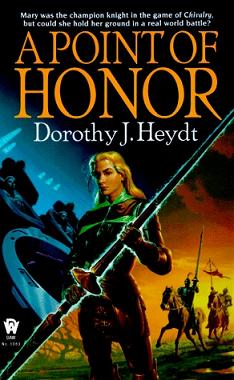
A Point of Honor — Dorothy J. Heydt

Cover of A Point of Honor


A Point of Honor
Dorothy J. Heydt
302 pages
published in 1998

A Point of Honor is the seventh book I’ve read in my Year of Reading Women challenge and the first I’ve read before. When I was setting up my reading list last year I wanted to include not just feminist sf classics or books to challenge myself, but also some old favourites that deserve a wider audience, of which this is one. I had read A Point of Honor when it was published back in 1998, after it had gotten some buzz on the old rec.arts.sf.written Usenet group, back in the day when that was still the number one science fiction hangout on the internet. The author herself was one of the group’s regulars, well respected and liked, one reason why I tried out her novel. This wasn’t the first nor the last time I did that: other writers I got to know through rec.arts.sf.written were Jo Walton, Brenda Clough and Matt Ruff, to name just three.

A Point of Honor is one of only two novels Dorothy Heydt wrote, the other being The Interior Life, a fantasy novel she wrote under the pseudonym of Katherine Blake. Apart from that she has only written short stories, some two dozen in total, the last ones a couple of years ago. None of her work is currently in print that I know off. A pity, but unfortunately an all too common fate for science fiction writers as their books for one reason or another fail to reach an audience. Which is another reason why I wanted to talk about this book, to bring some attention to an unfairly overlooked writer and do for A Point of Honor what Jo Walton did last year for The Interior Life.

read more…