Enginering the doubledip

Standard and Poor’s is a self-interested corporate entity and it is acting in accordance with what it perceives its self-interest to be, in precisely the way that self-interested corporate entities will consistently do. To ask whether a privately owned corporate entity is passing the correct judgment on our political process is to obscure that underlying, anti-democratic fact. They have the power to do so because they’ve been given it: a “Nationally Recognized Statistical Rating Organization” must be “nationally recognized” for its ratings to have the force that it has, and the way the system of financial regulation is constituted is what defines that force. If you’re so inclined, you could even argue that this is all a good thing. God speed to you. As for me, to the secular theology of a “just market,” I am somewhere between a practical agnostic and an angry atheist. The finance market is certainly real and powerful, but the only important question is whether we think the self interest of these kinds of entities is the same as that of the American people, how we will regulate their ability to make decisions, and whether we will continue to cede them the power that they presently have and are using to impose their will on the US’s political economy.

Zunguzungu’s excellent link heavy post on Standard & Poor’s downgrade of US debt is must reading. If you can only read any post about this sorry spectacle, that’s the one to read. All that’s left for me to do is to snipe around the edges.

The paragraph above is the key to understanding not just why S&P downgraded US debt, but the whole second phase of the bankers’ crisis. The 2007/08 financial crisis was a mistake, a bubble that burst, which required governments all over the world to step in and try to save the financial markets from their own greed. This left them vulnerable through having had to take on massive new debts to keep their economies from melting down altogether. It took a few years for the fsckers who had been culpable for that first crisis (S&P not the least amongst them) to get their courage back, but once they did, they saw their chances to use this vulnerability as leverage, to force governments to follow neoliberal orthodoxy, to leave the financial markets alone and of course to make money from betting on e.g. the Greek economy to go down the drain. That’s what’s going on right now, a deliberately enginered crisis so “the market” can get what it wants.

Having Standard and Poor’s, a commercial organisation, as a “Nationally Recognized Statistical Rating Organization”, with the blessing and approval of the American state, make decisions on which debts, especially government debts, are trustworthy sounds absurd on the face of it, but it’s an essential part of the neoliberal structure build up in the past three-four decades. Such an important part of the financial infrastructure cannot be trusted to be under political control with people that might actually care that pronouncements on the risk debt might have on minor things like say, unemployment. That independence enables it to try and pull the trigger on any US attempt to fix the crisis in ways that “the market” didn’t appreciate.
For Reinder

Reinder Dijkhuis has for most of the year been blogging about Kate Bush covers and posting videos. Here are two he missed.


That was Pamela Stephenson from an early Not the Nine O’Clock News episode. She did a lot of these parodies and was usually brilliant at them.


And that was the real Kate Bush, in duet with Rowan Atkinson for Comic Relief.

Incidently, this year is Reinder’s twentieth anniversary of his webcomic, The Rogues of Clywd Rhan, which makes it one of the oldest existing webcomic still being published and certainly the oldest Dutch one. It was also the first, after Dr Fun, that I followed regularly.

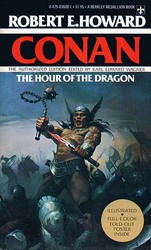
The Hour of the Dragon – Robert E. Howard

The Hour of the Dragon


The Hour of the Dragon
Robert E. Howard
292 pages
published in 1936/1977

When I think of Conan I see John Buscema’s Conan: feet planted firmly on the ground, glaring at you from under his helmet, the weight of his muscular frame apparant in every picture. That’s the image I had in mind while reading The Hour of the Dragon, Robert E. Howard’s sole original Conan novel. Written in 1935 as an attempt to interest a British publisher, it was instead serialised in Weird Tales when the publisher went out of business. Recycling scenes and plot twists from earlier stories, it’s somewhat of a greatest hits story: Conan has to fight an overwhelming horde of enemies, is captured and has to escape a dungeon through his great strength, wrestle a supernatural creature and so. Buscema’s Conan naturally came to mind therefore: no other version has the sullen determination and toughness Buscema put in his Conan.

The Hour of the Dragon is set at the end of Conan’s career, after he has become king of Aquilonia. He doesn’t remain king long though as a conspiracy between neigbouring country Nemedia and Valerius, the last remaining heir of the old royalty of Aquilonia use magic to invade the country and depose him. They do this by raising an ancient evil, Xaltotun, an ancient sorcerer from the pre-Hyborian empire of Acheron. As the Nemedian army invades Aquilonia, Xaltotun nearly kills Conan and demoralises and destroys his army. Conan comes to as prisoner of Xaltotun who has … plans … for him. Valerius meanwhile has become nothing more but a pawn for the evil sorceror.

Read more…

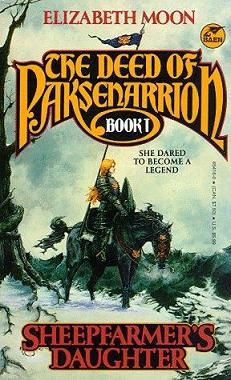
Sheepfarmer’s Daughter — Elizabeth Moon

Sheepfarmer's Daughter


Sheepfarmer’s Daughter
Elizabeth Moon
506 pages
published in 1988

Sheepfarmer’s Daughter was Elizabeth Moon’s first published novel and is now available from the Baen Free Library as a sample to get you to try her other work. I got it to have something to read in those stolen moments where it’s too much hassle to dig a paperback out of my bag, but I can get to my mobile. Sheepfarmer’s Daughter was the ideal book for this: not overtly complicated, easy to read in small chunks without missing much of the plot and engaging enough to keep reading.

I’ve only read one Elizabeth Moon novel before this one, A Sporting Chance, a science fiction adventure story that was decent enough but nothing special. From all I had read about her other novels, they seemed much the same so until now I’d never really sought out her books. But it’s hard to argue with free books and people I trust had been praising Sheepfarmer’s Daughter, so when I needed something new to read the choice was easy.

Sheepfarmer’s Daughter is the first in a trilogy called The Deed of Paksenarrion, which Elizabeth Moon allegedly wrote after she was introduced to Dungeons and Dragons by friends of her and got annoyed by the way it handled paladins, to show what real paladins were like. A paladin is “a holy knight and paragon of virtue and goodness”, as Wikipedia calls it and in D&D it’s one of the character classes you can play. What exactly Moon disagreed with I’m unclear about, but there certainly is some D&D influence visible in the fantasy world she created. The other influence on the series was Moon’s own background as an US Marine, giving her a somewhat more realistic idea of warfare than many other fantasy writers have.

Read more…