Books read July

I suppose the thing I find most tedious about Internet people is that a lot of them make a careful count of all the books they read in a year.

Nick can’t be talking about me, because I count how many books I read in a month. Ten this time. More than I thought I would manage this month, but there’s a lot of fluff on this list.

The Early Middle Ages — Rosamond McKitterick (editor)
This is intended as an introduction to and broad overview of (West) European history from 400 CE to 1000 CE, in which it succeeded reasonably well. Having some prior knowledge of this period helps though, especially if you got some grasp on the rough chronology.

The Sacred Art of Stealing — Christopher Brookmyre
Brookmyre’s slightly anarchistic thrillers are pure comfort reading.

An Imperial Possession — David Mattingly
A postcolonial history of Britain under Roman rule. What did the Romans ever do for us? Exploit our natural wealth, make our warriors into slaves and force us to grow cash crops for absentee landlords is the answer. This review at Blood & Treasure is why I bought this.

King of the Rainy Country — Nicolas Freeling
Another inspector van der Valk murder mystery, taking him far from his hometown of Amsterdam all across Europe.

Zoo City — Lauren Beukes
In Beukes’ near future/alternate South Africa (not quite clear which is the case) being a murderer can quite literally land you with a monkey on your back, or in Zinzi December’s case, a sloth. It makes her one of the new underclass, the Animalled, having to make a living exploiting the small magical talent to find anything she got along with her totem. Then she’s asked to find a lost person rather than a lost property.

Whoops! — John Lanchester
Readable if slightly out of date overview of why we were dropped in the shit when the financial crisis hit in 2007. Lanchester is the same guy who has written on this subject for the London Review of Books.

The Good, the Bad, and the Uncanny — Simon R. Green
Green is a cheerful hack writer (and probably the last to deny this) and this is a volume in his urban fantasy series. The whole experience is like reading a mediocre superhero title (Alpha Flight say) long after the talent left. Still enjoyable though.

A Point of Honor — Dorothy J. Heydt
Mary Craven is a world renowned player in the VR game of Chivalry, whose alter ego Sir Mary de Courcy is that game’s current champion of the Winchester Lists. And now she has stumbled on a real world secret hidden in the game, people are trying to kill her and she has to fight both offline and online for her very life. Dated in its technological assumptions, but something of a precursor to novels like Charlie Stross’ Halting State and Walter John Williams’ This Is Not a Game.

Trading in Danger — Elizabeth Moon
Entertaining and competently written adventure science fiction. First in a series, but enjoyable on its own.

Making a Killing — Iain McDowall
Treading some of the same ground as Ian Rankin, this is a slightly disjoint police procedural set in the fictional town of Crowby.
One more reason why I’ll never ever visit America


Don’t watch this video because it will only upset you. It shows the deliberate torture of a homeless man by California police officers for “resisting arrest”. Not content with tasering him a half dozen times, they then beat them up so bad he needed to be put on life support in hospital where he died a few days later. From the Gawker report:

Thomas—who suffered from schizophrenia, and was homeless—caught the attention of the police after someone reported that a burglar was breaking into cars parked near a Fullerton bus station. When officers approached Thomas in the depot parking lot and tried to arrest him, he resisted. What happened after that is a topic the Fullerton Police Department doesn’t seem too enthusiastic to discuss—but the sound of Thomas’s voice certainly speaks on their behalf. And as this gruesome photo shows, the six officers involved in the altercation beat Thomas beyond recognition; after several days on life support, Thomas was taken off the machines and died. (To be fair, two cops suffered broken bones.) Update: According to this report, a police sergeant stated on July 20 that, contrary to several news reports, no officers suffered from broken bones as a result of the Thomas incident—only “soft tissue damage.”

Did Thomas actually resist arrest? Mark Turgeon, who witnessed the beating, says no:

“They kept beating him and Tasering him. I could hear zapping, and he wasn’t even moving,” said Turgeon. “He had one arm in front of him like this, he wasn’t resisting. And they kept telling him, ‘He’s resisting, quit resisting,’ and he wasn’t resisting.”

The picture they refer too is gruesome and like the video should not be viewed because it will only upset you. But perhaps we need upsetting, to see the reality of what “the thin blue line” is up to. What hit me about this story is that the poor guy was beaten up while he cried for his dad, an ex-cop himself, and was only thirtyseven when he died, the same age as I’ll be next week. That could’ve been me, if I had been less lucky.

Dutch cops aren’t always squeeky clean either and I’m smart enough to know they don’t always have to be my friend, but I feel a hell of a lot more comfortable approaching them in public, or have them approach me, then I would be in the United States. Dutch cops aren’t convinced of their own superiority and obsessed by respect and authority the way American coppers are.

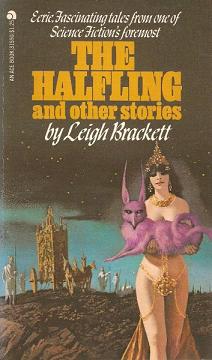
The Halfling and other Stories — Leigh Brackett

The Halfling and other Stories


The Halfling and other Stories
Leigh Brackett
351 pages
published in 1973

The Halfling and Other Stories is the sixth book I’ve read in the Year of Reading Women challenge I set myself after I’d noticed last year how few female written science fiction books I read. I had chosen this because it was something I hadn’t read before and I always liked Brackett. Unfortunately it turned out this was one of her lesser collections. The stories don’t fit well together, there’s no real theme to the collection and some are decidedly on the weak side.

It doesn’t help that the first two stories are basically the same. In both there’s the hardbitten protagonist falling for a mysterious beautiful alien girl who he knows is trouble yet can’t help himself but get involved with, who then turns out to be evil. Worse, in both stories this girl is shown to be representative of her race, their evil part of their biology. It’s a bit …uncomfortable… shall we say, but unfortunately these sort of assumptions are build into the kind of planetary romances Leigh Brackett wrote.

Read more…

Comics piracy

Tom Spurgeon on whether comics publishers should look at piracy for online pointers:

Two huge on-line manga stories may clinch this CCI as the Year Of Digital Comics Announcements. Viz launched its Viz Manga site, I believe in conjunction with an anniversary party; a group of Japanese publishers discussed their JManga effort at a panel devoted to same. I have no idea if either of these ventures will be successful. Strangely, you can make a case either way based on the thriving on-line piracy of such material. On the one hand, piracy has shown that consumers will indeed process this material on-line; on the other hand, paying for such material on-line as is the case with at least the Viz effort is an entirely different process. Heck, you can even make the case that piracy will have little to do with either effort, and I bet those involved will even make that case so as to duck the issue entirely.

And they would be right. The only thing comic book piracy proves is that people are willing to read comics on the screen, which we knew anyway. Apart from that I don’t think piracy proves one or another that going digital will be succesful or not for any given comics publisher. Certainly much less so than e.g. music piracy showed the way for legal downloads. The piracy scene is fairly hardcore & packratty, relatively small compared to other forms of piracy and getting pirated comics requires a moderate bit of technological skill in that you have to be able to deal with bit torrents or Usenet and know how to deal with *.cbr/cbz files. Hard as it may seem, the people involved, pirates and downloaders both are genuine comics fans, probably buying comics as well as downloading them. It’s not clear that this is the kind of audience publishers should try to reach when it’s almost as limited as the core comics audience anyway.

What comics publishers should try to do is to reach the much bigger audience that quite likes comics, but not enough to bother going to comics shops. Comics need to be available easily, cheaply and of interest to mainstream audiences. Worrying about piracy doesn’t help.

Bringing back the midlist

Last week I wrote about the new Gollancz ebooks gateway which will launch “this autumn”. A week later and we’re slowly getting to see which authors will have books on this service, as they start to mention it on their blogs.

One of the authors I’m most excited about, who most unfairly has been out of prints for years, is Pat Cadigan:

It’s been busy around here but, yes, in case you haven’t heard me turning handsprings from wherever you are, Orion/Gollancz is bringing all of my work back into print. Synners is going to be in the SF Masterworks series and Mindplayers, Fools, and Tea From An Empty Cup will be published in a single omnibus volume. My collections Patterns and Dirty Work will be ebooks.

And all will be part of Orion’s SF Gateway program.

also back in print, Nicola Griffith’s first two science fiction novels:

Ammonite appeared in early 1993 (from Ballantine/Del Rey in the US and HarperCollins/Grafton in the UK). It won some awards. Slow River followed two years later (ditto). And ditto. But the books still went out of print in the UK. (That’s the UK publishing reality. It’s different in the US. Here both books here have been through a zillion printings and still sell steadily, if not spectacularly, in print and digital editions.)

So it’s wonderful to be able to announce that I’ll finally be a Gollancz author–back where I started all those years ago. Repeat Yodel of Triumph, add Nod of Satisfaction, and follow, as always, with beer.

I was already interested in seeing what Gollancz was up to ebookwise, but these two announcements make it much more likely that’ll will buy books through them. Much will still depend on price, easy of buying and the absence of intrusive DRM on the books. The price needs to be roughly in the range of what I would spend on secondhand paperbacks or it wouldn’t be worthwhile to me, though I am willing to pay a bit more for the convenience of buying online, certainly for authors like Nicola Griffith and Pat Cadigan.

As Pat Cadigan noted in her post, twenty-thirty years ago it was normal for most of science fiction’s back cataloque to be in print and easily available. In the last decades this backlist has been steadily eroded as it no longer made commercial sense to keep most authors in print. Epublishing changes this equation: once an ebook is created, selling more of them doesn’t cost more unlike with physical books, where new print runs are usually too expensive for moderately profitable books. The Gollancz intiative helps to re-establish the backlist, another good reason to support it.

(Edited to erase an incredibly stupid brainfart; see comments.)