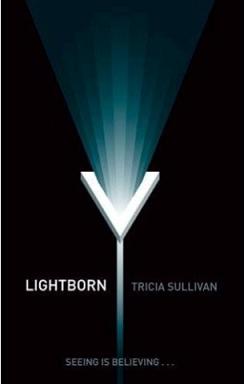
Lightborn — Tricia Sullivan

Lightborn


Lightborn
Tricia Sullivan
438 pages
published in 2010

Late last year Tricia Sullivan decried the fact that of the ten Clarke Award winners in the last decade, only one had been a woman, which in turned triggered a long discussion about women in sf in general much of it indexed at Torque Control. For me personally this discussion triggered a resolve to read more sf and fantasy written by women, as they had been woefully underrepresented until then. It was through the same discussions I learned about Tricia Sullivan herself, who as a writer had been completely unknown to me until then. Not only did she trigger the debate, her novel Maul ended second in the top ten Future Classics poll that Torque Control ran. So I kept an eye out for it at the local library, but they didn’t have it.

What they had instead was Lightborn, her latest novel. It’s a classic coming of age story, set in the city of Los Sombres in a somewhat alternate America, where instead of computers they have Feynmans and people use a special sort of light, Shine to program their own brains, as well as communicate with their version of the ‘net, the field, which is also inhabitated by the lightborn of the title, artificial intelligences, both benign and rogue. There are safeguards build/created in the field to keep the lightborn tame and Shine under control, but of course these fail at the start of the novel –otherwise there’d be no story after all. It leaves almost all the adults in Los Sombres permanently Shined and useless and kids like Roksana and Xavier, our heroes, scrabbling to survive in the aftermath.

Read more…

Jennifer Pournelle’s The Mote in God’s Eye sequel actually looks interesting

Sequels written to well loved science fiction classics by the children of the original writer never turn out right therefore you can safely ignore them. It’s a rule that saved me a lot of frustration, but I think I might break it for Jennifer Pournelle’s Outies, a sequel to her father’s and Larry Niven’s The Mote in God’s Eye. If the novel is as interesting and intelligent as this article makes it out to be, this could be a very good book:

What do you want the reader to get out of your novel?

JP: That monolithic viewpoints tend to drown out available options. That “first contact” is not a singular event. That urban sustainability depends upon ecological sustainability. That local people are not necessarily incompetent. That religion is as much about organizing principles as about belief systems. That the “hard science” in science fiction isn’t (or should not be) limited to physics and rocketry – to genuinely do “hard science,” you need to get your biology, geology, archaeology, anthropology, etc. right too.

Pournelle herself is an archaeologist and here she’s hitting a lot of my buttons — science fiction with a genuine grasp of the complexity of human history is rare and even in modern sf a lot of planets still feel no bigger than a small island…

A novel to look out for. Thanks James.

Crowpoek

jackdaws snacking on kroepoek

A somewhat blurry picture of us feeding the jackdaws at the hospital. They’re snacking on kroepoek, an Indonesian shrimp based crisp like snack, de riguer when you’re getting a Indo-Chinese takeaway, popular with crows as well as people so it seems.

And yes, that means S. is still in hospital, after three unsuccesful attempts to get back home earlier in the year. It’s still unknown when she can try again, but she’s waiting to undergo yet another operation, to cure yet another problem caused by interactions between the various medications she’s on. I’ll spare y’all the details, but it’s a long story full of medical mistakes and accidents that are more the product of the whole medical process as a whole than the fault of any one individual. It’s all getting her down, as you can imagine, so if you want to cheer her up a bit…

Her facts are all wrong, but does she get the spirit of the thing!

While Sarah Newton gets everything, but everything wrong about hard science fiction to rage against a problem with it that does not exist, she inadvertedly gets the spirit of it spot on in her introduction:

ow, a hundred or so years ago, it was widely regarded that all the known laws of physics had been discovered, and that theoretical physics was a “completed” science, with nothing more to do other than cross a few t’s and dot a few i’s. It was also believed that if you travelled more than 15 miles per hour in an automobile you’d probably suffocate…

Can you see what’s wrong with that? That’s right, “a hundred or so years ago” gets you to 1911, after the Wright Brothers, when the automobile was well on its way to become more than just a rich man’s toy and when steam locomotives had been travelling at speeds greater than fifteen miles an hour with no reports of suffocation for donkeys ages. Worse, 1911 was smack dab in the middle of the Einsteinian revolution, six years after Einstein’s Annus Mirabilis in which he introduced the special theory of relativity, his observations about the photoelectric effect that helped get quantum mechanics started, not to mention that whole E=MC squared thingie.

In this small paragraph Sarah gets her facts wrong, doesn’t think through when “a hundred years ago” was and ignores actual history and science for comforting myths about Progress — sounds remarkable like most hard science fiction to me.

(It doesn’t get much better in the rest of the post. Thanks James.)

Bruce Sterling reports on the Dutch War on Culture

Bruce Sterling comments on the philistinism of the current Dutch government’s arts policies:

“There are absolutely no policy reasons for the €200 million of cutbacks. This deal was struck with the PVV in exchange for its support in parliament of the minority cabinet. The intention is to inflict irreparable damage on an entire profession. Zijlstra is striving to decimate and eliminate this professional group’s creative, innovative and critical potential. Not a single member of his own party (VVD), or anyone from its coalition partner, the CDA (Christian Democratic Party) has opposed him. As far as they are concerned, traditional art is merely the superfluous ornamentation of a society. Contemporary art is labelled as alienating, and even, although no one actually says it out loud, as ‘degenerate art’.

The notion of “entarte kunst” does fit in well with the rightwing “populism” of the PVV and Wilders, as I also noted yesterday, but as Bruce Sterling indicates, the betrayal of the art by the supposedly respectable CDA and VVD is just as nihilistic. This is something that would not have been possible twenty or even ten years ago, but a decade of relentless rightwing philistinism in which everything had to be reappraised solely for its commercial potential has eroded the sense of social responsibility these parties used to hold. Obviously, there have alwas been disagreements over the arts and funding thereof; what’s new is the idea that they shouldn’t be funded at all, apart from very respectable high culture institutes like the Rijksmuseum or Concertgebouw. This is an ideologically driven attack, one that wants to make art safe for the rich and only aimed at their tastes.