Rightwing hobbies

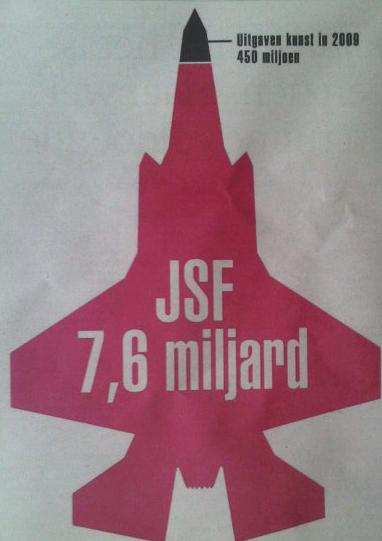
Total cost of Dutch culture budget v total cost of JSF

So we got ourselves a rightwing minority goverment in the Netherlands a while back, who now rule with support of the racists aka Geert Willders and his “Freedom Party”. Wilders thanks his success by pandering to the worst prejudices of the socalled common man, while the government thanks its succes to pandering to Wilders. Which explains why while the government tries to sell us on how Maturely they are trying to handle the Very Serious Task of getting Holland’s finances back in order in the wake of the bankers’ crisis, the sort of measures they come up with is to slash the culture budget. As the picture on top shows, the total amount of money the government spents each year on culture is roughly 450 million euros: a lot of money, but nothing compared to the 7,6 billion euros it would cost to buy the F-35. So why is that sacrosant when cutting the cultural budget is only penny ante stuff?

Because stopping money being “wasted” on opera, theatre and other “leftwing hobbies” as Wilders put it, is a goal in itself for this government. It keeps Wilders and its voters happy, can be spun as showing how serious the government takes the budget deficits and pisses off the leftwing opposition. Who cares that it doesn’t help achieve its nominal goal as long as white elephants like the F-35 are kept fully funded but does destroy a lot of cultural capital?

Pure pandering. And to add insult to injury, not only are the budgets slashed, the value added tax paided on art and other cultural products will be upped as well, from six to nineteen percent. Except on porn. Because wanking is a rightwing hobby…

The Second Anglo-Dutch War — Gijs Rommelse

The Second Anglo-Dutch War


The Second Anglo-Dutch War
Gijs Rommelse
230 pages including index
published in 2006

I’m not sure if in these enlightened times they still do it, but if you ever come across a Dutch naval ship with a broom in the top of her mast and you want to know what’s that all about, read up about the Second Anglo-Dutch War and especially the Dutch raid on Medway, when the English fleet was “swept” from the sea. Yes, though these days the Dutch have been reduced to the butt of cheap racist jokes about dope smoking and homosexuality in the English consciousness, there once was a time when Holland was Britain’s greatest enemy and competitor, despite the common ground between the two countries. In fact, it was exactly this common ground that was the problem. England and Holland both were dependent on trade for their prosperity, both tried to monopolise the lucrative trade in e.g. spices and it was inevitable that they would fight for supremacy — it took four wars in total for England to get the upper hand. Of the four wars, the Second Anglo-Dutch War (1665–1667) was the one with the clearest Dutch victory.

Apart from that very general outline however, I knew little about this war, so I’m glad Gijs Rommelse decided to turn his thesis into a proper book. The Second Anglo-Dutch War‘s main interest lies in determining the causes of the war, how commercial, as well as both foreign and domestic political considerations on both sides drove the countries to war. In process Rommelse also delivers an overview of the war itself, giving short and to the point accounts of all aspects of the war, including the struggle in the Americans and the privatering both the English and the Dutch engaged in. This was after all as much as anything a war about trade.

Read more…

They came from the seventies

From James Nicoll: which of these female sf/f authors who debuted in the 1970ties do you know? Italicize the authors you’ve heard of before reading this list of authors, bold the ones you’ve read at least one work by, underline the ones of whose work you own at least one example of.

  • Lynn Abbey
  • Eleanor Arnason
  • Octavia Butler
  • Moyra Caldecott
  • Jaygee Carr
  • Joy Chant
  • Suzy McKee Charnas
  • C. J. Cherryh
  • Jo Clayton
  • Candas Jane Dorsey
  • Diane Duane
  • Phyllis Eisenstein
  • Cynthia Felice
  • Sheila Finch
  • Sally Gearhart
  • Mary Gentle
  • Dian Girard
  • Eileen Gunn
  • Monica Hughes
  • Diana Wynne Jones
  • Gwyneth Jones
  • Leigh Kennedy
  • Lee Killough
  • Nancy Kress
  • Katherine Kurtz
  • Tanith Lee
  • Megan Lindholm (AKA Robin Hobb)
  • Elizabeth A. Lynn
  • Phillipa Maddern
  • Ardath Mayhar
  • Vonda McIntyre
  • Patricia A. McKillip
  • Janet Morris
  • Pat Murphy
  • Sam Nicholson (AKA Shirley Nikolaisen)
  • Rachel Pollack
  • Marta Randall
  • Anne Rice
  • Jessica Amanda Salmonson
  • Pamela Sargent
  • Sydney J. Van Scyoc
  • Susan Shwartz
  • Nancy Springer
  • Lisa Tuttle
  • Joan Vinge
  • Élisabeth Vonarburg
  • Cherry Wilder
  • Connie Willis

Lots of names I recognise but either never read or only read a few stories off in various anthologies.

Reviews up at SF Mistressworks

Dept. of self promotion: the last few weeks I’ve gotten some old and new reviews published at Ian Sales’ SF Mistressworks site, dedicated to showcasing good books by female sf writers. Thought it might be good to point y’all at them.

The Female Man — Joanna Russ: “The Female Man is a tough book, but not a hard book to read. Joanna Russ is a brilliant writer and everything in here sparkles”

Ammonite — Nicola Griffith: “Nicola Griffith’s goal was to create a world populated solely with women without falling back on clichés about what such a world would look like. No “seven-feet-tall vegetarian amazons who would never dream of killing anyone, no “aliens who are really women or women who are really aliens”, but “the entire spectrum of human behavior”. ”

The Sword of Rhiannon — Leigh Brackett: “What sets The Sword of Rhiannon a touch above other pulp adventure stories is both Brackett’s writing and that elegiac sense of loss that comes across through it.”

Sign of the Labrys — Margaret St. Clair: “The infusion of what at first seemed a fairly standard science fiction story with a dose of Wicca worked pretty well. If necessary, you can ignore all the Wicca mumbo-jumbo and just think of it as psionics.”

QotD: how superheroines dress

Harley Quinn in her new, awful costume

From Comics Alliance‘s roundtable on The fashion of the new DC universe, Laura Hudson pinpoints what bothers her about the female heroes wardrobes:

I really wish we had artists who were thinking about how these characters would dress themselves. I bet a lot of them would dress sexy! But this is like — did you ever watch Beauty and the Geek? These women look how the girls did when the guys went shopping for them. Female superheroes always have the guys going shopping for them. Well, almost always.

The picture above shows one of the worst re-imagined costumes: Harley Quinn’s new outfit. Here’s what she actually looks like, as originally designed by her creators Paul Dini and Bruce Timm for the old Batman animated series, creating one of the classic Batman villains, one of the few modern ones to be as iconic as the Joker or Catwoman or the Penguin. This new look? Not so much. Far too stripperific.