Russ Pledge: Jo Walton

We should take the pledge to make a considerable and consistent effort to mention women’s work which, consciously or unconsciously, has been suppressed. Call it the Russ Pledge.

Jo Walton joined rec.arts.sf.written at around the same time as I did, back in 1994. This was before the web had really started going and Usenet was the hot new social medium, though we didn’t call it that then. Text based, it played to Jo’s strengths and she quickly became one of the top posters on rasfw — not a small achievement in that pressure cooker full of highly articulate, intelligent people, not to mention huge egos. The same insights and knowledge she now brings to her posts at the Tor blog now, she already showed back then. Her presence was one of the things that made rec.arts.sf.written the best place to talk about science fiction online ever. Jo wasn’t just another sf fan; like so many of us she was also attempting to break into writing. Having written a couple of short stories, it was a connection made through rec.arts.sf.written, with Tor editor Patrick Nielsen Hayden, that got her first novel published in 2000. Since then she has written eight more.

Her best novel so far is her latest and also her most personal: Amongst Others, published in February, is both a fantasy story and the coming age story of a science fiction fan where you don’t need much imagination to see much of Jo herself in her protagonist. To quote from my review:

But that isn’t what her life revolves around. For the most part this is the diary of a fifteen year old girl interested in science fiction and fantasy, a fan of Ursula LeGuin, Robert A. Heinlein, Roger Zelazny and James Tiptree Jr., but not Philip K. Dick or Stephen Donaldson. Her diary entries are about what’s going on with school, reading books and buying books, getting involved with her father’s side of the family and worries about the family she left behind in Wales, Grampaw and Auntie Teg and finding other people who like science fiction, including her father. These parts are where the Jo-ness shines through, but also the most universal parts of the story. There’s one heartbreaking little scene when she and her father are staying in a hotel somewhere and he gets drunk in the bar below and comes into their room and tries to climb into her bed and kiss her and she’s trying to reason it out through what she learned from Heinlein that incest is not a sin if no children are concieved but she has no contraceptives and it doesn’t feel right but it’s nice to be wanted and…

Before that, there was the Small Change series of alternate history novels, featuring the familiar concept of a Britain that has made peace with Nazi Germany, but which Jo had managed to give a new twist. Again quoting from my own review of the first book, Farthing:

Farthing grabbed me by the throat from the first page and didn’t let go; one of the very few books to have ever done that. As with any other alternate WWII story, part of that is due to what you know is going on in the background that the characters themselves do not know yet or only suspect. Every such Hitler wins story depends on the tension between what the reader knows happened historically and what the characters in the story know or do not know: sometimes this is done explicit, as in Fatherland, where the whole point of the book is to get the protagonist up to speed on what we as readers already know. In Farthing’s case though things are kept implicit. What Walton does is let the essential horror of the setting speak for itself, keeping the swastikas and Gestapo goons offstage. What she does in fact is showing that England did not need these props to become a fascist state.

England after all was a deeply racist country before the war, where anti-semitism was deeply ingrained, as anybody who has read classic cozies knows — even an enlightened writer like Dorothy L. Sayers could talk about a “typical Jew” with all the stereotypes that entails. What Walton does in Farthing is take the casual racism and snobbery of a Josephine Tey and makes it all slightly more explicit and horrid, but still recognisable English. No Kristallnacht, but it is quite casually established Jews cannot buy land.

I’ve not read all of her books, but every book I’ve read of hers was no less than excellent. What’s more, she’s not content to keep repeating her earlier successes. Her first three novels were Arthurian sagas set in a fantasy Britain: this was follewed by her attempt at an Anthony Trollope novel, but with dragons. Then there were the three Small Change alternate history novels, a return to fantasy with Lifelode and finally Among Others. Despite their differences these novels do have something in common, in that each in their own way treats with the Matter of Britain, what it means to be British to the core, in the very old fashioned last Roman in England way that Jo Walton has.

Do yourself a favour and read:

  • The King’s Peace (2000)
  • The King’s Name (2001)
  • The Prize in the Game (2002)
  • Tooth and Claw (2003)
  • Farthing (2006)
  • Ha’penny (2007)
  • Half a Crown (2008)
  • Lifelode (2009)
  • Among Others (2011)

The Russ Pledge

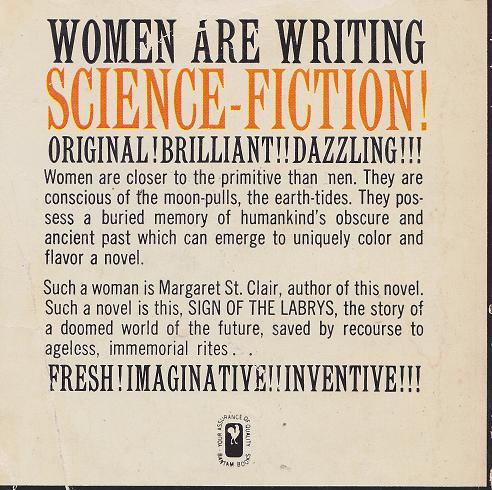
backcover blurb from Sign of the Labrys

That’s from the backcover blurb of Sign of the Labrys, a 1963 sf novel written by Margaret St. Clair. Even then the idea that it was new and different for women to write science fiction was laughably ignorant, but that didn’t stop whatever unnamed marketering genius who came up with that quote.

This blurb is the perfect illustration of why the “Russ Pledge” is important. No male writer would’ve been introduced like Margaret St Clair was here, as both representative of his whole genre and as something new. That’s one part of what Joanna Russ wrote about in How to Surpress Womens’ Writing: the constant emphasis that this female writer is an exception, that female writers are rare and strange. Though things improved since this blurb was written, we’re currently — with allegedly only two female sf writers having a book contract in the UK — in danger of moving back towards a situation in which it once again becomes easy to imagine such blurbs, unless we actively work to prevent this.

As Farah Mendlesohn made clear in her contribution to the SF Mindmeld linked to above, it is especially important for male sf writers, editors, reviewers and readers to take the lead in this. Though women can obviously share the same biases and are caught in the same distortion, it’s been us men who’ve — consciously or unconsciously — been setting this trap. Moreoever, if we don’t change our behaviour the same power dynamics will continue to be in force. Obviously. Hence the Russ pledge and its importance. What I’d therefore like to do, apart from reading and reviewing more books by female sf writers, is to do a series of posts on my favourites and why they’re my favourite female writers: people like Jo Walton, Mary Gentle, C. J. Cherryh, Leigh Brackett, Lois McMaster Bujold…

You don’t prove your feminist credentials with racism

You may know Sugar Ray Leonard as a seventies boxer. He recently released an autobiography in which he admitted he had been sexually assaulted by an unnamed boxing coach, just before the 1976 Olympic Games. Not an easy admission to make, especially not for somebody coming from the macho world of boxing. You therefore expect a leftwing, feminist blog to both take his confession seriously and treat it sensitively. Anthony McCarthy at Echidne of the Snakes is here to prove you wrong:

I have a hard time imagining that a very middle aged gay man would have chosen Sugar Ray Leonard to make a sudden, un-negotiated, physical sexual assault against just as he was about to win a gold medal in BOXING. Boxing, repeatedly and skillfully and forcefully hitting an evenly matched opponent in the face and head in order to inflict damage up to and including knocking him unconscious. Boxing is not track and field, it’s not gymnastics, it’s the training and practice of how to do physical damage to someone. No matter how physically attractive Leonard was, the possibility that he might beat you to a bloody pulp if he didn’t welcome your entirely unannounced, unapproved physical advance would have made him an unlikely man to choose to make one on.

Though he never quite comes out and says it, everything McCarthy says is based on the assumption that Black man = violent thug and especially that a Black boxer is a violent thug. Obviously it’s absurd to assume that just because Sugar Ray Leonard was a career boxer, he would beat up people outside the ring as well, as if boxing and criminal assault are the same thing. To make his case McCarthy has to ignore all other power considerations that could exist between a young, Black boxing hopeful and a well established, white boxing coach, has to ignore what the likely consequences for Sugar Ray had been had he indeed physically attacking this coach, had to ignore the very fact that awareness of sexual assault, especially sexual assault aimed at men, was pretty low in 1976. Instead he has to rely on unspoken but understood stereotypes of young Black men, dogwhistled through emphasising Sugar Ray Leonard’s boxing career.

Without this racism he only has own incredulity as an argument, but just because Anthony McCarthy finds something hard to believe doesn’t mean it didn’t happen — I found it hard to believe any self declared feminist could engage in victim blaming this blatant, yet Anthony made it happen anyway.

The Mammoth e-Book of Mindblowing Mars SF

Need something cool to read this weekend? Here you go:

The Mammoth e-Book of Mindblowing Mars SF (2009) presents 20 of the finest examples of mind-expanding, awe-inspiring, 21st-century Martian science fiction that are free and ready-to-read on the Internet. The storylines range from a spunky young bride-to-be truding across Red Planet sands, to a classical concert on Earth interrupted by unannounced guests, to a brutish psychic that roams the twisting urban alleys of the north face of Mars. These are works that take you across time and space -– from today’s top-name contributors, including Camille Alexa, Kage Baker, Terrie Leigh Relf, Patricia Stewart, Mary A. Turzillo, and Liz Williams. So sit back, adjust your glasses, and prepare to have your mind blown!

Bonus question: what’s different about this anthology?