Headachy and flueey. No post for you. So have some Betty Davis instead.
The Sword of Rhiannon — Leigh Brackett
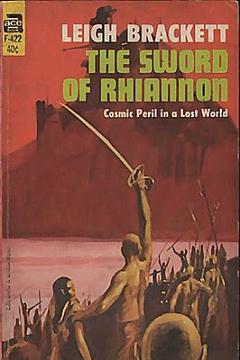
The Sword of Rhiannon
Leigh Brackett
141 pages
published in 1953
You may think you don’t know Leigh Brackett or read any of her stories, but you’re wrong. If you think The Empire Strikes Back is the best of the real Star Wars movies, you have her to thank for it, as she wrote the original screenplay, just before she died. This is no fluke either, as her screen writing career is almost as old as her science fiction career. She started off on The Big Sleep together with William Faulkner and has worked on other well known movies like Rio Bravo and The Long Goodbye. And with her long She knew her way around a film script; combine that with her long experience writing science fantasy for pulp magazines like Planet Stories and you know why Empire is so much better than any of the other Star Wars movies.
If you liked Empire than the good news is that Leigh Brackett is even better when working on her own stories. Though she wrote other science fiction, she’s best known for writing planetary romances (or science fantasy) in the tradition of Edgar Rice Burroughs. Her best stories are set on the Mars of Burroughs and dozens of pulp imitators, a dying world turned into a worldwide desert as its seas dried up, with a highly evolved but degenerated civilisation clinging to life through an elaborate system of canals, now turned into a new version of the Western frontier as Terran adventurers and never do wells come to try their luck. Brackett’s Mars is more than just a pulp adventure setting though. Her best stories leave you with a sense of melancholy and loss, perhaps nowhere more so than in The Sword of Rhiannon, “a hymn to the lost past of a Mars that never was” as Nicola Griffith put it in her introduction to a recent reissue.
Unknown Pleasures: Stan Martin’s Rapid Fire
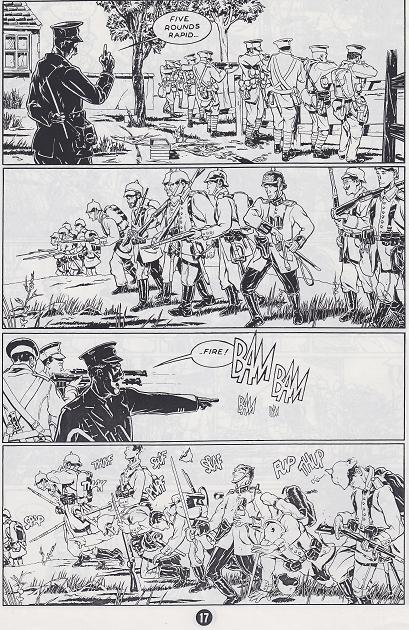
I’ve been to my parent’s place this weekend, to celebrate the birthdays of my sister and her partner who live nearby. As always a home visit is also an excuse to rescue some more of the vast collection of comics I’ve left behind there in storage. Amongst the gems I dragged away this time was an A4 sized, self published (?) comic called Rapid Fire: Terrible Sunrise Part Two, written and drawn by one Stan Martin. I known nothing more about it or its creator than what I could gleam from the comic itself when I bought it at Spacecaption 1999, a small Oxford comics convention. That’s one of the joys of going to cons, finding interesting looking small press or self published (“amateur”) comics done by people with no expectation — or even desire– to become professional cartoonists, but who draw comics just for the love of them. In this case I was drawn in by the subject matter, a battle set in the first days of World War I, as the forces of the British Expeditionary Force first come into contact with the vanguard of the German advance. Martin’s artwork, realistic, clear and with a hint of Ligne Claire in it also helped.
Rapid Fire depicts the battle between the North West Rifle regiment on the 23rd of August 1914 alongst the Mons-Condé Canal in Belgium and the advancing German forces of von Kluck. This wasn’t trench warfare, the front was still dynamic as the Germans were still pressing towards the Channel, trying to move around the defending English and French forces, who in turn were slowly retreating out of Belgium back into France. This was the last stand of the old professional British Army that had fought the colonial wars of the 19th century, opposing a modern conscription army much much bigger than them. As Martin puts it on the back cover:
The Kaiser’s army, of almost three million ferociously disciplined men, floods the farmlands of northern France. They attempt to crush the French before their Russian allies can mobilise to threaten Germany’s eastern border. The British Expeditionary Force barely figure in the Prussian plan to dominate the continent; two hundred and fifty thousand strong they are outnumbered more than five to one. The British soldier, however, is the most highly trained, best equipped in the world. In sixty seconds, armed with his short magazine bolt action Lee Engfield rifle he is capable of firing up to fifteen well-aimed rounds.
This is known as “the mad minute”.
Which also tells you that this is a war story, not an antiwar story, as we’re mostly used to when the First World War is brought up in fiction. Martin neither moralises about war nor glorifies the battle he depicts. His treatment is almost antiseptical, no sensationalist displays of gore, just men falling down with a “fup” or “thup”. This might seem old fashioned or a bit suspect, but it works well here; Martin trust his readers to know that war isn’t nice, he doesn’t have to rub it in nor has he any desire to. It’s an intellectualised view of battle, somewhat distancing you from it. The artwork helps with this. Even in action his figures look posed and stiff. The clean lines too help keep you detached from the story. He has a good eye for detail, but doesn’t go overboard with it.
I’ve never found another comic by Martin, nor much about him on the internet, save for one review of Rapid Fire, which coincidently uses the same page I scanned as well as an illustration. I’ve no idea if he has done more comics than this, but I hope so.
Respect ma authoritah
Everything in this story about the sentencing of a young autistic Black man sentenced for “assaulting” a police officer annoyed me, starting with the way in which the Washington Post buried the lede. Here are the last three paragraphs:
On the morning of the incident, Latson, who received an Asperger’s syndrome diagnosis in the eighth grade, slipped out of the house early to go to the library but found it closed. What followed was a call to police about a suspicious black male seen outside the library, wearing a hoodie and possibly carrying a gun.
Deputy Thomas Calverley, 56, spotted Latson, searched him for a gun, found none and repeatedly asked him his name. When Latson refused to give it, Calverley grabbed him in an attempt to put him under arrest. A scuffle ensued, leaving Calverley with injuries that forced him to retire early.
In court Tuesday, Latson turned to Calverley and, in a barely audible voice, apologized.
He shouldn’t have had to apologise, to it speaks well for him that he did. This poor bloke has gotten his life ruined because some busybody flipped out seeing a Black man in a hoodie near a library, some dick with a gun decided to harass him and pushed him around just that little bit too much. Had the officer used some common sense and not wanted to assert his authoritah nobody would’ve gotten hurt. But of course that’s too much to ask.
Taking the Russ Pledge
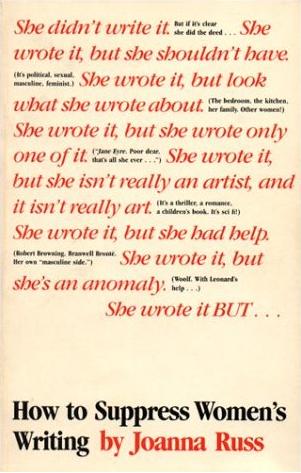
“She didn’t write it. But if it’s clear she did the deed… She wrote it, bit she shouldn’t have. (It’s political, sexual, masculine, feminist.) She wrote it, but look what she wrote about. (The bedroom, the kitchen, her family. Other women!) She wrote it, but she wrote only one of it. (“Jane Eyre. Poor dear. That’s all she ever…”) She wrote it, but she isn’t really an artist, and it isn’t really art. (It’s a thriller, a romance, a children’s book. It’s sci fi!) She wrote it, but she had help. (Robert Browning. Branwell Brontë. Her own “masculine side”.) Sje wrote it, but she’s an anomaly. (Woolf. With Leonard’s help…) She wrote it BUT…”
That’s the cover of How to Suppress Women’s Writing, Joanna Russ’ classic examination of all the ways women’s writing has been written out of literary history. The cover sort of gives the game away in how that was and is done. It’s so easy to outright deny or minimise female contributions to literature, consciously or unconsciously because despite a century of feminism, we’re still living in a male orientated world. Whether we like it or not, people like me — white, western, male, straight — are the default and if we don’t watch ourselves we find it easy to ignore all those not like us, while immediately finding it strange if we’re not present in our fictions, either as author or character.
In science fiction, despite its self asserted reputation of openmindedness, things are no better. If have been following this blog for a while, you know this, as we hashed this all out last year as well. That’s why I started a project to read at least one science fiction or fantasy book written by a woman per month, just to counter my own subconscious tendency to stick to male authors. The personal is the political after all and if I don’t take the trouble to look after my own reading, I can’t really fault others for ignoring female writers. It may seem odd to police your pleasure reading that way, but I’ve found that if I don’t, I get stuck in the same rut with the same male authors over and over again. I don’t just do it because it’s good for science fiction if more people pay as much attention to female as to male writers, but because it’s good for me.
Just because a few of us felt this way last year, doesn’t mean the war is being won of course. At the moment science fiction has gotten a bit more media attention again, if only through the by all accounts brilliant exhibition at the British Library, but sadly it has revealed that it’s still the male writers who get most of the attention. As Nicola Griffith found out, when The Guardian asked its readers to name its favourite sf books/writers, only 18 out of 500 writers were female. It reminded her of what Joanna Russ had analysed so well thirty years ago and it inspired her to a call for action:
Clearly, women’s sf is being suppressed in the UK. Oh, not intentionally. But that’s how bias works: it’s unconscious. And of course sometimes it’s beyond a reader’s power to change: you can’t buy a book that’s not on the shelf. You can’t shelve something the publisher hasn’t printed. You can’t publish something an agent doesn’t send you. You can’t represent something a writer doesn’t submit. Etc.
But, whether this bias is active or passive, it’s time to attack it on several fronts:
- reexamine and rewrite Best Of lists to take into account women who have been relegated to also-rans (this will involve public discussion and reevaluation)
- rexamine and republish Classics to include those women who, through the process Russ delineates, have slipped down the rankings (ditto)
- revive the old-style Women’s Press list of sf, historic and contemporary, by women writers
- acknowledge, in media pieces, likely inherent bias
- writers, stop self-censoring
- agents, stop narrowing the funnel
- editors, consider balancing your list
- booksellers, pay attention to your readers and categories
- readers, give books and writers a chance
- etc.
And always, always name the behaviour around you: we can’t change behaviour until it’s named.
From there on, Nicola called for The Russ pledge:
The single most important thing we (readers, writers, journalists, critics, publishers, editors, etc.) can do is talk about women writers whenever we talk about men. And if we honestly can’t think of women ‘good enough’ to match those men, then we should wonder aloud (or in print) why that is so. If it’s appropriate (it might not be, always) we should point to the historical bias that consistently reduces the stature of women’s literature; we should point to Joanna Russ’s How to Suppress Women’s Writing, which is still the best book I’ve ever read on the subject. We should take the pledge to make a considerable and consistent effort to mention women’s work which, consciously or unconsciously, has been suppressed. Call it the Russ Pledge. I like to think she would have approved.
This in turn inspired Ian Sales, who had been part of the debate last year as well, to start the SF Mistress Works blog, dedicated fto establishing a line of potential “Mistress Works”, classical sf novels written by women, ala the actually existing Gollancz SF Masteworks line. He’s calling for reviews of those works he has already put up as potential Mistress Works, either existing or new ones; I might just take him up on that.
As long as it’s not as natural or easy to think of female sf writers as it is to think of male ones, the Russ Pledge and initiatives like Ian Sales’ are necessary. As Maura McHugh says in in the title of her excellent summing up of the current “controversy”, be part of the solution. Take the Russ Pledge today!