Taking the Russ Pledge

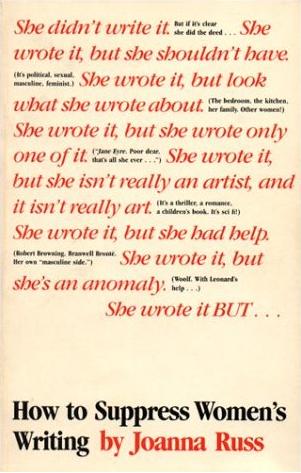
cover of How to Suppress Womens Writing

“She didn’t write it. But if it’s clear she did the deed… She wrote it, bit she shouldn’t have. (It’s political, sexual, masculine, feminist.) She wrote it, but look what she wrote about. (The bedroom, the kitchen, her family. Other women!) She wrote it, but she wrote only one of it. (“Jane Eyre. Poor dear. That’s all she ever…”) She wrote it, but she isn’t really an artist, and it isn’t really art. (It’s a thriller, a romance, a children’s book. It’s sci fi!) She wrote it, but she had help. (Robert Browning. Branwell Brontë. Her own “masculine side”.) Sje wrote it, but she’s an anomaly. (Woolf. With Leonard’s help…) She wrote it BUT…”

That’s the cover of How to Suppress Women’s Writing, Joanna Russ’ classic examination of all the ways women’s writing has been written out of literary history. The cover sort of gives the game away in how that was and is done. It’s so easy to outright deny or minimise female contributions to literature, consciously or unconsciously because despite a century of feminism, we’re still living in a male orientated world. Whether we like it or not, people like me — white, western, male, straight — are the default and if we don’t watch ourselves we find it easy to ignore all those not like us, while immediately finding it strange if we’re not present in our fictions, either as author or character.

In science fiction, despite its self asserted reputation of openmindedness, things are no better. If have been following this blog for a while, you know this, as we hashed this all out last year as well. That’s why I started a project to read at least one science fiction or fantasy book written by a woman per month, just to counter my own subconscious tendency to stick to male authors. The personal is the political after all and if I don’t take the trouble to look after my own reading, I can’t really fault others for ignoring female writers. It may seem odd to police your pleasure reading that way, but I’ve found that if I don’t, I get stuck in the same rut with the same male authors over and over again. I don’t just do it because it’s good for science fiction if more people pay as much attention to female as to male writers, but because it’s good for me.

Just because a few of us felt this way last year, doesn’t mean the war is being won of course. At the moment science fiction has gotten a bit more media attention again, if only through the by all accounts brilliant exhibition at the British Library, but sadly it has revealed that it’s still the male writers who get most of the attention. As Nicola Griffith found out, when The Guardian asked its readers to name its favourite sf books/writers, only 18 out of 500 writers were female. It reminded her of what Joanna Russ had analysed so well thirty years ago and it inspired her to a call for action:

Clearly, women’s sf is being suppressed in the UK. Oh, not intentionally. But that’s how bias works: it’s unconscious. And of course sometimes it’s beyond a reader’s power to change: you can’t buy a book that’s not on the shelf. You can’t shelve something the publisher hasn’t printed. You can’t publish something an agent doesn’t send you. You can’t represent something a writer doesn’t submit. Etc.

But, whether this bias is active or passive, it’s time to attack it on several fronts:

  • reexamine and rewrite Best Of lists to take into account women who have been relegated to also-rans (this will involve public discussion and reevaluation)
  • rexamine and republish Classics to include those women who, through the process Russ delineates, have slipped down the rankings (ditto)
  • revive the old-style Women’s Press list of sf, historic and contemporary, by women writers
  • acknowledge, in media pieces, likely inherent bias
  • writers, stop self-censoring
  • agents, stop narrowing the funnel
  • editors, consider balancing your list
  • booksellers, pay attention to your readers and categories
  • readers, give books and writers a chance
  • etc.

And always, always name the behaviour around you: we can’t change behaviour until it’s named.

From there on, Nicola called for The Russ pledge:

The single most important thing we (readers, writers, journalists, critics, publishers, editors, etc.) can do is talk about women writers whenever we talk about men. And if we honestly can’t think of women ‘good enough’ to match those men, then we should wonder aloud (or in print) why that is so. If it’s appropriate (it might not be, always) we should point to the historical bias that consistently reduces the stature of women’s literature; we should point to Joanna Russ’s How to Suppress Women’s Writing, which is still the best book I’ve ever read on the subject. We should take the pledge to make a considerable and consistent effort to mention women’s work which, consciously or unconsciously, has been suppressed. Call it the Russ Pledge. I like to think she would have approved.

This in turn inspired Ian Sales, who had been part of the debate last year as well, to start the SF Mistress Works blog, dedicated fto establishing a line of potential “Mistress Works”, classical sf novels written by women, ala the actually existing Gollancz SF Masteworks line. He’s calling for reviews of those works he has already put up as potential Mistress Works, either existing or new ones; I might just take him up on that.

As long as it’s not as natural or easy to think of female sf writers as it is to think of male ones, the Russ Pledge and initiatives like Ian Sales’ are necessary. As Maura McHugh says in in the title of her excellent summing up of the current “controversy”, be part of the solution. Take the Russ Pledge today!
Defending the indefensible: the DC reboot

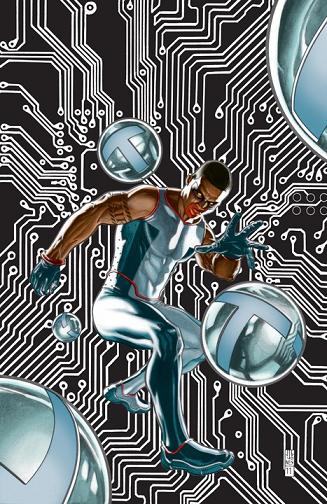
cover to Mr Terrific 1

On Twitter Hedi McDonald asked for essays to defend the
DC reboot in 400 words or less. Below is my attempt.

There’s an old joke about mules: before you can get them to do anything, you need to hit them with a 2 by 4, just to get their attention. That’s what the DC reboot is. In scale and audacity it’s the culmination of everything Dan Didio has been working on since he became Executive Editor. Having spent the past decade revamping and refurbishing its superhero line title by title, rebooting it completely is the logical end result of this ongoing process.

It is no surprise that fan reaction has been negative. After years of tinkering with continuity, soft and hard reboots anything that looks like more of the same is disliked. This is a mistake, as this reboot is not the start of more tinkering, but the end of it. By relaunching everything, DC has put a line under the endless succession of Crisises. Having everything restart with #1 means you can stop worrying about what came before.

What’s very clever is the way DC has tied the reboot in to its move to same day digital publishing. The need to get serious about digital publishing has been pressing for years, but it needed to be done without damaging the direct market. Comics retailers have been scared to death of seeing its sales cannibalized by the internet. The way DC has found of squaring this circle is through this reboot. New number ones always have a sales boost, providing at least a short term benefit to comics retailers. They also make it easier for new readers to jump aboard and the publicity the reboot is getting outside of the comics orientated media means more people now know about DC’s digital publishing efforts as well. DC needs to find new readers if it wants to remain viable and the only way to do this is to look outside the existing comics buying audience.

Piracy has made clear there is an online readership for comics, as long as they are easy to get. DC’s challenge is to do just that. If they succeed and can get their comics in front of potential readers than this reboot may just be the best thing that has happened to comics in years. It all depends on how well DC can sell its plans to retailers, fans and new readers alike. They got our attention, now they need to do something with it.

N.B. I don’t necessarily believe this.

Books read May

May saw a slight increase in books read, with less pressure from work and other interests. But with S. back in hospital again there was still less time and desire to read than usual.

Cowboy Feng’s Space Bar and Grille — Steven Brust
A strange book but that was just right for me when I read it, this quite cozy adventure set against a backdrop of succesive nuclear holocausts.

To Reign in Hell — Steven Brust
Brust does Paradise Lost. Another strange novel, but a good one.

Early Medieval Settlements — Helena Hamerow
A excellent archaeological/historical overview of settlements and their evolution in North-West Europe during Late Antiquity and the early Middle Ages. This is history on a much smaller scale than the books I have been reading about this period, but it complements them well.

Foreigner — C. J. Cherryh
The next novel I read in my Year of Reading Women project. The usual Cherryh story of a young man trust in a crisis beyond his control, with no power but a whole of responsibilities.

The Second Anglo-Dutch War — Gijs Rommelse
AKA the war in which we beat the English like a redheaded stepchild. A good overview, somewhat hampered by its origins as a ph.d thesis.

The Complaints — Ian Rankin
The first post-Rebus novel I’ve read of Rankin. The hero is younger, less cynical but the plot could’ve fitted a Rebus novel as well. This is not a complaint on my part, pun not intended.

“ten or twelve Roger Dean album covers with some sparse lettering across them”

I’ve been on an old comics kick lately – lots of bronze age stuff, some 80s and 90s books as well, maybe some stuff I’ll write about, maybe not – and it never ceases to amaze me how long it takes to read any average issue from 1985 or 1995 compared to almost any example from 2011. The change is easily explained: after Quesada and Jemas took over Marvel in 2000, they did away with thought balloons and third-person narrative captions. Not all at once, but slowly and more-or-less permanently. I still don’t know, and really have not seen a single compelling reason, why these changes were pushed through so thoroughly, but the more I think about it the more I am fully convinced that this shift was undeniably deleterious to the long-term quality of the line. It’s a question of economy: captions and thought balloons were an extremely efficient way of communicating a large amount of information in a surprisingly concise package. Back in 2000 $2.25 for 15 minutes of reading was a good deal. No amount of inflation will make $3 or $4 for 5 minutes a good deal for anyone.

In the course of reviewing Mighty Thor #2, Tim O’Neil says a lot of what I tried to say here, but does it better.

Rich Boomer turns rightwing, feels need to write book about it

David Mamet interviewed for the New York Times:

Years ago, you described “American Buffalo” as being about “how we excuse all sorts of great and small betrayals and ethical compromises called business.” In this book, you defend enormous payouts to C.E.O.’s working for failing corporations. You seem to have changed radically.
I have. Here’s the question: Is it absurd for a company to pay hundreds of millions of dollars to a C.E.O. if the company is failing? The answer is that it may or may not be absurd, but it’s none of our goddamned business. Because as Milton Friedman said, the question is not what are the decisions but who makes the decisions. Because when the government starts deciding what’s absurd, you’re on the road to serfdom.

Don’t you have to denounce your early, anticapitalistic work then?
Of course not. At that time in my life I didn’t have a penny, and I was glad to be working at entry-level jobs. Having lived for quite a while longer, I see life from a different perspective. What am I going to do, go on denouncing capitalism all my life?

Mamet first came out three years ago, in a screed for the Village Voice in which he explained that all you liberals are doodyheads and he never liked you anyway. Judging from the interview above he has swallowed the whole range of wingnut beliefs whole and as uncritically as he himself said he had believed his old liberal assumptions Which is a sad commentary on (arguably) America’s greatest living playwright but typical for a lot of those road to Damascus stories. All those people who move to the right when they’re middleaged and rich always have to make up a fairytale about how their eyes were suddenly opened to the evils of liberalism, yet their conversion stories never betray more than a superficial understanding of either their old or their new politics. Their vanity doesn’t allow people like Mamet to admit they switched for purely selfish reasons, hence that urge to write books about their completely unprecendented journey from unthinking liberal to still unthinking conservative.