The audience knows what it doesn’t want

Robot 6 puts together a couple of quotes of various comics professionals bitching about the superhero audience and its expectations. Mark Waid kicks off:

The audience doesn’t know what it wants. If it knew what it wanted, it wouldn’t be an audience. It just knows that it wants to be entertained somehow, and that’s a perfectly reasonable expectation. I wish we were better at it. The 50,000 hardcore fans of periodical print comics that we have left, the ones we haven’t and can’t drive away, seem to indicate with their buying patterns that they’re interested only in nostalgia, which is terrifying. And I understand why publishers cater to that; they’re kinda forced to, given that the print distribution system is targeted SOLELY TO THOSE 50,000.”

There’s the rub. Waid may or may not be right that the audience doesn’t know what it wants (though it’s certainly vocal about its preferences), but it does know what it doesn’t want. And what it has wanted less and less over the last two decades is superhero comics. Print runs that in the late eighties were reasons for cancellation were bestsellers in the mid nineties and by now are only reached by the top two-three titles in any given month, if at all. Waid talks about the fans “we haven’t and can’t drive away” and this is more true than he may like, because fuck me, DC and Marvel and their imitators have done their best to drive fans away. Pointless crossovers, cover gimmicks, an endless milking of hot characters, the deconstruction/reconstruction of Superman, Batman, Wonder Woman, Spider-Man, the sheer disdain for readers shown by letting issues be late for months or years, the sheer shit that has been published over the years, no wonder readership has been dropping steadily.

What has saved the superhero publishers, at least for some time, is the sheer loyalty fans have shown towards the characters. It’s the same sort of loyalty that people show towards their favourite sport teams; no Cubs fan will stop watching them just because they lose every game, just like a hardcore Spider-Man fan will stop reading his comics just because Marvel made him into a clone, or decided they didn’t like him married. But at the same time a team that always loses and doesn’t offer its fans anything worth being a fan for will not get many new ones, just like the long runs of mediocre Spider-Man titles will not have gotten him many new readers. They’d rather watch the movies or the cartoons, much cheaper too.

It always annoys me a bit when writers talk disdainfully about their readers, when somebody like Johanna Draper Carlson says “When did fans get the idea that they could dictate content to creators? If you aren’t enjoying something, stop buying/watching/reading it.” As if the only role fans get to play is to consume and cannot have any say about what happens to their favourite characters. Because certainly with superhero comics the readers are there for the characters, to see Spider-Man or Green Lantern in action, without necessarily caring or knowing the creators working on them. Fans have just as much if not more invested in their comics as the creators have. They deserve more than just the privilege of plunking down their three or four dollars each issue.
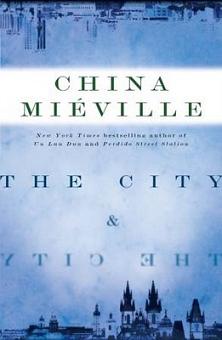
The City & The City — China Miéville

The City & The City


The City & The City
China Miéville
312 pages
published in 2009

Right. China Miéville is one my favourite writers, one of the few (together with Terry Pratchett, Iain M. Banks and Ken MacLeod) I’ll always buy in hardcover. I love the way in which he fuses science fiction and horror and fantasy together into what he himself has called New Weird, essentially a new genre that emphasises the grotesque and baroque sides of its parent genres. What I also admire in Miéville is that he keeps his imagination firmly grounded in a keen appreciation of political and economical realities, no doubt helped by his background as a proper socialist. That combination made Miéville’s creation of New Crobuzon one of the more fully realised cities in science fiction/fantasy. With Miéville there’s always the feeling that his heroes do have to work for a living, that the daily struggle for existence is just as important, if not more as whatever existentialist crisis they’re on the fringes of.

It’s this sense of realism that links The City & The City with Miéville’s earlier novels. Set on Earth in two fictional Eastern European cities with no fantastical or science fictional elements and written as a police procedural: The City & The City cannot be more different from its predecessors. Yet at the core of the novel are the same political and economical themes Miéville always write about. At its best the police procedural is a very political novel, just because policing itself is intensely political — just think about the decisions being made about which crimes to prosecute and which not, which investigations to support and which to starve of resources. There’s therefore a long tradition of writers using the police procedural as a vehicle for social criticsm and Miéville fits in well with this tradition. Of course Miéville being Miéville he does more than that but we’ll get to that.

Read more…

Gil Scott-Heron


Could there be any other poem to honour Gil Scott-Heron for a science fiction fan/space age believer than this?

Depicting Israeli politicians in political cartoons

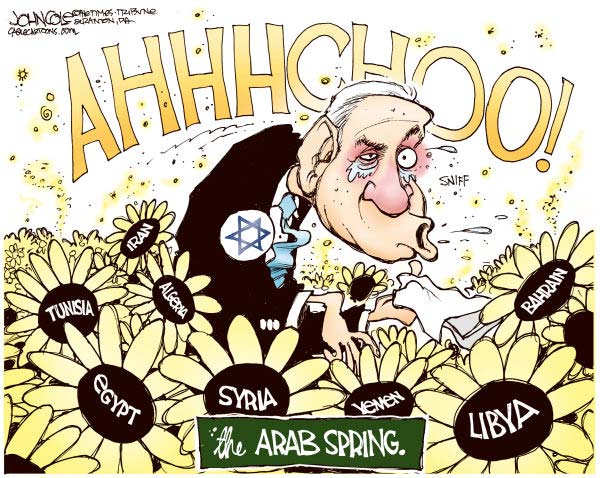
Arab spring cartoon by John Cole

Tom Spurgeon asks:

speaking of something that will be interpreted as mean but I swear I don’t mean it that way, is it weird to anyone else that pinning a Jewish star to the clothing of Israel politicians is an accepted visual signifier? I’ve seen it a bunch this week, and it strikes me as sort of odd.

Is it really that odd? It is after all part of the Israeli flag and hence just as unambigious an visual shortcut as putting a stars and stripes pin on an American politician would be. The cartoon Tom linked to is shown above and it’s not clear which particular Israeli politician is intended (if any) to be allergic to the Arab Spring, but thanks to the Israeli flag pin the joke/trenchant political commentary isn’t lost. For cartoonists not particularly good at caricature or those operating for an audience unlikely to be familiar with what any Israeli politician looks like such a shortcut is essential.

It may be mildly strange or distasteful for those who’d sooner see a star of David in it than an Israeli flag, but considering the alternatives of depicting Israeli politicians, where even well intentioned cartoonists can run into anti-semitic stereotypes quickly, it is a fairly neutral way of showing their Israeliness. Lazy and unoriginal yes, but at least it’s inoffensive, which seems to be the best you can hope for with editorial cartoons. Where it does get squicky is when a cartoonist uses it on a non-Israeli politician, to show they’ve been bought by the Israel lobby. That does reek a bit too much of the protocols of the elders of Zion.

Srebrenica: why humantarian intervention isn’t


The arrest of Ratko Mladić today has put the Srebrenica massacre back in the spotlight. It was the greatest warcrime in postwar European history and it’s our national shame. Srebrenica is the reason why I stopped believing in humanitarian interventions: here finally there had been a clearcut case, a chance to stand against the same sort of evil we had been liberated from fifty years before and we fucked it up.

In Srebrenica Holland had the opportunity to prevent genocide, but instead we enabled it. For fifty years we’ve grown up with the stories about World War II and the moral choices our parents and grandparents had to make, for fifty years we had known that we would’ve made the right choices, that we would have been part of the resistance, as every book, movie and television series told us we would’ve been. Yet at the first real test, the first chance for us to prevent the same sort of evil we had read so much about, we fucked up. Our commanders liked the Serb leaders much better — so cultured and European — than the not quite civilised Muslim combatants. Our soldiers were glad to trade in their guns and bullet proof vests for a chance to go home and tried to think too hard about the men they were supposed to protect. Our politicians spoke of a tragedy and a crime but were firm and insistent that the Netherlands were not to blame, that “our boys” had “done their best” and that there had been nothing more that they could’ve done. It would’ve been better had we not been there.

Had we not been there to establish a safe haven that wasn’t, had we not been there to give people a false sense of security, all those Bosnian Muslims wouldn’t have been trapped there and some 8,000 men and boys might still be alive today. At the very least they wouldn’t have been trapped unarmed and been handed over to their murders so easily. Our humanitarian intervention only make things worse and since then I’ve always been convinced it almost always will.