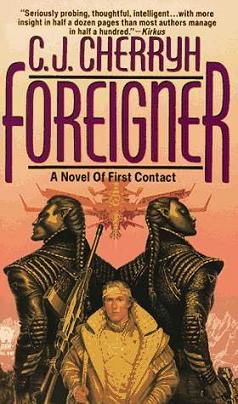
Foreigner – C. J. Cherryh

Cover of Foreigner


Foreigner
C. J. Cherryh
423 pages
published in 1994

Foreigner is the fifth book in my Year of Reading Women project. It is the first novel in one of C. J. Cherryh’s more popular series, yet until now I had never read any of them. She is such a prolific writer that it’s easy to miss a series or two. She also has such a wide range, writing anything from fantasy to space opera, that not everything she writes appeals to every one of her fans. The number of people I’ve known who hated her breakthrough novel Downbelow Station for example…

Yet, once you’ve read a few of her novels, you discover that there is one narrative trick all her stories have in common, no matter what the setting or the plot is. What she likes to do is to take her protagonists out of their comfort zone, get them at their most vulnerable and then put the pressure on. Every one of her novels I’ve read has the same structure. The protagonist is a young man (rarely a young woman) put in a position of responsibility but without power. Usually he’s an outsider in an alien culture, cut off from his own people, in the middle of some sort of political crisis he barely understands let alone can influence. She then let’s this crisis heats up, makes sure her hero gets little to eat and less sleep and is as far removed from the centre of the crisis as possible, yet still has a vital role to play in resolving it, even if he not necessarily knows it. To make sure the reader is as much in the dark as the hero, she usually makes sure they’re only looking at the story through his eyes.

Read more…

Bob Morane

A selection of William Vance drawn Bob Morane covers

Bob Morane is a Belgian pulp series created and written by Henri Vernes, first published in 1953 with some 200 novels appearing since. Rather popular in the French speaking world, it has recieved the obligatory movie and television treatments, including a recentish animation series, as well as a comics adaptation that has run for almost as long as the original series, with the first installment having been published in 1959. Interestingly, the comics were written by Vernes himself, with a number of artists as collaborators, the best of which was William Vance, now best known for his work on XIII. Some of his cover work for the series is shown above. I love the pulp look of them, which could’ve just as well be used on the original books.

The content of these comics matches the covers: pure pulp in the best possible way. Bob Morane and his heterosexual life partner Bill Ballantine get into all sorts of scrapes, working in the traditional adventuring profession of journalist, though for the most part Morane’s job is only an excuse for him to be somewhere exotic. Usually there’s some woman for Morane to flirt with, be they damsel in distress, an opponent or villain, or a fellow adventurier like Sophia Paramount. Most stories stand on their own, though there is a rough sort of continuity with various villains returning several times, especially L’Ombre Jaune, Morane’s arch enemy. Every sort of pop cultural obsession sooner or later found its way into Bob Morane plots, so where you’d have something relatively restrained as Bob and co fighting the mob or getting caught up in a revolution in a fictional Central American country in one album, the next could see them going on a dinosaur or flying saucer hunt, or getting caught up in the schemes of one of various criminal masterminds and mad scientists littering the series, or even traveling through time saving the world from L’Ombre Jaune’s latest scheme.

None of it is any great shakes as literature, or even rising to the level of a top flight adventure series like Bernard Prince or even Bruno Brazil, but as light entertainment they do well. Especially with Vance drawing, who always brings a bit of extra class to even the most formulaic of adventure series. And Bob Morane inspired perhaps the greatest French New Wave pop song; Indochine’s L’Aventurier:


Paul Gillon 1926-2011

Not the best way to start the day, learning that Paul Gillon had died. One of the giants of French comics, with a career dating back to the 1940ties and who was still producing new work as recently as a few years ago, Paul Gillon was never as well known as e.g. Moebius in English speaking countries, with little of his work having been translated — as per usual Lambiek’s comiclopedia hasa good bare bones overview of his career. For a more extensive tribute to him, the ActuaDB obituary Tom Spurgeon linked to is a good start, though obviously in French.
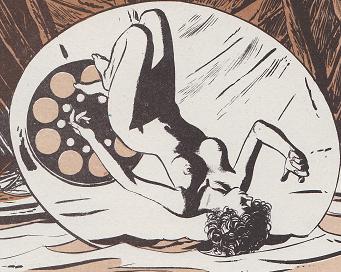
one example of Paul Gillon art

For me personally Paul Gillon was the man behind one of the best science fiction comics ever created, Les Naufragés du Temps (Castaways in Time). The first story in this series was published in 1964, in collaboration with another French giant, Jean-Claude Forest, who scripted the first four albums. Gillon returned to this series in the late seventies, taking over writing duties from Forest with the fifth story, having updated some of the original stories first. With and without Forest, in Les Naufragés du Temps Gillon managed to create a mature, lush space opera, almost Vancean in the interesting worlds it showcased, with a big dose of New Wave sensibility.

The series revolved around Christopher and Valerie, cryogenically frozen and launched into elleptic orbits around the Sun at the end of the twentieth century when Earth was suffering an attack of extraterrestial spores. A thousands years into the future Christopher is woken up and goes on a quest to find his lost love. Though he is quickly reunited with Valerie, plot twists and circumstances keep interfering and it doesn’t help that he seems to be falling in love with every other woman in the series as well. There’s Mara, the no-nonsense scientist who helped recover Christopher from his slumber, the little girl robot assassin Bébbé, the whore Quinne, whose left hand was mutated into a giant claw by the series’ main villain, the Tapir: all fall for him as soon as they meet him. It’s very seventies in this regard, with a lot of bare boobs and a bit of softcore sex.

Most of the stories sees Christopher and his allies and friends move around the Galaxy trying to escape from the clutches of the Tapir and the various other villains, searching for Valerie and discovering new exotic locales. Gillon had a flair for those. In the fourth album for example, “L’Univers Cannibale”, Christopher and co move through a wormhole into another universe — in the end it turned out to be a literal wormhole, that universe being a giant cosmic tapeworm!
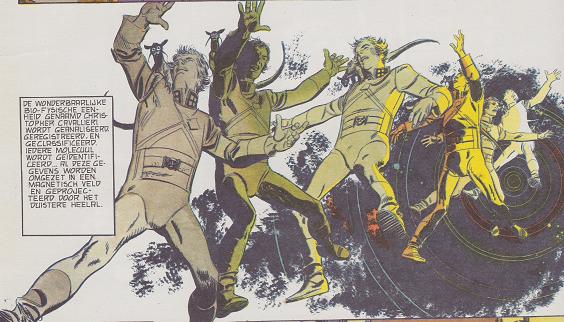
another example of Paul Gillon art

Paul Gillon’s art is instantly recognisable, in the realistic tradition, but unlike anybody else working in this tradition. There’s a static feel to his art and composition, his characters caught just before or after a moment of action, posed even when fighting for their lives. They have no sense of movement, even when in full flight — Gillion is an artist who uses little exagerration to show movement, which lends a stilted quality to his art. His characters are not handsome, with Christopher not just being a bit on the porky side, but definatively balding too, a convincingly middle aged man. His female characters are more conventionally pretty, but not the classic femme fatales and pinups of other comics. They’re pretty in a way that a woman you see in the street is pretty, not supermodel pretty. In general all his characters seem drawn from life, without being too obviously based on a particular model.

Part of Gillon’s appeal as an artist is that he was, even more so than the average Metal Hurlant/Heavy Metal artist, not adverse to drawing pretty women having sex. This is still somewhat restrained in Les Naufragés du Temps, but takes centre stage in his next science fiction series, La survivante, about a young woman who’s the only survivor of the apocalypse that left all other people dead, but their world undamaged and filled with robots eager to do her bidding to fullfill their programming. Which includes quite a bit of sexual stimulation as well. This may seem juvenile and prurient, but Gillon’s interest in these matters is genuine as far as I can determine; it’s present in all of his work I’ve read.

Les Naufragés du Temps has only had its first four volumes translated into English, all long out of print. In this golden age of comics publishing, with more comics being reprinted than ever before, surely there’s some publisher willing to take a gamble on a series of just ten albums of one of the best science fiction series ever published?
Guess what didn’t happen yesterday?


It’s been incredibly annoying to have to struggle through all the coverage of one loon/conman’s (strike which is applicable) idea of when an why the world will end, all done in a jocular fashion but with a bit of whistling past the graveyard mixed in. It all makes for lazy, easy reporting and since that’s the sort of thing reporters like best, we got saturation coverage.

As an atheist this annoys me, but coming from a background of sensible protestant Christianity it offends me to see this brand of lunacy protrayed as the face of an entire religion. The socalled Rapture is a cheat, a way for people who don’t have a clue about the real meaning of their religion to get out of the hard work of being Christian. We were told in school that “the kingdom of heaven is within” and we’d have to build a new Jerusalem on Earth ourselves, rather than wait for salvation from on high. With the Rapture and everything associated with it, you can short circuit that whole tedious work of actually improving the world and get to heaven directly. It’s Christianity for wankers.

And now proper churches have to clean up the mess this particular brand of wanker left behind.

Cheap Segars

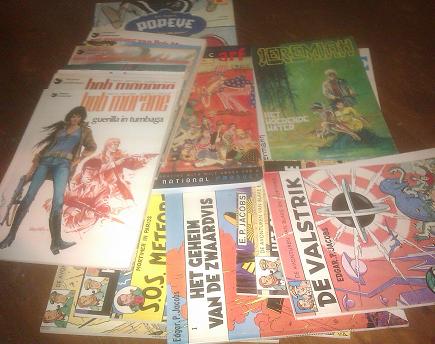
comics bought today

The result of a day shopping for comics. Quite a lot of E. P. Jacobs’ Blake and Mortimer, several William Vance drawn Bob Morane, a Jeremiah I needed, the first album in the Comanche western series also drawn by Hermann and the two absolute toppers: Comic Arf, a collection of Craig Yoe’s comics obsessions and volume 2 of the Fantagraphics’ E.C. Segar’s Popeye series. Which only cost me ten euros at the English remaindered shop at the top of Kalverstraat. And they got a whole stack of them left, so if you’re in Amsterdam…