Mitchell and Webb explain the origin of The Apprentice which is surprisingly plausible. It is just watching monkeys at the zoo for those of us who wouldn’t stoop to watch Big Brother or The X-Factor. Not that there’s anything wrong with that.
More Dutch comics awards

I hadn’t heard of the Benelux Beeldverhalen Prijs, but apparantly it’s a competition sponsored by Dutch newspaper NRC Next, the Dutch Fund voor Visual Arts, Design and Architecture (Fonds voor Beeldende Kunsten, Vormgeving en Bouwkunst (FBKVB)) who also sponsor the Marten Toonder Award and comics publisher De Vliegende Hollander (at least, they did so last year; couldn’t see if they were involved this year). The five best entries are published in NRC Next this week, with the top three also winning cash prizes of 1,000, 500 and 250 euros respectively. This year there were some 84 entries, down from the 112 last year. The top fifty entries will be exhibited in Art Gallery 37PK in Haarlem.
I found out about this award through a small newsitem on the FBKVB website, which sadly does not list the winners. It’s strange how little I could find online about this year’s award, when the winners are already being serialised, even at NRC Next‘s own site. A missed opportunity.

Compare this with the Jan Hanloprijs, a biannual literary award founded in 1999 in memory of poet and prolific letter writer Jan Hanlo on the thirtieth anniversary of his death, to honour essay writers. This year the Hanloprijs added a media essay category to its two existing ones (for best original essay and best essay collection) “to promote the idea that the qualities of a good essay are not limited to prose” and chose comics as the inaugural medium, thanks to the support of the FBKVB.
According to Michael Minneboo ( Dutch) fortytwo cartoonists entered a comic essay for the award on the theme of “senses”, based around a Jan Hanloo quote stressing the importance of senses other than sight. An anthology of the ten entries the jury liked the best was published in a print run of 500 copies. Which sadly is not available commercially, a shame, as the list of participating creators is quite strong: Bas Köhler, Gerrie Hondius, Albo Helm, Jeroen de Leijer, Sam Peeters, Wouter Gresnigt & Kasper Peters, Milan Hulsing and Margreet de Heer, with the winner being Jeroen Funke (one part of the Lamelos collective), who got 1500 euros for his troubles. He won with his strip “Spruitjes, Bier, Leverworst”.
While both the Benelux Beeldverhalenprijs and the Jan Hanloprijs handed out awards this week, only the latter had the nous to actually announce who the winners were. Or at least to do so in a way that I could easily find out who they were….
Cowboy Feng’s Space Bar and Grille — Steven Brust
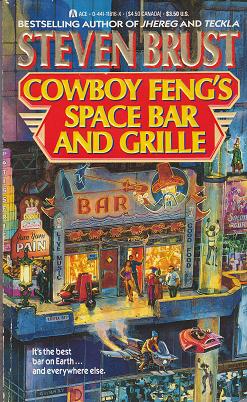
Cowboy Feng’s Space Bar and Grille
Steven Brust
223 pages
published in 1990
Sometimes when I’m depressed I go on a book reading binge — I managed to read every Wheel of Time book up to Lord of Chaos in a week when I was at a low point during my time at college. Pure escapism, fleeing into a story to temporarily ignore the world around me. A few weeks ago I fled back in that habit when my wife was having a very bad night, the day before she had to go back to hospital again. I was sleeping on the couch to try and give her an easier night’s sleep but then couldn’t sleep myself, so I grabbed the nearest book at hand. This turned out to be Cowboy Feng’s Space Bar and Grille.
Which perhaps wasn’t the best book to keep the night terrors at bay. Cowboy Feng’s Space Bar and Grille is a strange book, if only because it’s one of Steven Brust’s rare science fiction novels, but also because it’s a light adventure story about a Strange Bar, set amongst a series of nuclear holocausts. Amongst Brust fans it’s apparently a bit of a controversial book with some hating it, but for me it was the right book at the right time. It may be strange to think of a book that has a succession of nuclear wars at its heart as comforting, but that’s what it was.
It’s comforting because Brust makes it so. The nuclear death is in the background, while in the foreground we get the story of the bar that has the best matzo ball soup in the galaxy, as well as some of the best Irish musicians. Whether or not Billy, the protagonist narrating the story in first person, counts himself amongst them remains unrevealed. This is the picture you get in the first few sentences and the cozy atmosphere it evokes neutralises much of the existential dread the nukes evoke. It reminds me of the urban fantasy people like Emma Bull and other of the Scribblies — a group Brust of course belonged to too — were writing in the eighties.
Satoshi Kanazawa is still a massive douche
Having a relatively old blog means you can see certain subjects coming back again and again over the years. One of such is the sheer stupidity and nastiness of Satoshi Kanazawa. In 2006 I posted about his bizarre theory that Asians cannot do science properly, two years later about his masturbatory fantasies of having Ann Coulter in charge of the War on Terror. Today he’s back in the news again for saying that evolution made Black women unattractive, especially to middle aged evolutionary psychologists paid to spout scientificesques excuses for prejudiced bullshit.
Not to long ago the London School of Economics was pilloried for taking money to let one of Khadaffi’s sons study there. Yet I think the LSE should be more ashamed for having Kanazawa on its staff…
Holland’s Glory: Minck Oosterveer draws Spider-Man

Minck Oosterveer is an old school Dutch newspaper cartoonist who used to do several adventure strips for Holland’s largest newspaper, until it dropped all of them. He was the last to work in this tradition, the last Dutch creator to have his own adventure strip. Unfortnately the Dutch comics market, both in newspapers and otherwise, has little room for him. His recent work on the Storm series, originally drawn by the legendary Don Lawrence, sold relativelt well but was intensely disliked by the fans, while his western series for the reborn Eppo, Ronson Inc also failed to set the world on fire, cancelled after two albums.
But where the Dutch comics market had no room for him, he has managed to get a foot on the ladder in the US. After a try out story for Boom! Studios, Oosterveer worked with Mark Waid on two miniseries: The Unknown and The Unknown: The Devil Made Flesh. From there he followed Waid to Marvel, working on at least one issue of Ruse and that in turn led to work for the miniseries Spider-Island: Deadly Foes. All relatively small beer perhaps, but it still pays better than working for Dutch publishers does, as he admitted in an interview Michael Minneboo had with him a couple of months ago:
Marvel betaalt royalty’s en het beginnerinkomen is indrukwekkender dan het eindinkomen dat je hier kunt verdienen. De enige die nog een paginaprijs betaalt is stripblad Eppo. Maar daar krijg je per pagina de helft van wat ik bij Marvel ga verdienen. In Nederland kan ik eigenlijk niet meer rondkomen met strips maken. Dat kun je de Nederlandse uitgevers niet kwalijk nemen, want de albumverkoop is hier gewoon te laag.
Marvel pays royalties and the money you start with there is more than you could earn here. The only ones still paying a page rate is Eppo strip magazine. But there you get half of what I’m going to earn at Marvel per page. In the Netherlands I really can’t ake a living from comics anymore. You can’t blame Dutch publishers for it, because album sales here are just too low.
And this is a cartoonist who has been working for years and this year even won the Stripschapsprijs, the Dutch equivalent of an Eisner, for his entire career as one of the few people working in a realistic drawing style in the Netherlands. Yet now he too has had to abandon the Dutch market for greener pastures…
On the one hand it’s very nice to see a Dutch artist managing to build a career in the US comics market, definately not an easy market to break into. On the other hand it is a symptom of how bad the Dutch market is, that even veteran cartoonists cannot make a living off it anymore.