Same as it ever was

So it turns out the 101st Flying Keyboard Division is off all times, as Joseph Addison could already satirise their breed in 1709:

…More hard than that of the soldiers, considering that they have taken more towns, and fought more battles. They have been upon parties and skirmishes, when our armies have lain still; and given the general assault to many a place, when the besiegers were quiet in their trenches. They have made us masters of several strong towns many weeks before our generals could do it; and completed victories, when our greatest captains have been glad to come off with a drawn battle… It is impossible for this ingenious sort of men to subsist after a peace: every one remembers the shifts they were taken to in the reign of King Charles the Second, when they could not furnish out a single paper of news, without lightening up a comet in Germany, or a fire in Moscow.

As quoted in Brendan Simms’ Three Victories and a Defeat: the Rise and Fall of the First British Empire, a military/political history of Hanovarian Britain from the ascent of George I up to the defeat in the American Revolution. A good read so far, very traditional in its narrative and focus which unfortunately does mean a lot of “Britain is propping up Austria to counter France and so keep the Balance of Power in Europe but oh no, now Austria is too powerful and Britain needs to swing behind Spain to counter Austria and so keep the Balance of Power”.

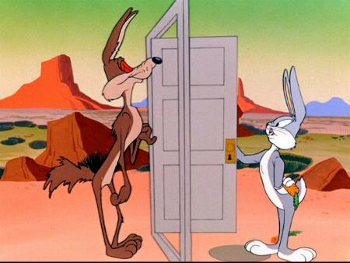
Scott E. Adams, supergenius

Wile E. Coyote, supergenius

James Nicoll links to a Gawker post on how Scott Adams has been trolling MetaFilter under a pseudonym. So far, so Mary Rosh, but what struck me was how his alter ego “PlannedChaos” defended Scott Adams:

As far as Adams’ ego goes, maybe you don’t understand what a writer does for a living. No one writes unless he believes that what he writes will be interesting to someone. Everyone on this page is talking about him, researching him, and obsessing about him. His job is to be interesting, not loved. As someone mentioned, he has a certified genius I.Q., and that’s hard to hide.

Emphasis mine. That’s the hallmark of a true internet kook that is, that insistence on being a supergenius, too smart for your opponents to understand. It’s one consequence of the Dunning Kruger effect: people who are too obtuse to realise how dumb they are tend to overestimate their IQ as well, not to mention the importance of IQ as a real measure of intelligence.

(That this is not an exclusive internet phenomenon can be seen in Chuck Jones’ “Wile E. Coyote, Supergenius” cartoons, hence the title.)

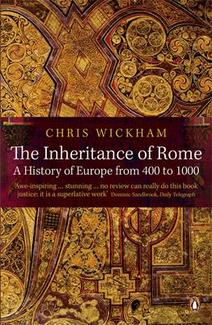
The Inheritance of Rome — Chris Wickham

The Inheritance of Rome


The Inheritance of Rome 400-1000
Chris Wickham
651 pages including index
published in 2009

The way you learn about history as a kid, both in school and through pop culture is as discrete chunks. You got your prehistory, your Bronze Age, your Greeks and Romans, your Biblical Times if you’re in an Christian school, your Middle Ages and so on and so weiter. It’s comprehensible, makes history all very neat and tidy and of course completely wrong. This is not a new truth of course, but it was driven home for me once again by Chris Wickham in The Inheritance of Rome, which is all about showing the continuity the Early Middle Ages had with the Late Roman Empire, without being blind to the ways in which Europe evolved away from its Roman era roots during this period. There is no bright line you can draw that divides these two eras.

Nor is there a Dark Age. As Wickham puts it in his introduction, the centuries between the Fall of Rome and the Central Middle Ages, between 400 CE and 1000 CE, tend to fit it awkwardly with the traditionally whiggish view of history as one of inevitable progress leading from antiquity to modern times, where Classic Antiquity can be seen as a vanished Golden Age, with the Renaissance or Late Middle Ages as the starting point for that story of inevitable progress, the centuries inbetween banished to the awkward limbo of the Dark Ages. When these centuries were treated in traditional history it was because that’s when modern European nations like France or England got their first start. Neither view sits well with Wickham, who argues that these essentially teleogical views of this transitional period, judging them in the context of what came after them, give the wrong image. You have to look at this time on its own terms rather than trying to glean the beginnings of future developments in it.

Read more…

Can’t fight it

Depending on your perspective, this is either the most cute or the most disturbing thing you’ll see all day: a penguin being tickled. Don’t worry: it seems to like it…