
Comes this ad for the new “royal” Willem vibrator, bright orange for that special Queensday vibe. How the real queen thinks about this offer is not on record.
Comes this ad for the new “royal” Willem vibrator, bright orange for that special Queensday vibe. How the real queen thinks about this offer is not on record.

James Nicoll links to a Gawker post on how Scott Adams has been trolling MetaFilter under a pseudonym. So far, so Mary Rosh, but what struck me was how his alter ego “PlannedChaos” defended Scott Adams:
As far as Adams’ ego goes, maybe you don’t understand what a writer does for a living. No one writes unless he believes that what he writes will be interesting to someone. Everyone on this page is talking about him, researching him, and obsessing about him. His job is to be interesting, not loved. As someone mentioned, he has a certified genius I.Q., and that’s hard to hide.
Emphasis mine. That’s the hallmark of a true internet kook that is, that insistence on being a supergenius, too smart for your opponents to understand. It’s one consequence of the Dunning Kruger effect: people who are too obtuse to realise how dumb they are tend to overestimate their IQ as well, not to mention the importance of IQ as a real measure of intelligence.
(That this is not an exclusive internet phenomenon can be seen in Chuck Jones’ “Wile E. Coyote, Supergenius” cartoons, hence the title.)
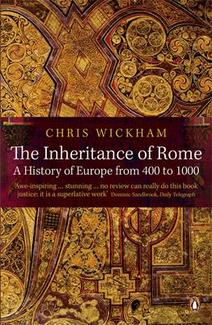
The Inheritance of Rome 400-1000
Chris Wickham
651 pages including index
published in 2009
The way you learn about history as a kid, both in school and through pop culture is as discrete chunks. You got your prehistory, your Bronze Age, your Greeks and Romans, your Biblical Times if you’re in an Christian school, your Middle Ages and so on and so weiter. It’s comprehensible, makes history all very neat and tidy and of course completely wrong. This is not a new truth of course, but it was driven home for me once again by Chris Wickham in The Inheritance of Rome, which is all about showing the continuity the Early Middle Ages had with the Late Roman Empire, without being blind to the ways in which Europe evolved away from its Roman era roots during this period. There is no bright line you can draw that divides these two eras.
Nor is there a Dark Age. As Wickham puts it in his introduction, the centuries between the Fall of Rome and the Central Middle Ages, between 400 CE and 1000 CE, tend to fit it awkwardly with the traditionally whiggish view of history as one of inevitable progress leading from antiquity to modern times, where Classic Antiquity can be seen as a vanished Golden Age, with the Renaissance or Late Middle Ages as the starting point for that story of inevitable progress, the centuries inbetween banished to the awkward limbo of the Dark Ages. When these centuries were treated in traditional history it was because that’s when modern European nations like France or England got their first start. Neither view sits well with Wickham, who argues that these essentially teleogical views of this transitional period, judging them in the context of what came after them, give the wrong image. You have to look at this time on its own terms rather than trying to glean the beginnings of future developments in it.
Depending on your perspective, this is either the most cute or the most disturbing thing you’ll see all day: a penguin being tickled. Don’t worry: it seems to like it…
Alex asks whether politicians learned anything from the News of the World phone hacking scandal:
Also, did the central government have any communications security at all? Did CESG or MI5 not have anything at all to say about this? Didn’t any of them just change their damn password, or even change their damn number?
Of course not. As a class politicians are the group most clueless about ICT and worst placed to make decisions on anything to do with it and that gets worse the higher up the ranks you get. Most modern politicians these days have never been anything but politicians and in that job you only need a pc as a glorified typewriter, while once you get high enough on the ladder the normal computer scutwork most of us have to deal with day to day can all be fobbed off on interns who’ll print out all the important documents for you. So I doubt they’ve spent any time at all thinking about communications security.
Case in point: several Dutch politicians got hit with a variant of what the News of the World did recently, as investigative reporters from the newsshow Één Vandaag “hacked” their voicemails by trying the standard Vodaphone pincode on them. Quite a few ministers turned out not to have bothered resetting this or even knew that they had to do that. Worse, neither did their IT department. Personally I think having voicemail at all is way too much of a security risk anyway and I’d switch it off altogether if I were in such a responsible function, but than that’s too much of a hassle.
What doesn’t help either is that is how much party political business is interwoven with government responsibilities for modern politicians, meaning that there’s a high risk for cross pollution anway. In an ideal world government ministers would have two or three separate mobiles: one for their job, one for journalists and party workers to reach them on and another for the family, but I suspect most people use the same phone for everything…