Wikipedia finally notices it’s in trouble

Is doomed Wikipedia doomed?

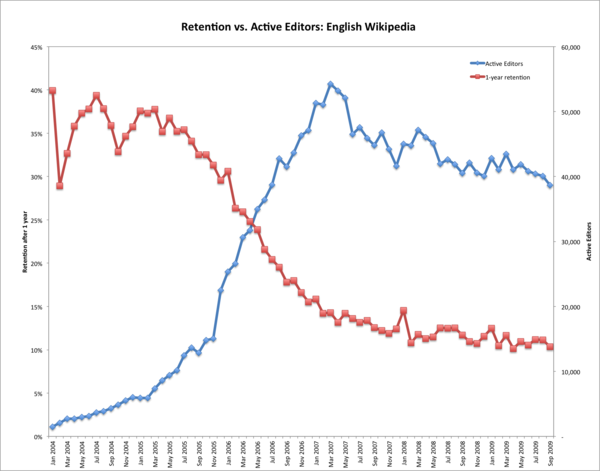
graph showing the rate of active editors versus their retention

Here’s what we think the Editor Trends Study tells us: Between 2005 and 2007, newbies started having real trouble successfully joining the Wikimedia community. Before 2005 in the English Wikipedia, nearly 40% of new editors would still be active a year after their first edit. After 2007, only about 12-15% of new editors were still active a year after their first edit. Post-2007, lots of people were still trying to become Wikipedia editors. What had changed, though, is that they were increasingly failing to integrate into the Wikipedia community, and failing increasingly quickly. The Wikimedia community had become too hard to penetrate.

As the graph shows, while the number of active editors shot up from 2005, the retention rate of editors, those who are still active a year later, shot down. So there are more editors, but they quit editing earlier. Which in turn means that you have a hard core of longterm, dyed in the wool editors who know how to game the system and a much larger mass of people who discover Wikipedia, start editing and usually drop out in a couple of months, either because they lose interest or because they’re driven out by the hardcore. Editing Wikipedia is not fun anymore.

Three reasons for this is: notability, verification and rules lawyering in general. It used to be that Wikipedia culture was fairly tolerant of people following their own interests, putting up entries on lesser known webcomics say and appreciated their efforts. But just when Wikipedia really took off, in 2005-2006, the rules started to change and anything that couldn’t be found in the Encyclopedia Brittannica was suddenly not noticable enough to be in Wikipedia either. The balance in Wikipedia culture switched over from erring on the side of inclusiveness to “when in doubt, delete” — with quite a few editors seeing it as a holy mission to get rid of “fancruft”, insulting and alienating just those people who would’ve made good recruits.

At the same time, responding to a couple of scandals (some more so than others), editing existing articles became harder as well, as verification became the magic word. Every fact had to be verified, linked to some source that proclaimed its truth. It’s not an unreasonable rule, it’s the way it has been used that’s the problem. Too often new editors have had their their heads bitten off for innocently adding facts without verification, or using “suspect” sources, or for using sources not easily verificable or for just happening to disagree with a particular editor’s hobby horse. And verification, like notability is also increasingly used in editor fights, as disagreeing editors nitpick each other’s editors.

Which brings me to the rule lawyering that this emphasis on process over content brought with it. Wikipedia could always be gamed, but when following the rules correctly became more important than actually writing articles, it became that much easier to do so. Too many editors who where more interested in playing this game than in improving Wikipedia became administrators or got themselves in other positions of power and hence warped the project towards their interests. It doesn’t help to improve Wikipedia, but of course winning your fights with other editors because you can twists the rules better is much more important…

However, the fact that the Wikimedia Foundation has finally woken up and recognised this danger is a good sign. Hopefully they will actually do something about it as well: relax the rules on noticability and verification, get rid of the rules lawyering and get back to making Wikipedia a good encyclopedia.

(Via Vuijlsteke.)
Beeldverhaal: new Dutch tv series about comics

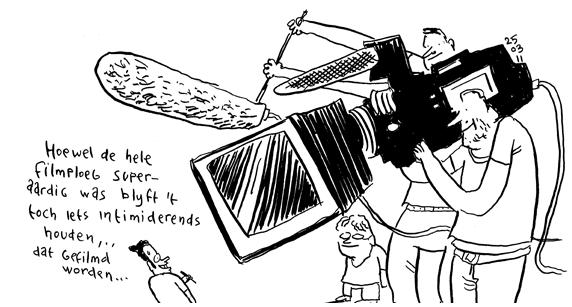
Michiel Pol draws about his experiences with a tv crew

Michael Minneboo blogs about a new Dutch documentary series on comics, to be broadcast in October. Eight parts long, each episode will take a different comics character to symbolise a specific genre or style of comics. SoSuperman will represent superhero comics and why they never quite made it here, while longrunning family strip Jan, Jans en de Kinderen will symbolise the slice of life (auto)biographical strip. The presenter of the series is Jean-Marc van Tol, one of the people behind the runaway succes of Fokke & Sukke and somebody who always seemed interested in not just making strips, but in thinking and writing about them as well; iirc he used to be active on the old Comix e-mail list as well.

The series is going to be called Beeldverhaal (picture story), something of a pune or play on words, as it’s both an old Dutch synonym for comics and in this context, the history of pictures. Those interviewed for it include Barbara Stok, Maaike Hartjes and Michiel Pol — who reported about it in his cartoon diary — so it looks like the documentary makers have taken the time and effort to get to know and understand contemporary Dutch comics and its history. Good or bad, it’s about time Dutch television paid some attention to the ninth art, other than through the annual “look at the weirdos” reports from the big comics cons.

Shaft or Sidney Poitier

“In comics there are two kinds of Black people: Shaft or Sidney Poitier” — Dwayne McDuffie.


A trailer for Jonathan Gayles’ documentary movie on Black masculinity in comics, which came out last year. Its site has a great selection of takes from the movie, to give you an idea of what it’s about. Lots of talking heads of course, but the subject itself is interesting enough for this to not matter. Since it seems to currently do the rounds of various film festivals, it’s not available to buy yet, but I’ll certaintly keep an eye out for it once it does come out on dvd. Especially when the teasers promise things like the influence of the P-Funk mythology might have had on superhero comics and vice versa.


(There was at least one comics writer funky enough to know about George Clinton, Bootsy and Bernie Worrell, Peter B. Gillis, who would Tuckerise them as the founders of A.I.M. in, IIRC, an issue of Supervillain Team-up.)


When I first got into that P-funk cosmic mythology a few years backs, the images that the music put to mind where all pure Kirby. If P-Funk had ever been put into comics, Kirby at his most seventies extravagant would’ve been ideal for it.

Nina


Back in ’87 this was the tune for a Chanel No 5 ad, which in turn led to a rerelease of this tune from 1958 with a videoclip by Aardman animation. I remember there being a whole wave of ad-driven, nostalgia fueled hits for old soul/jazz singers around that time, what with the Levi 501 ads, Jive Bunny and not to mention the similar claymation videoclip for Jackie Wilson’s Reet Petite… But this is the one that stuck with me the most.


And this is what I came across on Youtube while looking for completely different things, a song I’d never heard or seen before, but from the same album as “My Baby Just Cares for Me”, Nina Simone’s debut album. Both songs are jazz standards, originally written for quite different singers, but which of course she completely makes her own. Especially that little bit of Bach iimprovisation on the piano in the middle of “Love Me or Leave Me” left my drymouthed, slackjawed the first time I heard it. I’m normally a rockist at heart and it’s easy to underestimate the power of a song like this, dominated by piano rather than by drums and guitar, but damn this grabs you by the throat.