
It’s just not an English murder with a Black victim

Midsomer Murders creator explains why he wants to keep his murders white:

The ITV1 detective show, which has run for 14 series, ‘wouldn’t work’ if there was any racial diversity in it, producer True-May said.

‘We’re the last bastion of Englishness and I want to keep it that way,’ he told Radio Times.

He insisted he had never been tackled before about the ‘whites only’ rule in the show, which stars John Nettles as Det Ch Insp Tom Barnaby.

He said: ‘I’ve never been picked up on that but quite honestly I wouldn’t want to change it.

‘We just don’t have ethnic minorities involved. Because it wouldn’t be the English village with them. It just wouldn’t work.

‘Suddenly we might be in Slough. Ironically, Causton (one of the main centres of population in the show) is supposed to be Slough. And if you went into Slough you wouldn’t see a white face there.’

Racist, obnoxious, outrageous, call it what you want, but it’s the creative bankruptcy of his statement that explains why I’ve never watched a full eposde of Midsomer Murders. As if you can’t get that specific brand of sophorific excitement with the occasional Black or Asian face, as if the cozy menace can’t be created without some pasty white 1930ties England that never was.

Giefors


Really everything that came out in the seventies or eighties and has some appeal to thirty and fortysomething grownup nerds is being made into movies or tv series these days, isn’t it? Gatchaman is no exception and while the hardcore fan might find anything but the original anime suspect, I suspect this is really aimed at those of us who got to know it under another guise, as Battle of the Planets, bowlderised and chopped to bits as it was. Gatchaman was my first fandom, playing in the sandlot at kindergarten in the very early eighties and fighting over who got to be Mark, Jason, Tiny though not so much the princess or Keyop. Yet back then we didn’t have the slick version shown above; rather we had something like this:


More on the Cancellation of Eisner

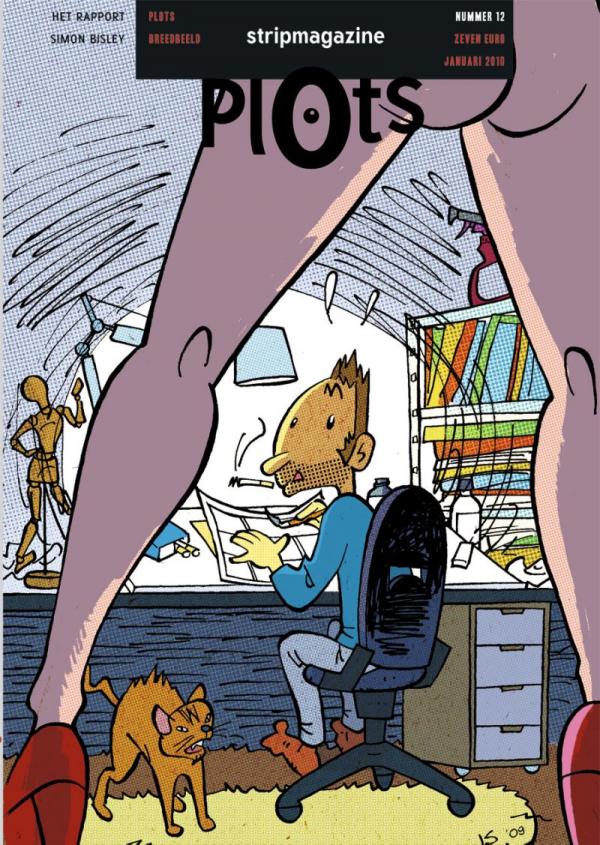
cover of Plots #12 by Jeroen Steehouwer

In the comments thread at Michael Minneboo’s original post (Dutch), Peter Moerenhout responds with his own experiences in publishing a comics zine (also Dutch), the Flemish-Belgian Plots. It’s interesting to read his comments to see the quite different strategies Plots and Eisner used.

Plots got 28,000 euro subsidy to publish twelve issues, nine of which were sold for 5 euro per issue, 2 more for seven euro and one for ten euro, but this was a double length issue. Each issue sold some 600 copies, with the normal issues having 84 pages and the double issue 148 pages. This as compared to Eisner that got 30,000 euro for only five issues and sold them for fifteen euros and managed to sell at most a 1,000 copies or so per issue. The former broke even but the later lost money. The big difference? Eisner paid its contributors but Plots didn’t, if I understood Peter correctly, which meant that they could spent less per issue. Peter also muses that if they had had an actual advertising budget, it might have done better, yet the Eisner people had this but it didn’t matter. Both magazines failed, or at least could not carry on without more subsidies.

Such failure is not preordained: Zone 5300 is a similar sort of magazine that has been mixing comics with the detritius of cult culture since the mid nineties, first as a monthly US comics size pamphlet, currently as a quarterly magazine. It has helped quite a few Dutch cartoonists get their step up from fandom (Maaike Hartjes, Barbara Stok, Jeroen de Leijer, Marcel Ruiter undsoweiter) as well premiered quite a few good international cartoonists for the Dutch language comics market, like Jim Woodring. It has had its ups and downs but so far has always managed to weather the various crisises it went through. It can be done, but you need money, talent and probably quite a bit of luck…

Literay comics zine Eisner cancelled

cover of the first issue of Eisner Beeldverhalen

Eisner is a Dutch literary comics magazine founded in 2008 and published twice a year. So far five numbers have appeared, but there won’t be a sixth, as the publisher has pulled the plug. According to Michael Minneboo’s story (Dutch) even with a subsidy of 10,00 euro each for the first three issues sales never broke even. Eisner only managed to get around 250 subscribers, with about 1,000 issues sold to book and comics shops, though a lot fewer than that actually ever reached a reader.

A sad story for what, as far as I can tell from Michael’s post, seemed like an interesting magazine, an attempt to publish comics aimed at a proper literary audience rather than at grownup comics readers as classic comics zines like Titanic or Wordt Vervolgd (The Dutch edition of A Suivre) used to do in the eighties. As it turned out, this was much harder than it seemed and judging from the sales figures it never found its readers. The main question now is whether this is because that audience just isn’t there, or whether Eisner never was promoted properly to this audience.

One clue might be the first sentence in the previous paragraph. Michael Minneboo’s post was the first I heard about Eisner myself and if I’m not part of its target audience, who is? Somebody like me, who is or used to be seriously comics addicted, who no longer has collecting comics as a hobby, but rather reads comics like they read any other book, who doesn’t necessarily keeps up with comics news all that much but who would try a magazine like this if they stumble across it. Yet Eisner never reached this audience because I never knew about it, so it must have done something wrong..

That is the best scenario I can think of. The worst scenario is that there just isn’t an audience for good comics, or “graphic novel”s as we’re supposed to call grown up comics in the Netherlands now. It might just be that the sales success of a select few “graphic novels” was a fluke, that Persopolis or Logicomix sold so well because of their subject matter and a media hype rather than because these tapped a new literary audience that would be interested in more “graphic novels”. The flood of inferior comics packaged as “graphic novels” won’t have helped either in this regard.

Quite likely the truth lies somewhere in the middle: a magazine that only appears twice in a year and is fairly expensive (fifteen euros per issues) isn’t perhaps the best way to get potential new readers to sample the delights of comics. If you only appear once every six months you get lost in the flood of magazines and you need to keep publicising your existence. The price meanwhile, though obviously needed to break even, is too high for an impulse buy. So it had two strikes against it already, which need excellent p.r. and a bit of luck to find an audience that looks to be smaller than the sales of the few bestselling graphic novels might lead you to expect.

And of course most magazines, comics or otherwise, fail.
Too optimistic

So of course we were too optimistic. S. tonight had to go back to hospital as, probably due to an infection, she quickly got worse again this afternoon. We don’t quite know what has caused it, but fortunately she has been doing better once she was in hospital. Incredibly pissed off: less than a week home is a new record…