More on the Cancellation of Eisner

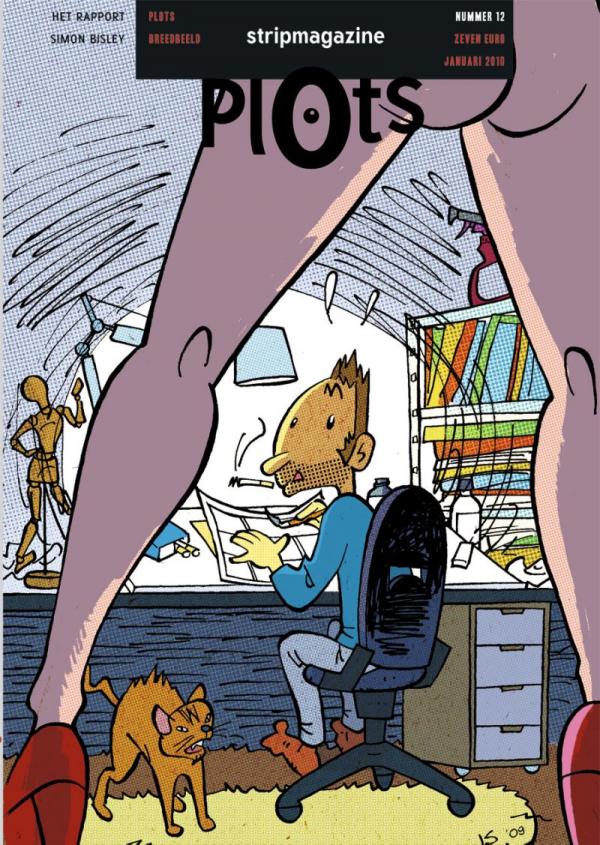
cover of Plots #12 by Jeroen Steehouwer

In the comments thread at Michael Minneboo’s original post (Dutch), Peter Moerenhout responds with his own experiences in publishing a comics zine (also Dutch), the Flemish-Belgian Plots. It’s interesting to read his comments to see the quite different strategies Plots and Eisner used.

Plots got 28,000 euro subsidy to publish twelve issues, nine of which were sold for 5 euro per issue, 2 more for seven euro and one for ten euro, but this was a double length issue. Each issue sold some 600 copies, with the normal issues having 84 pages and the double issue 148 pages. This as compared to Eisner that got 30,000 euro for only five issues and sold them for fifteen euros and managed to sell at most a 1,000 copies or so per issue. The former broke even but the later lost money. The big difference? Eisner paid its contributors but Plots didn’t, if I understood Peter correctly, which meant that they could spent less per issue. Peter also muses that if they had had an actual advertising budget, it might have done better, yet the Eisner people had this but it didn’t matter. Both magazines failed, or at least could not carry on without more subsidies.

Such failure is not preordained: Zone 5300 is a similar sort of magazine that has been mixing comics with the detritius of cult culture since the mid nineties, first as a monthly US comics size pamphlet, currently as a quarterly magazine. It has helped quite a few Dutch cartoonists get their step up from fandom (Maaike Hartjes, Barbara Stok, Jeroen de Leijer, Marcel Ruiter undsoweiter) as well premiered quite a few good international cartoonists for the Dutch language comics market, like Jim Woodring. It has had its ups and downs but so far has always managed to weather the various crisises it went through. It can be done, but you need money, talent and probably quite a bit of luck…
Literay comics zine Eisner cancelled

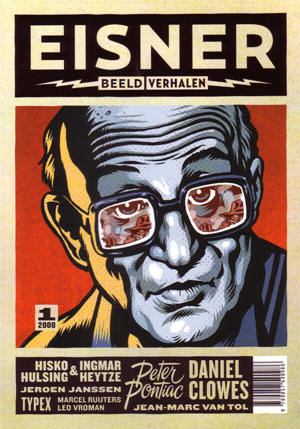
cover of the first issue of Eisner Beeldverhalen

Eisner is a Dutch literary comics magazine founded in 2008 and published twice a year. So far five numbers have appeared, but there won’t be a sixth, as the publisher has pulled the plug. According to Michael Minneboo’s story (Dutch) even with a subsidy of 10,00 euro each for the first three issues sales never broke even. Eisner only managed to get around 250 subscribers, with about 1,000 issues sold to book and comics shops, though a lot fewer than that actually ever reached a reader.

A sad story for what, as far as I can tell from Michael’s post, seemed like an interesting magazine, an attempt to publish comics aimed at a proper literary audience rather than at grownup comics readers as classic comics zines like Titanic or Wordt Vervolgd (The Dutch edition of A Suivre) used to do in the eighties. As it turned out, this was much harder than it seemed and judging from the sales figures it never found its readers. The main question now is whether this is because that audience just isn’t there, or whether Eisner never was promoted properly to this audience.

One clue might be the first sentence in the previous paragraph. Michael Minneboo’s post was the first I heard about Eisner myself and if I’m not part of its target audience, who is? Somebody like me, who is or used to be seriously comics addicted, who no longer has collecting comics as a hobby, but rather reads comics like they read any other book, who doesn’t necessarily keeps up with comics news all that much but who would try a magazine like this if they stumble across it. Yet Eisner never reached this audience because I never knew about it, so it must have done something wrong..

That is the best scenario I can think of. The worst scenario is that there just isn’t an audience for good comics, or “graphic novel”s as we’re supposed to call grown up comics in the Netherlands now. It might just be that the sales success of a select few “graphic novels” was a fluke, that Persopolis or Logicomix sold so well because of their subject matter and a media hype rather than because these tapped a new literary audience that would be interested in more “graphic novels”. The flood of inferior comics packaged as “graphic novels” won’t have helped either in this regard.

Quite likely the truth lies somewhere in the middle: a magazine that only appears twice in a year and is fairly expensive (fifteen euros per issues) isn’t perhaps the best way to get potential new readers to sample the delights of comics. If you only appear once every six months you get lost in the flood of magazines and you need to keep publicising your existence. The price meanwhile, though obviously needed to break even, is too high for an impulse buy. So it had two strikes against it already, which need excellent p.r. and a bit of luck to find an audience that looks to be smaller than the sales of the few bestselling graphic novels might lead you to expect.

And of course most magazines, comics or otherwise, fail.

Too optimistic

So of course we were too optimistic. S. tonight had to go back to hospital as, probably due to an infection, she quickly got worse again this afternoon. We don’t quite know what has caused it, but fortunately she has been doing better once she was in hospital. Incredibly pissed off: less than a week home is a new record…

No Fly-Zone wanking

In the middle of a comment thread on liberal Conspiracy on the desirability of a no-fly zone over Libya, Sunny Hundal says:

I’m happy for people to make valid points, but if the only response is IRAQ IRAQ IRAQ!!! – then frankly one should join Stop the War coalition and hang out with Lyndsey German. That is about the extent of your political nous.

Sunny Hundal is one of the founders of Liberal Conspiracy as the name implies a soft left blog that over the past five years or so has become one of the more important UK political lefty blogs. Sunny has his heart in the right place, but also an eye firmly on a possible political career so sometimes tend to let conventional Westminster wisdom overrule his own intelligence which makes him sound much dumber than he really could be. As a prominent leftist, even a soft leftist, Sunny has also been a frequent target of rightwingers and Decentists, and as with many people who are subjected to such hate campaigns he has internalised some of their assumptions. Put the two tendencies together and you have an explenation for the above quote.

For those of us who can remember as far back to the runup to the Wars on Afghanistan and Iraq, it’s quite clear that “Lyndsey German” (sic) and the Stop the War Coalition were right to oppose them, that all our fears about what these wars would be have been fully justified and that in fact far from the outcast fringe group Sunny paints them as, millions of ordinary people were smart enough to share their views and march with them in opposition.

So if Sunny and co want to argue that a no-fly zone in Libya is urgently needed and that this time, western military intervention will work, that calling for it is done for more substantial reasons than just wanting to show how morally upright and brave you are, that it’s needed in this particular occasion and not say in Ivory Coast for more substantial reasons than that Libya is on the telly, they need to do more than get hysterical. Some choice quotes:

Sunny: If the Libyans rebels want some support against Gaddafi, then I’m afraid the arguments against helping them fall apart.

We definitely need some way to stop Gaddafi massacring his people and its a shame some on the left want to just sit back while it all happens in front of our eyes.

[…]

Galen10: Doing nothing is only an option if you have no conscience.

[…]

Sunny again: Gaddafi’s son Saif Al-Islam says the time has come for full-scale military action against #Libya rebels – Reuters

Clearly, the correct response is to sit by and vent outrage on blogs and twitter while people are killed in their hundreds.

Yeah, nice one guys.

[…]

The delightfully named Rubert Read: I hope y’all will remember this debate, if and when Benghazi is crushed and the Arab Spring is demoralised and essentially finished.

This sort of posturing and emotional appeal reminds me more of the prowar “debate” in the runup to Iraq than anything opponents to the no-fly zone proposal argued in that thread. It’s an attempt at emotional blackmail by people who will never ever have to suffer the consequences of their advocacy. Or more succinctly:

Ok. I hereby announce the formation of the Free Libyan Legion. Since we all care so much, we’re going to follow in the footsteps of Byron in Greece and Orwell in Spain and get ourselves over to Benghazi and actually fight for Libyan Freedom. In person.

Hanco Kolk — Friday Funnies

Hanco Kolk was one of the last Dutch cartoonists to follow a sort of “traditional” career path in comics. Born in 1957, getting sucked into comics as a child and not putting them away when getting older, starting drawing himself, continuing to do so, actually submitting work to a proper comics zine and getting published, doing some work for the Dutch Donald Duck (something of a finishing school for young talented cartoonists for decades) in the early eighties, switching over to working for Eppo, aimed a slightly older kids and where you could do more and actually get credits for your work, getting a few strips under his belt, often working together with Peter de Wit and doing pretty well, culminating in their signature series Gilles de Geus, a historical comedy strip set in the time of the Dutch War of Independence and which in a better universe would’ve been as big a success as Asterix. He and Peter de Wit also did some work for television, including an actual series on how to become a cartoonist in the early nineties. Hanco Kolk seemed destined for a pretty good career doing humour strips for the comic mags and other children’s magazines but something happened in 1993.


That something was Meccano. Set in a fictional city state equal parts Monaco and Sarajevo the series is a cynical look at war, love, society and religion, all done in Kolk’s new style of not quite Clear Line drawing. Each album in the series stands on its own and the second album, “Gilette” is one of the best Dutch comics of the past twenty years. None of them have been translated in English unfortunately, but luckily there is a website.


One of the few Hanco Kolk books that has been published is Club Paradise, part comic, part sketch book, some extracts of which can be found above. Club Paradise is the story of Kolk’s badly timed trip to New York to attempt to break into American newspaper comics or, as he puts it “Exactly one month after nine eleven I decided it was the perfect time to go to New York and sell my comics to newspapers”. That doesn’t work out, he has to spent his time somehow and he ends up drawing people in a sleazy nightclub called “Club Paradise”. There’s nothing more to the story, but it’s the art that makes it worthwhile. Kolk is a master at using just a handful of lines to set down a character, with faces that don’t need noses or ears or sometimes not even anything but a smile, some eyebrows and hair to create the impression of a lap dancer or a hulking security guy. It’s the art of leaving things out, paired down drawing while keeping his lines fluid and elegant. Interspersed with this clean, warm art are the sketches, often in blue ballpoint, much more wiry and dirty, but still with a hint of the elegance of his finished artwork.