Hanco Kolk — Friday Funnies

Hanco Kolk was one of the last Dutch cartoonists to follow a sort of “traditional” career path in comics. Born in 1957, getting sucked into comics as a child and not putting them away when getting older, starting drawing himself, continuing to do so, actually submitting work to a proper comics zine and getting published, doing some work for the Dutch Donald Duck (something of a finishing school for young talented cartoonists for decades) in the early eighties, switching over to working for Eppo, aimed a slightly older kids and where you could do more and actually get credits for your work, getting a few strips under his belt, often working together with Peter de Wit and doing pretty well, culminating in their signature series Gilles de Geus, a historical comedy strip set in the time of the Dutch War of Independence and which in a better universe would’ve been as big a success as Asterix. He and Peter de Wit also did some work for television, including an actual series on how to become a cartoonist in the early nineties. Hanco Kolk seemed destined for a pretty good career doing humour strips for the comic mags and other children’s magazines but something happened in 1993.


That something was Meccano. Set in a fictional city state equal parts Monaco and Sarajevo the series is a cynical look at war, love, society and religion, all done in Kolk’s new style of not quite Clear Line drawing. Each album in the series stands on its own and the second album, “Gilette” is one of the best Dutch comics of the past twenty years. None of them have been translated in English unfortunately, but luckily there is a website.


One of the few Hanco Kolk books that has been published is Club Paradise, part comic, part sketch book, some extracts of which can be found above. Club Paradise is the story of Kolk’s badly timed trip to New York to attempt to break into American newspaper comics or, as he puts it “Exactly one month after nine eleven I decided it was the perfect time to go to New York and sell my comics to newspapers”. That doesn’t work out, he has to spent his time somehow and he ends up drawing people in a sleazy nightclub called “Club Paradise”. There’s nothing more to the story, but it’s the art that makes it worthwhile. Kolk is a master at using just a handful of lines to set down a character, with faces that don’t need noses or ears or sometimes not even anything but a smile, some eyebrows and hair to create the impression of a lap dancer or a hulking security guy. It’s the art of leaving things out, paired down drawing while keeping his lines fluid and elegant. Interspersed with this clean, warm art are the sketches, often in blue ballpoint, much more wiry and dirty, but still with a hint of the elegance of his finished artwork.

Light linkblogging

Learning to Read Adam Roberts and On Learning to Read Adam Roberts
How do you solve a problem like Adam Roberts, a writer every book of which I’ve read I’ve disagreed with and/or disliked? Whom, despite this, I still keep coming back to every few years or so. Bad writers you can dismiss, writers that you dislike you can dismiss, even writers you like and enjoy you can often set aside more easily than a writer that irritates you, like a piece of sand in an oyster.

Vuijlsteke brainstorms the right colours to use in a health check for some server or something
For now he’s settling on a scheme with five colours between dark green and dark red. Myself, I’ve more and more realised anything but three colours (safe, unknown/undecided and danger Will Robinson danger) is overkill and confusing especially to higher management. Really high management (or “overhead”) only needs two: “need to deal with this to be finally rid of this project” and “let the little people worry about this when we’re gone”.

Remember when Iron Maiden got a number one hit?
The discussion is a bit unfair on “Bring your Daughter …to the Slaughter” which is a better live than single track but interesting in seeing people’s opinions about who’s actually listening to metal. The consensus seem to confirm my own hunch that it was both the boys you wouldn’t trust in woodshop with a sharp knife and the more nerdy dreaming types with Tolkien posters and D&D habits as well as people like, well, Ben.

Somebody else fed up with the Holland Uber Alles message of much current advertising
Not to mention in current politics cultural commentary, popular culture… Holland is a decent enough country to live in, if it were not for a large part of the people living in it and their absymal tastes in everything. Dutch culture does not have to be inferior to anywhere else, but by and large we’ve mostly seem to haven given up competing with the big boys and retreated to celebrating our own mediocrity. As long as it drapes itself in orange and clogs and windmills any old shit can sell as shinola.

The Comics Journal has been redesigned and under new management
It keeps its worst aspect though: having to register to be able to comment. I hate sites that do that, especially when if you really feel the need to filter your readers, use OpenID and let people register with e.g. their Livejournal accounts rather than setting up your own crappy registring process. Tor.com does this as well and my comments nine out of ten times still get eaten. Doesn’t endear me to the fsckers.

Exhume to consume

The good people of Crooked Timber are debating the replacement of human labour with machines as if the great robotisation/computerisation debates of the late sixties up to the mid-eighties never happened, nor for that fact the original industrial revolution, as if this has never happened before. But never mind that, at least Henry Farrell managed to get science fiction into the debate which in turn reminded me of Frederik Pohl’s great 1957 novella, “The Midas Plague”:

Frederik Pohl’s Midas Plague Equilibrium under which robots produce consumer goods so cheaply that they flood society, and lead the government to introduce consumption quotas, under which the proles are obliged to consume extravagant amounts so as to use the goods up (the technocrats fear that any effort to tinker to the system will risk reverting to the old order of generalized scarcity). This is a world of conspicuous non-consumption in which the more elevated one’s social position the less possessions one is obliged to have. Crisis is averted when the hero realizes that robots can be adjusted so that they want to consume too, hence easing the burden.

Frederik Pohl is a writer whose heart has always been on the left, having been a card carrying communist before World War II and the Hitler-Stalin pact, remaining a socialist/leftist afterwards, something that has always remained visible in his writing, both his solo work and his collaborations with C. M. Kornbluth in the 1950ties. Their novels The Space Merchants and Gladiator-At-Law are sharp social satires of aspects of 1950ties capitalism projected towards extremes, still relevant and recognisable today. The same goes for “The Midas Plague”. The idea of a world no longer defined by material scarcity is an old one in science fiction, from Iain Banks and his Culture novels all the way back to –as Henry’s post alluded to — E. M. Forster’s The Machine Stops. Where “The Midas Plague” differs from most other examples is that it does not show an utopia, false or otherwise, but a still recognisable capitalist society.

McMansions

It just flips the parameters of our own capitalist society: rich people live simple lives unencumbered by materialist possessions and get to enjoy the challenges of meaningful work, poor people are burdened by mountains of disposable consumer goods, having to spent more time using them up than doing any real work, spurred on by government rationing rather than advertising. The absurdity of this situation, in which ghettos consist of sixtyroom houses in a riot of loud, extravagant styles and poor people are forced to use up seven cars a year and dozens of suits a month makes clear the absurdities of real existing capitalism. The end result, of robots making an endless stream of consumables for other robots to wear out to make more consumables is the perfect endgame of capitalism.

And Pohl’s imagination is actually closer to our own reality than we might care to contemplate. We have after all a middle class that has loaded itself with debt to be able to afford the American dream of the big mansion, two point one cars, HDTV in every room and vacations in Europe, that lives a life that could be mistaken for that of a rich person, but is completely depend on keeping one step ahead of the next credit card payment. Meanwhile there are people genuinely making the argument that because poor people can afford colour televisions and Ipods they are no longer poor, even if they’re living in one bedroom apartments in suburban slums three hours away by bus from their lower than minimum wage job and working three of those to feed their children.

“The Midas Plague” cuts to the heart of that by showing that just having more and more possessions to use up does not make one rich or ruling class if you don’t actually have the power to accompany your “wealth”.

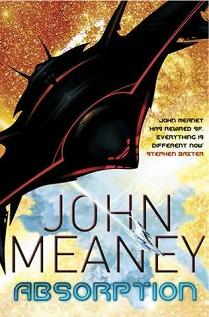
Absorption — John Meaney

Cover of Absorption


Absorption
John Meaney
407 pages
published in 2010

Absorption is the first volume in John Meaney’s new Ragnarok trilogy. It seems to be set in the same future as most of his novels, from his first book To Hold Infinity onwards, have been set. You don’t need to have read those to understand this book, but if you have you’ll know roughly what to expect and will get certain references quicker than a new reader would. In general however it is enough to know that John Meaney is of the same generation of British writers like Richard Morgan, Alastair Reynolds and Neal Asher and writes the same sort of widescreen “hard space opera”, though a bit more cyberpunky.

But Absorption is more than just another space opera novel. You could in fact say that this is not science fiction at all, but fantasy dressed up as space opera. Because while one of the three main storylines is set in Meaney’s standard future of Mu-space pilots with jet black eyes and the computer upgraded Luculenti upperclasses of Fulgor around 2603 AD, the two other storylines are set in 777 AD and 1926 AD and both feature things that look a lot like magic… And with flashes of an even father future in which the main characters of all three storylines meet, as well as hints of magic in the main future storyline as well, who knows what’s really going on?

Read more…

What I did today

Brought this to the garbage dump:

old sofa in the skip

So I could put in this (from a certain Swedish flatpack furniture seller):

old sofa in the skip

All to make sure S. is comfortable when she comes home tomorrow. Also, some cleaning and tidiying up; but not too much or she won’t recognise the place…