Of course one unelected head of state will support another

Queen Bea is supposed to go on a stat visit to Oman and Quatar this weekend. Trouble is, in both countries an unfortunate and badly timed enthusiasm for democracy has broken out which makes the visit of her majesty slightly awkward. Holland is after all supposed to be a beacon of democracy and human rights, a shining example to the rest of the world even if the silent partner of the current government would like to limit those rights to people with the right skin colour religion. We sort of miss the sangfroid of the French, never worried about the rights of those they do not do business with, or the fundamental hypocrisy of the British, able to lecture dictators on the need to allow a fair and transparant move towards democracy while selling them the weapons to prevent this. Don’t worry, this doesn’t mean the queen won’t go or we wouldn’t sell them our leftover tanks: it’s just that we prefer to practise our own hypocrisy and complicity under cover of darkness and are not used to having to braze it out in the full glare of publicity.

Oh and of course we sold weapons to both Quatar and Oman, mostly helicopter (NH-90/Lynx) parts as well as radar, C3 and other electronic equipment, but also short range anti aircraft systems. Not to mention that a lot of foreign arms were shipped through Schiphol to those two countries as well. Holland’s gotta eat and if that means propping up undemocratic regimes by selling them weapons, as long as they are our allies, who cares?

The unbearably whiteness of British literature

The 12 best new novelists look frighteningly white

The BBC is doing another of its tedious “reading is cool and hip and you should read more too or at least watch our programmes about books” promotions. In the process The Culture Show also chose its top twelve new writers and, well, there’s something off about them. It’s not just the facepalmingly awfulness of how the chair of the jury describes what literary fiction is in The Guardian:

What is literary fiction? It is not genre fiction. Hilary Mantel’s Wolf Hall is a historical novel. Kazuo Ishiguro’s Never Let Me Go was shortlisted for the Arthur C Clarke Award, the leading British prize for science fiction. Yet you only have to think about these two examples to see how they escape their genres. Mantel’s novel revisits the favourite stamping ground of historical fiction – Henry VIII and his wives – in order to rethink what it might be to see events filtered through the consciousness of a person from a distant age. Ishiguro takes a dystopian hypothesis – human clones being bred for their organs – and then declines to put in place any of the sci-fi framework that would allow us to understand how this could be. Indeed, the whole interest of his story is in the limits placed upon its narrator. These are both “literary” novels because they ask us to attend to the manner of their telling. And, despite their narrative demands, they have both found hundreds of thousands of readers willing to do so.

But well, doesn’t that group of up and coming literary fiction writers look a bit white to you? Granted, they all look awfully middle class as well, but BBC and Guardian, so let it go. Is the state of literature in Britain so bad that no promising writer of colour could be found?

(Found via BLCKDGRD.)

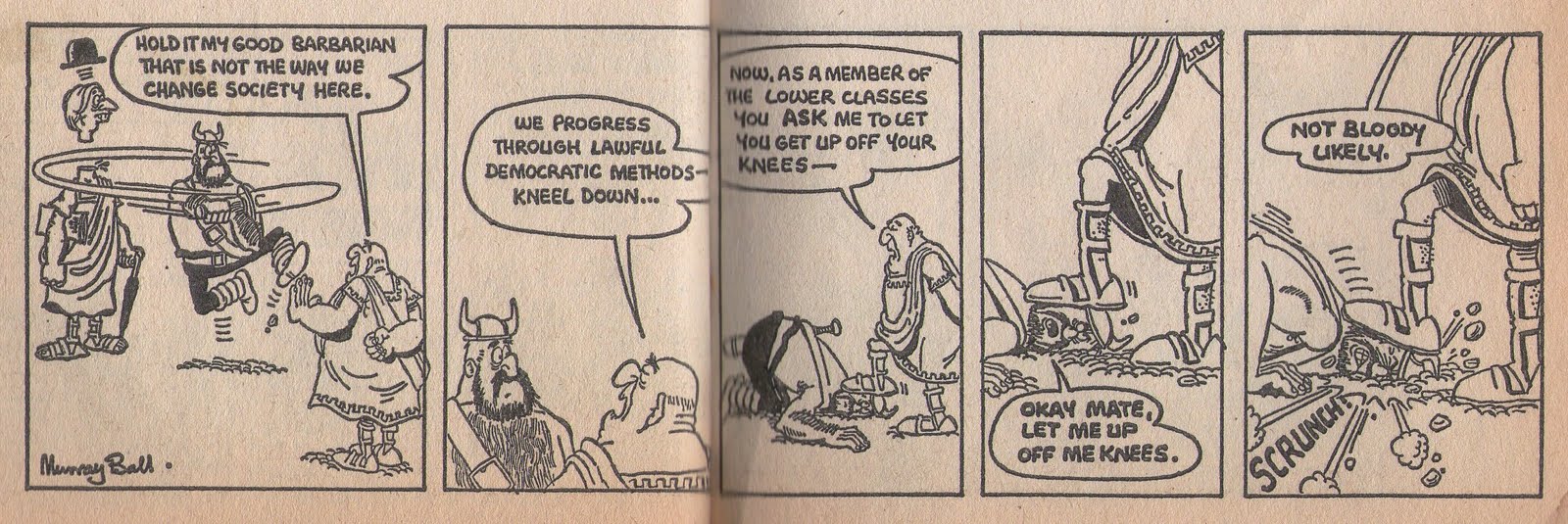
Murray Ball’s Bruce the Barbarian

sample of Bruce the Barbarian

Murray Ball is best known for Footrot Flats, set in the New Zealandian countryside and starring a sheep farmer called Wal, his pointedly nameless Dog, Horse the cat, sof touch neighbour Cooch, Major the pigdog and a host of other animal and human eccentrics. A strip revolving around the great obsessions of New Zealand country life (cricket, lambing, rugby, hunting, the weather etc) it was hugely popular in its home country but barely known outside it, the type of cartoon you find and treasure in some dusty secondhand bookstore and nobody else knows about. I’ve only talked to one other person here in Holland who knew it and she was a Kiwi herself. It turns out Murray Ball also used to do a satirical comic for the Labour party of all people, as discovered by Owen Hatherly:

The premise is a little peculiar, but once you’ve accepted it, the cartoon is not exactly complicated. Bruce, a Barbarian from the East – specifically, New Zealand – comes to invade the (falling) British Empire to ‘RAPE and LOOT and PLUNDER’, but, says the blurb, ‘he found the Tories had got there first!’ So he sets out to ‘save the British from Ted the Tory and grab a fair share of the looting, plundering and raping’. This should give you some sense of the somewhat complex allegiances of the strip, particularly with respect to sexual politics. Various forms of disbelief have to be suspended – most of all the portrayal of Edward Heath, or rather, ‘Emperor Tedius Heath’, as a proto-Thatcherite Roman Emperor bent on class war – but the lack of pissing about occasionally makes for extremely sharp political satire, which the hint of wrongness only helps. It’s Up Pompeii-goes Class War, with Frankie Howerd replaced with an Antipodean barbarian armed with a ‘pig-sticker’, which gets regularly plunged into sundry toga-ed plutocrats.

This is the sort of comic strip that’s most likely to disappear down the cracks of history: done for a specialised audience on a specialised subject, for a publication that has long since disappeared itself, by a relatively unknown cartoonist. Footrot Flats will quite likely be rediscovered and reprinted as long as there are New Zealandian sheep farmers, but Bruce the Barbarian is too rooted in its time and context to be of much interest to anybody but Labour and comics historians…

Dwayne McDuffie — Friday not so Funnies

Dwayne McDuffie was a writer I only learned to appreciate belately. At first I thought he was just another of the endless series of editors turned writers Marvel threw up in the late eighties and early nineties. It was only in hindsight that I realised McDuffie was much better than that, that his writing on Deathlok e.g. was something special, something Tim O’Neill did understand, that Deathlok was asking fundamental questions about the superhero comic:

I can’t think of many – any? – comics that have ever dealt so openly and lucidly with the most basic ethical questions at the heart of superhero fiction: what are the ethical responsibilities of power? When is it ethical to exercise power, and when is it unethical? It’s not simply “with great power there must come great responsibility” – that’s elementary. The real question is whether or not it’s even possible to exercise great power in a responsible fashion.

That was the sort of writer McDuffie was. If you look at his bibliography it looks a bit hit and miss and he never quite got the recognition he deserved. His stints on both Justice League of America and Fantastic Four were short, and in the first case, unhappy. But he was also a cofounder of Milestone, a much needed corrective to the whiteness of standard superhero comics, a not very appreciated corrective. He co-created Static, perhaps the most interesting and original new superhero created in the last twenty-thirty years and if you want to know how how important Static is, just look at how many non-comics readers remember the Static Shock cartoon fondly.

I didn’t know McDuffie as a person, only as a writer and occasional poster on the old rec.arts.comics newsgroups and as a writer I will miss him. The only book of his I actually have in the house right now is a collection of the 2006 Beyond miniseries, which is actually a good introduction to his strengths as a writer. Here you have a fairly silly concept, a sequel to the first Secret Wars miniseries, from back in 1985, in which a group of heroes and villains is yet again transported to the Beyonder’s Battleworld, to fight each other to get all their wishes fullfilled. It’s got a motley crew of characters, the most prominent of which is “killed” in the first issue, while the rest is so mismatched it shouldn’t work, but it does. It works because McDuffie has an excellent grip on each character, from the benign arrogance of Medusa, the gung-ho leadership style of the Wasp, Henry Pym’s insecurity and guilt, to Venom’s unpredictability and Kraven’s flippancy. He also knows how to tell a story, every issue ending on an upbeat, a climax. culminating in the penultimate issue, with the final issue wrapping the whole story neatly up. A fun story that showcases McDuffie’s talent; not the most important comic he wrote, but a good way to get to know him.