Gorey unclaimed by comics or were its claims rejected?

Tom Spurgeon is disappointed no comics creators were present in a NYT article about Edward Gorey:

That’s what it seems like reading this New York Times profile of Edward Gorey, anyway, as authors and designers line up to claim his influence, without a cartoonist in sight. I’ve said this before, but it intrigues me that someone whose major works embody both the Scott McCloud (sequential narrative) and RC Harvey (verbal/visual blend) definitions of comics gets so little mention by and, actually, seems to have little direct influence within, the medium in which he seems to have worked.

I wonder if this is an example of comics not claiming its own, or more a case of the NYT not letting cartoonists in to the party. Neil Gaiman is quoted, but only as the author of Coraline, not for his comics work, which has its Gorey influences as well. More generally, with a respectable cartoonist like Gorey, there is as much a tendency for the wider art world to seperate him from his comics context is as there sometimes is for the comics world to disown him. It’s a pattern we’ve seen time and again, with people like Gorey, Al Hirschfeld or Charles Addams, or even Art Spiegelman with Maus.

Obsolete ideas about high brow art versus low brow commercial product still determines the framework in which we think about comics and individual cartoonists. From a comics theory point of view whether a cartoonist’s work is published in in the New Yorker or Action Comics might not matter, but in practise it does reflect on how people percieve him: as a caricaturist/social commentator working in a highly respected tradition of satirical drawing dating back to at least the 18th century or as just another hack doing work for a medium held in contempt almost from its inception. Consciously or unconsciously, this sort of consideration will have helped shaped that NYT profile. Because Gorey was published in respectable, high art venues, the sort of people that will be asked to provide quotes for this profile will be novelists and film makers rather than cartoonists.

At the same time, with creators that do manage to break out of the comics ghetto something more insidious happens. From Spiegelman onwards, what you see is that their work is decontextualised, treated as a singular occurrence rather than as a work of art which is part of a wider tradition. Again, this is not necessarily done consciously, but just part and parcel to the way in which the respectable media ignore the low rent comic book. That usually, something like Maus or Fun Home is respected more for its subject matter than its strengths as a comic.
Low rent but effective


The political commercial shown above was made for the provincial elections last Wednesday, by a CDA candidate who was put on a normally unelectable place in his party’s election list. It shows a man and woman together in bed, the woman asking the man what his tattoos mean. He answers he doesn’t know but just likes how they look. The woman answers that she would never put something on her body she doesn’t understand and tells him she has a tattoo too: cue closeup of her bum with the CDA logo on it…

It led to a bit of controverse (the CDA not being a party much given to using sex to sell itself) but it got the guy noticed enough to get him elected. Sex sells, even in elections normally ignored by the great unwashed.

S. is coming home

So after more than a year of going in and out of hospital and her not having been home since early July last year, she’s finally well enough to try once again to leave the hospital. She’s already been home on trial for a day last Saturday and from Tuesday she’ll stay indefinately. It’s going surprisingly quick after such a long wait; we had expected to have a couple more trials first. Not that we’re complaining of course; it just means a lot more work for me getting the house back in order…

So you may get some lighter posting than you’re used to here. I don’t think anybody will begrudge me that…

Books read February

Though February is a short month, I still read much less than I should’ve. Only four books, three of which cost me a bit of trouble and one of which I would not have finished if it hadn’t been for my “Year of Reading Women” project.

Among Others — Jo Walton
A coming of age story a very many science fiction fans can recognise parts of, but with a certain kind of magic mixed in. A book that, if you recognise yourself in the protagonist, keeps you grinning for days after finishing it.

Bold as Love — Gwyneth Jones
In a near-future, dissolved England, rock ‘n roll revolutionaries take over real power in a country beset by ecological problems, internal strife and political unrest. Uneven, but much better than this quick summary makes it sound. This took me more time to read than I expected.

Sons of the Conquerors — Hugh Pope
Though located in the history section of the local library, this was more of a travelogue, though dense with history. Hugh Pope is a writer and journalist who has long lived in Turkey and been fascinated by the Turkish peoples, who comes across and oldfashioned Turcophile.

Swordspoint — Ellen Kushner
One of those books that’s published as fantasy and reads as fantasy, but could just as well be a straight historical romance: sword and sorcery without the sorcery. Nicely written but again a book I did longer over than I normally would’ve.

Unbearable whiteness of British science fiction

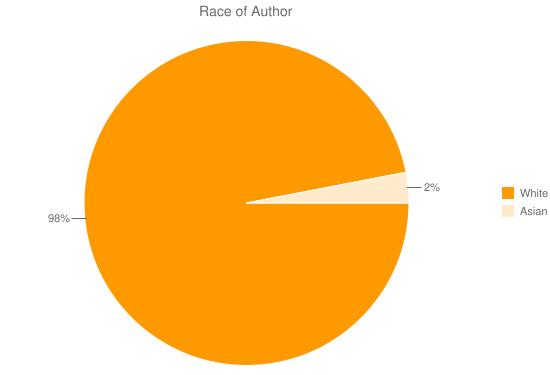
Pie chart depicting the race of 2011 Clarke Award submissions

Everything is Nice has some nice, juicy posts up analysing the eligible submissions for the 2011 Clarke Award. The Clarke Award is awarded annually for the best science fiction (or fantasy) novel published in the UK the previous year. It doesn’t have a long list but a short list is selected from all submitted novels; those submissions cover roughly 90-95 percent or so of new sf&f novels being published in the UK each year. Some works of course always slip through the crack, especially from non-sf publishers who don’t know or care about the awards. The Clarke Award submissions list than is a good, but not perfect indicator of the state of the UK’s sf publishing industry and as such Martin Lewis has analysed them, which resulted in e.g. the figure above.

In other words: sf publishing is only marginally less white than the group of writers the BBC thinks represents the future of British literary fiction. And worse, it has a much bigger gender imbalance: only 17 percent of the 54 novels submitted this year were written by women. Martin also looks at other identity markers (sexuality, nationality) and it all points to the conclusion that it’s largely straight, white British or American men that were published last year. (The raw data for all this can be found at Torque Control. )

The questions this inevitably puts to mind are a) is this analysis reliable when applied to the general state of the UK’s sf&f publishing industry as opposed to just the Clarke Award submissions b) is this a bad thing (imo: yes) and c) what can we do about it?

Assuming the answer to a) and b) are both yes, the question what we readers can do to change this situation is a difficult one to answer. You can only buy what’s being published after all and if only two books out of fifty-plus are by people of colour, how big an impact will it have when enough people buy their books? It’s easier to send a signal by boycotting a given company’s products, not so easy to express a preference through your buying habits. More projects and media attention to under represented people in science fiction as with the various “women sf writers” reading projects started this year would be a start, but are only suited to provide attention to this problem, not solve it. Suggestions?