Abandoning outdated socialist cliches — yes please!

Jack Crow’s post, “abandoning the past sometimes allows you to see better the present…” starts off well, but dissolves into a familiar prolier-than-thou appeal to drop “our” preconvictions about revolutions and who should lead them:

The working class, the colonized, the oppressed, the alienated and the poor don’t need theories conjured up in academic discussions, in the coffee houses which line the well paved streets of upper class neighborhoods. They don’t need special vocabularies and essays on superstructure, intersectionality and sociocultural meta-meta critique.

If there’s any socialist cliche that needs abandoning it’s the supposed contradiction between the educated ivory tower intellectual and the oppressed working classes. It’s the leftwing version of the “salt of the earth, white working class man telling it like it is”: only evoked to push through the writer’s own prejudices. Crow wants to have his cake and eat it too, by both putting himself above the “The working class, the colonized, the oppressed, the alienated and the poor” and telling us that he knows what they want.

This sort of rhetorical trick presupposes both that intellectuals cannot be part of the working classes and that the working classes cannot do theory, cannot be intellectuals themselves. This sort of distinction might have made some sense in the nineteenth century, but in today’s world most of us “intellectuals” are just as much wage slaves as your average factory workers are.

Jack Crow very much has a point that reifying dead, white Marxists is counterproductive when it comes to understanding why the Egyptian revolution is happening now, that even Marx himself can be wrong or outdated and that his works at best hands us a tool to help understand the world, not a prefabricated solution. A pity he falls into the same outdated cliches himself at the end of his post.


Killing for England — Iain McDowall

Cover of Killing for England


Killing for England
Iain McDowall
305 pages
published in 2005

I picked up this book because I thought it was by a writer I sort of knew, then kept looking when it became clear McDowall wasn’t the writer I was thinking of, because the back cover blurbs compared him favourably to Ian Rankin. That intrigued me enough to read the first few pages and those few pages in turn hooked me and got me to take the book out of the library. For once, the blurb writers had done their work well, though the comparison to Rankin turned out to be only superficial.

Like Rankin, McDowall has a gritty, older detective as his hero, Chief Inspector Jacobson, somebody, again like Rankin’s Rebus, who does not sit well with his police force’s hierarchy. Like Rankin, McDowall has a good eye for the politics of policing as well. Where they differ is in the setting: Rebus polices gritty, urban Edinburgh, while Jacobson patrols fictional, small town English Crowby. Jacobson is also less cynical, less worldweary than Rebus, more idealistic perhaps. McDowall, on the strength of Killing for England at least, is no Rankin clone, but won’t be a disappointment for those looking for a similar sort of writer.

Read more…

Dutch weapons used to suppress democracy protests in Bahrain

A possibly Dutch AIFV on the Pearl Square in Bahrain

The “tanks” we’ve been seeing on the news from Bahrain suppressing the democracy protests at the Pearl Square are partially from Dutch origin. The armoured infantry fighting vehicle shown above is a YPR-765, of either Belgian or Dutch origin, sold to Bahrain in the mid-nineties. In total the Netherlands sold 25 of these vehicles, all armed with 25mm guns, as well another 35 M113 armoured personnel carriers, and a couple of support and command vehicles. As seen at the Broekstukken blog (Dutch) it amounted to roughly ten million euros worth of arms delivered to a regime that was far from democratic. This week the inevitable happened and these weapons, supposedly sold to Bahrain for self defence, have been used against Bahrain’s own citizens to keep a despotic regime in power.

Dutch governments over the years have been keen to lecture others on human rights, yet this is just a small example of our own moral failings. It shows that these same governments were quite keen to put profits before human rights when selling off surplus military equipment. Bahrain is not the only country we’ve sold those YPR-765 to: Egypt got 1207 of them from both Belgium and Holland. The Netherlands also sold them to Jordan, while Belgium helped supply Morocco and Lebanon with these vehicles. As long as a country was a loyal ally of America, its human rights record did not matter to our governments.

Jim Woodring and Weathercraft — Friday Funnies

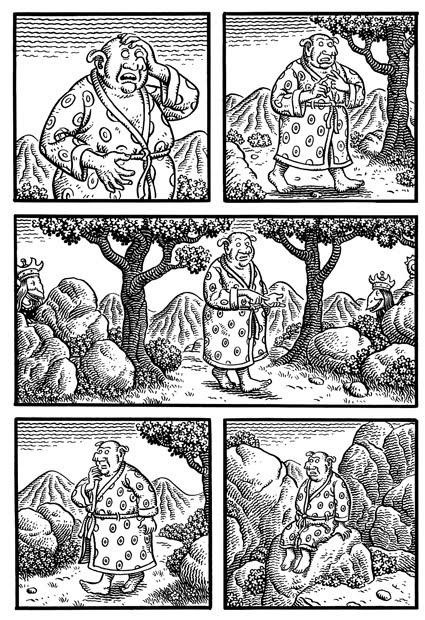
I’ve talked about Jim Woodring before in my Friday Funnies series. Weathercraft is the newest book in his Frank series. As always, it’s a nearly wordless comic, no dialogue, no captions, just art. Reading it can be done in five minutes, you’ll be able to follow the story from panel to panel, from page to page, but you’ll have no clue as to what just happened. I’m a text orientated guy, I read comics text first, art second and I did read Weathercraft that way first, fast, just getting the bare bones of the story, following it panel to panel, page to page but without taking in it as a whole.

page from Weathercraft

This naive way of reading any Frank story comes natural, thanks to Woodring’s art. There’s nothing difficult or unclear about his artwork, as you can see from the page above. For the reader, the hard work does not lie in following the story from panel to panel, but in coming to some understanding what the symbolism in the story could mean, whether it is representing some deeper meaning or is meaningful of its own accord. For Woodring, the hard work must lie as much in making things so clear to the reader, to making Manhog’s expressions so easily readable, to keep the flow of the story obvious especially when the symbolism grows heavy.

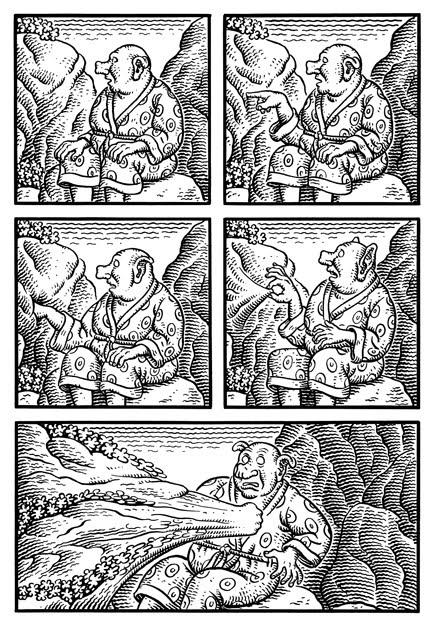
page from Weathercraft

Such as it starts to do here, as Manhog discovers the plasticity of what seemed until now be a solid reality. As might be obvious by now for readers already familiar with the universe in which the Frank take place, the unifactor, this is a Frank story in which Frank is only a secondary character and Manhog is trust into the lead role. His transformation and edification as to the true nature of the Unifactor, the universe in which he lives, is the story of Weathercraft

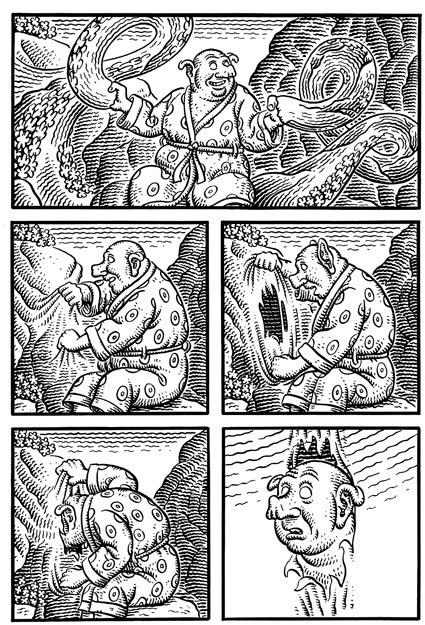
page from Weathercraft

But what this story is, what Manhog’s investigations reveal, will remain a secret for now. It’s pointless trying to recap it here. More perhaps than any other comic, the pleasure in this lies not with its plot revelations, but with the flow of the story. You do not even need to attempt to understand What It All Means, just reveling in the worlds Woodring has created here is pleasure enough.

For those who still want to know at the very least what Woodring thinks it all means, there’s his video walkthrough over at Fantagraphics. Personally, I find ignorance is bliss in this instance.

They don’t like it up them

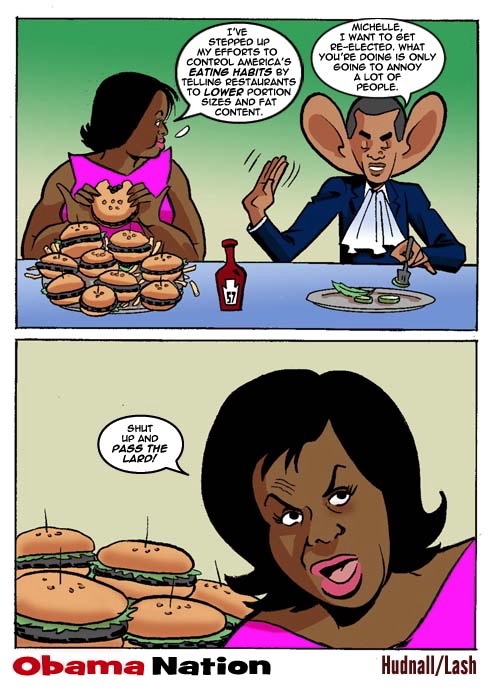
One of the least impressive features of Team Comics is how quickly it closes ranks against the Big Bad outside world sometimes. I first noticed this in the ongoing Danish Cartoons debacle, where the question of whether these cartoons were racist/bigoted never played an important part in the narrative that developed around them. What with death threats against the cartoonists involved, that this was never much discussed was understandable, but there was still a worrying lack of self criticism nonetheless. Something similar is going on right now, after MSNBC’s Lawrence O’Donnell attacked a James Hudnall/Batton Lash cartoon for being racist. This cartoon:

What Barack and Michelle Obama look like according to Hudnall and Lash

Which, if perhaps not overtly racist, is keen to use the Big Black Mama stereotype on Michelle Obama, somebody you really cannot accuse of being fat or prone to gulp down a dozen hamburgers in one go (not fried chicken?). It’s an excruciatingly bad cartoon, part of a series that’s published on the Andrew Breidbart Big Hollywood site and which includes entries like this. Breitbart, for those who don’t know him, is waging a personal war agains the socalled liberal elites and media, has a hate-on for Obama and his readers are hardcore wingnuts: racist, sexist and convinced the president is a sekret muslim socialist born in Kenya wanting to unleash sharia law on America. That’s the context in which this cartoon was published: on a site that’s not know for its racial sensitivity, as part of a series that is happy to use racial dogwhistles (one cartoon showing Obama in Joker makeup kniving the statue of liberty) for an audience that eats up stories about Obama being ghetto.

Not surprising therefore that O’Donnell attacked them. And while the emphasis in the comics news coverage is on the alleged death threats the pair have recieved (The Beat, Comics Reporter) , it would’ve been nice if the coverage had also looked at the context in which Lash and Hudnall created their cartoons, their own role in fueling the political anger and hatred on the American right. Because they’re not innocent victims and this is not just about freedom of speech. You cannot pump out hatred and not expect a backlash.