Pavlovian scolding

I have a fair amount of sympathy for the idea that you shouldn’t give trolls undeserved attention, even famous trolls, but Cheryl Morgan hacked me off:

Yesterday I launched Salon Futura #6 on the world. Like any publisher, I watched keenly for online reaction to my new baby, and a few people were very kind about it. Thank you, folks. But honestly I didn’t expect much reaction. You see, I hadn’t set out to offend anyone.

What did get a lot of reaction from teh intrawebs yesterday? Well, some ignorant prat wrote a long blog post about nihilism in modern fantasy, which served mainly to demonstrate his lack of knowledge of fantasy’s history, his lack of breadth of reading in modern fantasy (I suspect he’s never read a book by a woman in his life) and probably his lack of understanding of nihilism (though I’ll leave that to people with philosophy degrees to deal with). As journalism it was, to put it bluntly, a foetid heap of steaming dingo’s kidneys. So of course my little corner of teh intrawebs went apeshit over it.

The one thing more tiresome than engaging trolls is complaining about other people engaging trolls, especially when you make it seem that you’re mostly offended that they don’t pay attention to you. Which I’m sure wasn’t Morgan’s intent, but it does come across that way. I’m sure she understands something like Salon Futura with its mixture of short stories and thoughful non-fiction takes time to digest and reflect on, while Leo Grin’s fart of outrage takes no more than five minutes to read and mock. It makes for a nice bit of light entertainment as it does the round of Twitter and sf&f blogs, with e.g. Joe Abercrombie responding to it with some deft skewering:

But why all the fury, Leo? Relax. Pour yourself a drink. Admire your unrivalled collection of Frank Frazetta prints for a while. Wrestle the old blood pressure down. When an old building is demolished to make way for a new, I can see the cause of upset. Hey, depending what’s lost and what’s gained, I might be upset myself. Let’s all take a look at the plans together and see if we can work something out. But books don’t work that way. If I choose to write my own take on fantasy, what gets destroyed? What loss are we bewailing here?

That’s very far from the “pornography of rage” Morgan talks about, more a sort of bemused merriment at the idea that somebody can be so threatened by any kind of fantasy that isn’t like he imagined the “two titanic literary talents” J. R. R. Tolkien and Robert E. Howard wrote that he has to write such a dumb polemic. It can be interesting to dissect, though I won’t bother myself, to understand why somebody is so insecure that he has to imagine that any fantasy he dislikes is not just to his taste, but actively undermining western civilisation…. To scold those who are interested in doing this seems counterproductive.
Google: threat or menace

It’s a bit self serving, but this Torrentfreak article about Google censorship does raise a genuine concern about its power as the world’s number one search engine:

Apparently Google has decided that its users should not be searching for the keyword BitTorrent, so why list any results then? It’s the beginning of the end.

Jamie King, the founder of Vodo – a platform where artists can share their work with million of people at no cost – agrees with this assessment. Searching for one of their perfectly legal releases on Google used to suggest the word “torrent” with a link to the download page, but not anymore.

“Google already showed it will censor for the highest bidder — China Inc. springs to mind. Now it’s doing it for MPAA & Co.,” King told TorrentFreak.

“I guess it’s simple: our favorite search monopoly cares less about helping the thousands of independent creators who use BitTorrent to distribute legal, free-to-share content than they do about protecting the interests of Big Media in its death throes.”

If you’re not on Google, you’re effectively invisible on the internet. Google therefore has an inordinate amount of power, yet barely any accountability. As a commercial organisation, their only responsibility is to their bottom line, fluff about “not being evil” notwithstanding, Yet having say a nationalised version of Google would not fill me with confidence either. Google is one of the ‘net’s natural chokepoints and what we need to get if we want to keep the internet free is a decentralised Google. Think what might have happened had Google censored the news of the Egyptian revolution.

More about the Dutch comics market

More grist on the mill for the idea that there’s something wrong with the Dutch comics market for adventure strips comes from Bart Croonenborghs:

Minck Oosterveer combines fluid brush work with high contrast black and white art and is best mostly known in US comic circles for his Boom! Studios work with Mark Waid on The Unknown. After The Exiles of Thoom debacle, Oosterveer just flat out admitted that at the moment the comic strip business in the Netherlands is not really worth the effort anymore. His popular Zodiac and Nicky Saxx newspaper strips both having been retired, Oosterveer finds the process of of actively hunting down new leads on projects tiring and time consuming, doubly so since payments are not what they used to be for these kind of newspaper strips.

Even Nicky Saxx recently winning the Dutch Oeuvre Award 2011 – the most important strip award in the Netherlands – couldn’t budge Oosterveer’s determination in abandoning the Dutch comics field. He has since revealed signing with an American agent, that he will be doing a new series with Mark Waid and is working on a creator owned graphic novel with writer Charles Webb. Having found the American comics work much more rewarding in terms of creator respect and payment, he has decided to focus his efforts on breaking through in the US comics market.

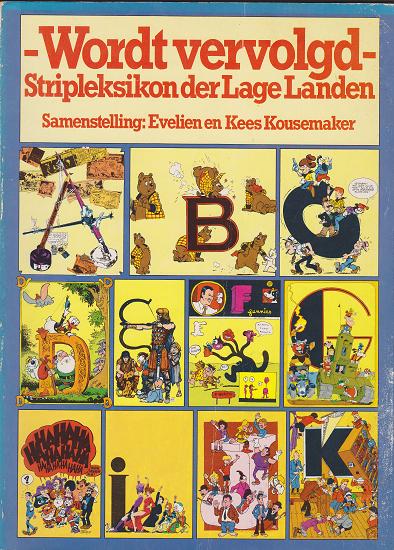
Word Vervolgd, Strip Leksikon der Lage Landen

Minck Oosterveer was the only Dutch comics creator still working in the long tradition of the adventure strip, that he has had to focus his efforts on the American comics market because Dutch comics paid too little to make a living is …not good. The comics market in the USA is after all godawful and has been for years, so to prefer that to the Dutch market means that for creators like Oosterveer at least the market here is worse…

And yet, as I showed last year, the market for “graphic novels” is booming, with books like the translated Robert Crumb Genesis or Logicomics selling well over 10,000 copies, something that for a normal book too would be very respectable in the relatively small Dutch book market.The graphic novel as a publishing phenomenom has indeed become succesful enough to become a bandwagon, with a flood of inferior work released as “graphic novel” which would’ve never gotten any media attention had they been called “comics”. Tonio van Vugt, editor of Zone 5300, Holland’s most prominent alt-comix zine, already warned about the detrimental effect this could and would have on the reputation of comics as a medium, when on the one hand you have an artificial divide in “graphic novels (literature, hip, available in quality bookstores) and “strips/comics” (pulp, oldfashioned, bought in strange little shops normal adults won’t go) and on the other hand much of what’s sold as “graphic novel” is crap, only able to confirm the stereotypes people already have about comics.

But there’s more going on. The Dutch comics market has always been very open to foreign comics, yet at the same time managed to have a strong comics industry itself as well, nourished through publication in a variety of weekly and monthly magazines, as well as newspaper publication. All these outlets slowly disappeared over time however, while the competition of cheaper foreign comics became stronger. There are so many good American, French, Japanese and other comics being translated that few Dutch cartoonists can competite with them. Who will take a gamble on Jan Janssen from Lutjebroek when they can publish e.g Charles Burns Black Hole quicker and cheaper and probably get a bigger audience? It’s the same as what happened to Dutch language science fiction in the seventies and eighties, when for a moment it did seem we could get a reasonable scene going (Eddy C. Bertin, Bob Laerhoven, Felix Thijssen, Wim Gijssen, the Gandymedes anthologies etc.) , but it turned out translating yet another Keith Laumer or Larry Niven novel was cheaper and more profitable too..

There are exceptions to this trend, like Barbara Stok or Maaike Hartjes (here reviewd by Branko Collin), but what they do is slice of life stories rooted in everyday Dutch life; not something you can easily find foreign substitutes for…

Reassuring to know Martin Amis remains a knob

Wild horses couldn’t drag me in front of the television to watch Sebastian Ffaulks on fiction and fortunately it’s also forbidden under the Genevea Conventions to force people to watch his self-satisfied smug face, which is why I missed Martin Amis being a knob again. When asked if he would ever write a children’s book he said “‘If I had a serious brain injury I might well write a children’s book”:

Remarks about children’s books made by Martin Amis on the BBC’s new book programme Faulks on Fiction, broadcast this week, have caused anger and offence among children’s writers.

“People ask me if I ever thought of writing a children’s book,” Amis said, in a sideways excursion from a chat about John Self, the antihero of his 1984 novel Money. “I say, ‘If I had a serious brain injury I might well write a children’s book’, but otherwise the idea of being conscious of who you’re directing the story to is anathema to me, because, in my view, fiction is freedom and any restraints on that are intolerable.”

“I would never write about someone that forced me to write at a lower register than what I can write,” he added.

These remarks led to the usual (justified) outrage by those he targeted, but they’re really nothing more than unthinking snobbism from a has-been, a somewhat desperate attempt to remain “controversial”. Of course Amis would be disdainful of children’s books: he wouldn’t be Amis if he didn’t look down on anything that wasn’t written by him or his mates like Ian McEwan. It’s pointless to get angry at him or try to reason him out of his prejudices; he only says these things for the publicity and the image.