The Deep State

The Deep State is an idea that originated in Turkish leftwing circles, as leftwing activists in the seventies and eighties started to notice the links between the army, police, judiciary, certain political parties, organised crime and the intelligence services and how these various interests groups worked together to block unwanted democratic developments like the election of leftist parties and politician or later, the rise of political Islamistic parties. The Deep State has supposedly apolitical organs of the state working together with extra-governmental and even criminal or fascists groups to pursue their own political agenda, while keeping up the appearance of a democracy, through a largely informal network of likeminded people in positions of power both within the state as outside of it, sometimes even working against the interests of their own government.

Through it was first articulated this way by Turkish leftists, the idea of such a “deep state” is not unique to that country of course. As made clear by Watergate, the Lockheed Affair or the Gladio Network and other such scandals, deep state structures can be found in any western democracy, especially in its intelligence services. It’s inevitable. Those who join institutions like the army, police or secret services are more likely than not to have rightwing sympathies and especially in the higher echelons of such a service, contempt for “fickle politicians” is almost bred into them, as any Tom Clancy novel shows. Combine that with an outlook that’s designed to see reds under every bed and is professionally pessimistic when estimating threats and the temptation to do something about these threats must be high. All this doesn’t really need men in suits around a big table in some smoky backroom, though I’m sure some such scenes will have happened, just people of similar backgrounds and political opinion informally helping each other against a common enemy. The people at the top don’t really need to do anything, just turn a blind eye to what their subordinates are doing.

A perfect example of such a Deep State conspiracy is the current News of the World phone hacking scandal. You have journalists hacking the phones of mainly leftwing politicians, as well as the usual celebrity suspects in the service of finding sleaze to splash on the frontpages of rightwing newspapers and in Scotland Yard, a police service that is a) highly politicised already and b) is strangely reluctant to investigate these crimes or even inform victims that their phones had been hacked, to the point that even Gordon Brown had to ask if he had been a victim. Meanwhile Andy Coulson, the ex-editor of the News of the World, who had to resign back in 2007 when one of his journalists had been convicted of phone hacking, was deemed respectable enough to become and remain David Cameron’s spin doctor until he was scapegoated this weekend.

The mainstream spin on this is that this is all an awful example of Rubert Murdoch’s grip on the UK’s political classes but that since all newspapers are complicit, do not expect much to change. And sure, perhaps ninety percent of such hacking is just done for crass commercial interests: getting the scoop on the next Royal scandal, digging up dirt on the newest X-Factor celebrity, “getting” yet another MP playing hanky panky with somebody else’s husband, a rubber suit and a large orange and so on. This is bad enough, but it is also the perfect instrument for the intelligence services to keep a tap on “enemy” politicians. No need to set up your own, risky surveillance programme if you can get friendly journalists to do it for you. These services have long had ties with the more respectable British newspapers (see e.g. Spycatcher) anyway and the illegality of such phone taps, as well as the expertise needed to get that bit of hacking done (not always very great, admittedly) means that the papers won’t look too closely at who’s helping them get their material and sharing it either — one hand washes the other.

It’s not surprising then that Scotland Yard has been reluctant to look too closely into the phone hacking allegations, other than when they’re forced to through the courts. They have every reason not to.
Other people’s new year’s resolutions

Like me, another science fiction reader/blogger called Martin (Lewis in his case) found out he read shockingly little science fiction by women and decided to do something about it:

Over Christmas I decided to do something about this: I would read and review one SF novel by a women every month in 2011. I appreciate this sounds pathetically modest but in the context of my current reading I’m afraid it isn’t. There were several SF novels by women already languishing on my shelves, bought but unread and in this state for some time. I rescued these and then topped them up from Amazon. This in itself was an eye-opener; almost all the books I searched for – even those which had only recently been published – were out of print.

He’s not the only one to set himself this challenge: so did Ian Sales:

Torque Control’s Women in SF Week has inspired me to read twelve science fiction novels by women writers during 2011 as my reading challenge. I’ve tentatively identified the dozen novels I’m going to read. I didn’t want to pick only those published since 2001, although many are from the last decade. Nor would I limit myself to books published in the UK. But I did want my list to be comprise only authors I’ve not read before (bar one or two slight cheats).

And, neatly satisfying the law of threes, over at Torque Control, Vector‘s new editor Shana Worthen will be holding a monthly bookgroup reading through the winners of last year’s poll of best sf novels by women published from 2001-2010.

For myself I had already decided last year I needed to read more female science fiction, spending the last months of year reading and rereading some writers I had neglected for too, like Lois McMaster Bujold, C. J. Cherryh and Mary Gentle. But perhaps I should try and set myself the same sort of goal as Ian and Martin as well, even if what I read is so depend on my mood and interests on any given day. So let’s pick a list of twelve books I can and should read this year, either science fiction or fantasy, all written by women:

  • January: The Left Hand of Darkness — Ursula LeGuin (start with a classic, especially when it’s a short one…)
  • February: Bold as Love — Gwyneth Jones
  • March: The Female Man — Joanna Russ
  • April: China Mountain Zhang — Maureen McHugh
  • May: Foreigner — C. J. Cherryh
  • June: The Halfling and Other Stories — Leigh Brackett
  • July: A Point of Honor — Dorothy J. Heydt
  • August: Golden Witchbreed — Mary Gentle
  • September: 10,000 Light Years from Home — James Tiptree, Jr
  • October: Trouble and Her Friends — Melissa Scott
  • November: No Present Like Time — Steph Swainston
  • December: The King’s Peace — Jo Walton

These are on my shelves right now, all save three not read before and selected to have a relatively wide selection of science fiction/fantasy. These (hopefully) won’t be the only female written sf/fantasy books I read this year, but these are the ones I will read.

Confusing “available in English” with “worldwide success”

Earlier this week, Tom Spurgeon linked to an article in The Irish Times on French comics and their supposed failure to become a success abroad:

Perhaps the chief reason for this relative obscurity is that the festival celebrates a cultural product that has, to date, stubbornly resisted any and all attempts to export it. Unlike cinema, or jazz, or any of the other artistic endeavours for which France is regularly feted, Francophone comics have, for reasons mysterious, never quite managed to “cross over” and translate local mass-popularity into success on an international stage.

There are, of course, exceptions – most notably the peerless Franco-Belgian duo of Asterix and Tintin, two series that have conquered minds and markets both regional and global. Yet for all their success, these venerable titans represent but the uppermost tip of a thriving, prolific and progressive creative iceberg.

Which is only true if you define “success on an international stage” as “popular in the UK, US and/or other English speaking countries”. It’s true that Franco-Belgian comics have done badly in English, but that doesn’t go for the rest of Europe, or large parts of the rest of the non-English speaking world. That this sort of success is invisible in the Anglo-American parts of the world is due to the failure of the former to pay much attention to anything outside its own borders, rather than due to the lack of this success.

Friday Funnies: The Portable Frank

The Portable Frank

The Portable Frank
Jim Woodring
Fantagraphics, 2008
200 pages/$16,99
Get if from Fantagraphics.

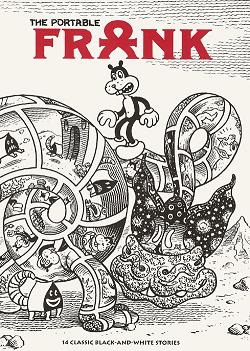
The Portable Frank is a collection of fourteen of the black and white Frank stories wrote and drew in the twenty-odd years since Frank first appeared on the cover of Jim issue four back in December 1990. Frank looks like a mutated Felix the Cat wearing Mickey Mouse’s shoes and gloves and even so is the most normal looking of the cast of characters Woodring assembled around him. Two words you’ll hear a lot when describing Frank’s adventures: dreamlike and surreal, as reviewers try to grapple with the world and cosmology Woodring has created with these stories. A copout, but it is difficult to explain Frank to people who haven’t seen these stories.

The best comparison I can make is to finding a collection of legends or fairytales from some unknown mythology. The stories make no sense together, sometimes contradicting each other, characters changing from one story to the next, dying in the one and returning with no damage in the next. At the same time you can see how this mythology must’ve developed over time, how each character has their role to fullfil in it. That’s what these Frank stories are like.

Frank himself is the innocent everyman, kindhearted, a bit naive but capable of shocking cruelty at times. His main nemesis is the manhog, half man, half pig, all rage and id. Manhog often attacks and bullies Frank, but as often is the victim of others, used and abused by the closest figure the strip has to a true evil personage, Whim, the moonfaced grinning devil figure, who acts as the tempter to Frank, warpinghim spiritually as well as physically. His servant (?) Lucky is a human looking figure, but with a hugely elongated face, usually seen manhandling Manhog for some menial task or other. As his protector Frank has Pupshaw, a dog kennel shaped creature with a sort of bushy raccoon-like tail, whom Frank takes for a pet in the first story. Pupshaw largely behaves as a sort of dog or cat like creature, but transforms herself into a monsterous form when needed. There are also Faux Pa and Real Pa, older looking, more heavyset and stubbly versions of Frank, who walk on four paws. Faux Pa, in league with Whim, turns up in several stories to try and transform Frank into something more cruel, while Real Pa only shows up in the last story, guiding Frank out of the dungeons he had landed himself in.

All of Frank’s stories are nearly wordless, told in pantomime, with no dialogue and only a few captoins here and there, usually at the end of a tale. What we see and get to know of the various character’s emotions and their inner life has to be deduced from their expressions and postures. Woodring is a master at this, in drawing attention to a character’s mood by showing it on their faces, slightly exaggerated but never forced. He also uses a lot of reaction shots, where in panel one something happens and in the next panel you see Frank’s reaction to it, acting as a counterpoint.

Woodring’s art is stylised and inventive, as can be seen at Fantagraphic’s official flickr stream. You can run through this book in an hour, but come back to it time and time again discovering new details. Woodring is one of those artists that make you sees the world through his eyes, where you can’t help but see his figures and poses everywhere you look.

As a collection, The Portable Frank is an effort to have an affordable introduction to Frank’s world, the title of course harkening back to Viking’s old collections like The Portable Mark Twain. The format is nice, slightly smaller than a regular comic book in dimensions, but some concessions had obviously to be made to keep the price low. So there’s no bibliographical material, no key to the characters (whose names never appear in the stories and I had to get from Wikipedia), there’s just the stories themselves. But that’s enough.

Rammstein: fascist, or secret socialists (but who cares?)

As Roy Edrose has shown time and again, to analyse and judge any artwork soley on its political merits is a fool’s game, as he dissects yet another hapless rightwing culture warrior failing to understand why the latest Hollywood blockbuster is not best viewed as a potential liberal propaganda vehicle. You find such naive appraisals of art on the left as well, but its heyday has long passed and most leftist culture critics are more subtle than that, able to both see the political dimension in art and still appreciate it on artistic merits as well.

Not always though.

On the Australian Socialist Alternative website, one Tom O’Lincoln is struggling to determine whether or not Rammstein is a leftist band or just plain fascist:

People call them far-right wing, and you can see where this impression comes from. With the extreme costumes and pyrotechnics, their concerts do have moments that look like some kind of post-modern Nuremberg rally. Till Lindemann’s bunker-busting voice sounds menacing and his long trilled r’s are reminiscent of Hitler.

So one critic called their work “music to invade Poland to”, and the New York Times thought Lindemann exuded such macho aggression that “it seemed he could have reached into the crowd, snatched up a fan, and bitten off his head”. Rammstein once got a lot of flak for featuring Leni Riefenstahl propaganda clips, and neo-Nazis have used their material – without permission. But they responded to accusations of being right wing or neo-Nazi with a 2001 number called Links (Left) 2,3,4 which declared:

Sie wollen mein Herz am rechten Fleck
Doch seh ich dann nach unten weg
Da schlägt es links.
Links!

They want my heartbeat on the right
But whenever I look down
It’s beating on the left.
Left!

Does that settle the question? No it doesn’t, as we’ll see. Neither can you settle it by reading all their lyrics. Firstly the English translations are seriously unreliable (I’ve done my own). But secondly, that’s nobody’s fault, because even German speakers will wrestle with the deliberate ambiguity of just about everything these guys write.

A glimmering of understanding in that last paragraph, but unfortunately O’Lincoln spents the rest of the article just doing that which he himself just said is pointless: analysing Rammstein’s lyrics to see if any clues to their political orientation can be found there. He concludes:

To be on the left means a responsibility to make a clear statement on the issues you raise. This Rammstein often fail to do.

Which is about the worst kind of pronouncement you can make about art, to call for an end to all ambiguity and to want rigidly defined areas of doubt.


Propaganda needs clear, simple statements. Art doesn’t. What Rammstein is doing with their music is much more complex by that and any attempt to find an explicit political message in it, whether fascist or socialist, is doomed to failure, as that’s not what they are interested in. Which doesn’t mean there isn’t anything interesting to be found in looking at Rammstein in a political context, but it does mean more than just a cursory scan of their song texts and actually analysing them, contextualising them and engaging with them. Not just showing that the lyrics in Wollt Ihr Das Bett in Flammen Sehen are misogynistic, not just explaining how they are, but why they are, how the song fits in with the rest of their work.

But that’s much harder than what Tom O’Lincoln did.