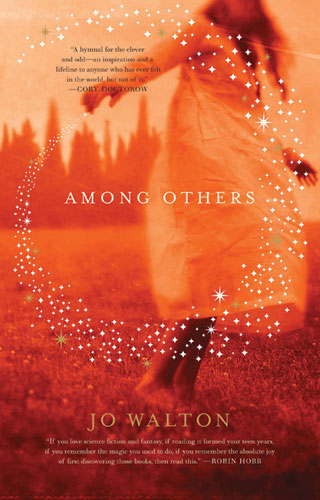
Amongst Others

cover of Among Others

When you have Patrick Nielsen Hayden:

I am not Welsh or female, I do not walk with a cane, and I do not have a dead sibling or a parent who wants me dead. I never attended a boarding school, my family is far-flung and American, and I have never (to the best of my knowledge) conversed with fairies. And yet to a startling extent Among Others feels like a book about the experience of being me when I was, like Mori, fifteen. This turns out to be a fairly common reaction to reading Walton’s novel, at least among the kind of people I tend to know. It is quite possibly the best thing I have ever read about the way people of our ilk, when young, use books and reading to—in the words of Robert Charles Wilson—“light the way out of a difficult childhood.”

Locus reviewer Gary K. Wolfe:

I don’t believe I’ve seen, either in fiction or in memoir, as brilliant and tone-perfect an account of what discovering SF and fantasy can mean to its young readers – citing chapter and verse of actual titles – as in Jo Walton’s remarkable and somewhat autobiographical new novel Among Others.

As Cory Doctorow:

This is one of the places where Walton does something that made my head spin. For though Morwenna’s life has much that makes her unhappy, from her family to her pariah status to her gamey leg, these books are not an escape for her. She dives into them, certainly, and goes away from the world, but she find in them a whole cognitive and philosophical toolkit for unpicking the world, making sense of its inexplicable moving parts, from people to institutions. This isn’t escapism, it’s discovery.

Rave about the same book and with largely the same comments, you pay attention. Not that I needed introduction to Jo Walton, having know her as a fellow fan on Usenet since the mid-nineties and as an excellent science fiction and fantasy writer since her first published novel, The King’s Peace, but such high praise from such distinguished reviewers does concentrate the mind. Amongst Others might just be Jo’s breakthrough book, the novel that moves her from a cult author into a proper success, finally. She has been upping the stakes with every new book: from her start with her three book Histoire à clef series fo Arthurian fantasy, to her reworking of Anthony Trollope with dragons in Tooth and Claw, to one of the most chilling alternate histories in the Small Change series. In each case I had expected her to achieve the same sort of success as somebody like Alastair Reynolds had gotten, but for some reason it never quite happened. Even those alternate history novels, which I had thought would’ve been a surefire hit, well, didn’t quite make it:

Well, actually, Half a Crown is arguably an example of the system not working as well as it might. Farthing did okay midlist numbers in hardcover and actually better-than-expected numbers in mass-market paperback. But for reasons best described as “weather” (i.e., nothing whatsoever to do with the book), Ha’penny took a dip in hardcover–fewer library sales, among other things, if I recall correctly–and the mass-market paperback fell off a cliff. This is why Half a Crown hasn’t had a softcover edition yet–since we were clearly doing something wrong, I didn’t want to spray-paint further lousy numbers onto Jo’s track record.

You do wonder why a great writer like Jo hasn’t been able to catch a break yet — insufficient promotion perhaps, though I’m not sure how much that still matters in this interweb age, or perhaps it’s because she switched genres too much, or not writing in the right subgenre, not writing widescreen space opera or, as Patrick says, it’s just the weather? Good writers can and do bubble under, write books that everybody who finds them loves, but which never quite find their audience. Science fiction is littered with examples (William Barton, T. J. Bass to name but two examples from my own shelves); it would be a shame if the same happened to Jo.

Especially since Among Others does sound incredibly interesting, ever since Jo told of how she grew up in a post-industrial landscape on her Livejournal and people started to tell her to turn it into a novel. She has managed to turn her own experiences discovering science fiction and growing up with it in a world where nobody else cared for it into a proper fantasy novel and while with any other writer I would be wary, Jo has been writing about this online for a long time, ever since we both were regulars on rec.arts.sf.written. She still does so at Tor.com, talking about all her favourite books and what they meant to her and why they’re so good and you should read them — she’s probably the one person who has done the most to nudge me towards books I would not have read otherwise, after S.

Which is why I put my order in for the hardcover at the local science fiction bookstore, which had already sold out of the two copies they had apparantly recieved in November. Eight days I got to wait now, oy.

Did he have to be a comics retailer?

Tom Spurgeon reports that comic retailer and internet hard man J.I. Corcoran is under investigation by his local police force for the remarks he made after the Tucson shootings:

Robot 6 has their usual sterling write-up here about this article from regional Boston media about the police in the community of Arlington (about five, ten minutes northwest of Boston proper) suspending the firearms license of Heavy Ink comics retailer Travis J.I. Corcoran and seizing what they called a “large amount” of weaponry and ammunition from his possession. Both moves were made pending the outcome of an investigation into statements made by Corcoran after the shooting of Arizona congresswoman Gabrielle Giffords and 19 others on January 8 in Tucson. The main statement in question was “one down 534 to go” in reference to her membership in the House Of Representatives. As tracked by on-line comics media — including at Comics Alliance, where apparently the police encountered the story — Corcoran has thus far qualified rather than backed down from the statement.

Spurgeon also mentioned that several comix creators had “expressed their distaste” at Corcoran’s remarks, some going so far as to call for a boycott, or rather, that he should stop selling their works. His sentiments were, if not nasty or evil, certainly mistimed and boorish. Yet it all seems a bit over the top to try and destroy his livelihood for what at heart is the same sort of half-joke many Americans could’ve made in private about Congress, or other “hated” groups like lawyers. Corcoran’s mistake was his bad timing and his inability to let go of it graciously, rather than dig his heels in. It’s understandable that the police is investigating him in the current climate, but it’s also clear that all he was doing was being a typical, rightwing internet blowhard talking bull when he should’ve kept his mouth shut. Bad publicity for comics, but nothing serious.

The moving finger blogs; and, having blogged, moves on, selfconsciously

Just put a post up at Prog Gold, where I try to explain what I think is now happening in Tunesia in that great blogging tradition of instant expertise on subjects learnt about in five minutes of cribbing from smarter people. You may want to go over there and see if I make any sense.

Or you could read Lenny’s last, three posts and get his, much more self assured, analysis of the situation,as he’s actually quite good at this sort of thing. Mind, there’s a thin line between what Lenny does and the sort of communique put up on the websites of every obscure Trotskyite three man band revolutionary tendency, explaining Tunesia in their own, slightly warped Marxist theory and why only their interpretation of what $INSERT_DEAD_SOCIALIST said about The Revolution can provide a full understanding of the revolt in Tunesia and why this is the True Start of the WorldWide Revolution, or just a Intra-Capitalist Struggle, though not why they never paid attention to the country before.

Because for the most part of course none of us in the English language, political/socialist blogosphere did, but we do now do our level best to become instant experts on it. Just as we did with Honduras last year, or Georgia before that. Nothing wrong with that, but there is a tendency to fit such happenings in whichever schema we’re pushing on our blogs, especially on the more hardcore socialist blogs, without much regards for what’s happening on the ground.

Portugal shows Holland the way

Nine years ago, Portugal decided to try and solve its persistent drugs problems through decriminalisation: the results are encouraging:

As the sweeping reforms went into effect nine years ago, some in Portugal prepared themselves for the worst. They worried that the country would become a junkie nirvana, that many neighborhoods would soon resemble Casal Ventoso, and that tourists would come to Portugal for one reason only: to get high. “We promise sun, beaches, and any drug you like,” complained one fearful politician at the time.

But nearly a decade later, there’s evidence that Portugal’s great drug experiment not only didn’t blow up in its face; it may have actually worked. More addicts are in treatment. Drug use among youths has declined in recent years. Life in Casal Ventoso, Lisbon’s troubled neighborhood, has improved. And new research, published in the British Journal of Criminology, documents just how much things have changed in Portugal. Coauthors Caitlin Elizabeth Hughes and Alex Stevens report a 63 percent increase in the number of Portuguese drug users in treatment and, shortly after the reforms took hold, a 499 percent increase in the amount of drugs seized — indications, the authors argue, that police officers, freed up from focusing on small-time possession, have been able to target big-time traffickers while drug addicts, no longer in danger of going to prison, have been able to get the help they need.

Here in the Netherlands we’ve had this policy for much longer with largely the same results. Softdrugs like hash and wiet became generally accepted, as normal as drinkign alcohol and — surprise — turned out to be much less dangerous too. Meanwhile the greatest problem with hard drug users, especially heroine addicts, was that they were getting older and less healthy, as the existing users aged and few new people got addicted. Decriminalisation worked, but was awkward as no government ever quite dared to take the step to full legalisation. And now we have a rightwing government that is actively trying to hollow out decriminalisation by ill thought out measures like the “wietpas”. Ironically, it’s only now that other countries like Portugal have discovered the benefits of a more measured antidrugs policy…

Second Variety


Philip K. Dick lives! As Beamjockey explains, this is the second robotic head of Philip K. Dick, the first having been lost in transit back in 2005. Hanson Robotis now has rebuild the head, stronger, better, faster and what’s more, this was supposedly done with support from Dutch broadcaster VPRO. This doesn’t surprise me; the VPRO is the kind of broadcaster that suits Dick very much, somewhat on the experimental side with not every experiment being a success.