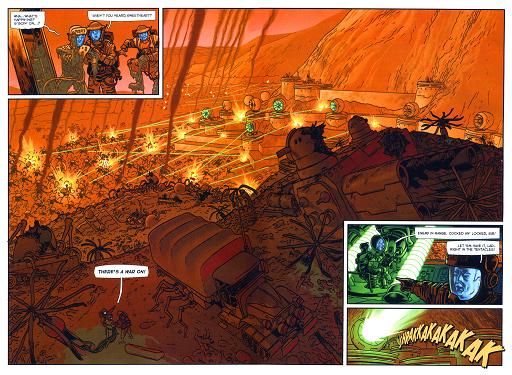
The War of the Worlds battlefront moves to Mars….
Since I am reading comics again, I thought why not do something with them, though preferably not something as lunatic as last year’s Fifty Essentials in Fifty Days. Instead, from now on every Friday I’ll attempt to spotlight some deserving, newish comics. Comics such as today’s offering, Ian Edginton and D’Israeli’s Scarlet Traces: the Great Game.
In the same year that H. G. Wells’ War of the Worlds was published, the first unauthorised sequel Garrett P. Serviss’ Edison’s Conquest of Mars appeared, a jingoistic tale of American derring do overcoming the Martian evil, far removed from Wells’ own intentions. Ever since writers have continued to be inspired by it or swiped from it to enlive their own retro-futures, like e.g. Christopher Priest in The Space Machine In comics, apart from the inevitable Classic Illustrated adaptation, there of course also was Marvel’s great over the top reimagination of it in Killraven and which thanks to Don McGregor and P. Craig Russell was much better than it had any right to be. Alan Moore and Kevin O’Neill also used it in League of Extraordinary Gentlemen volume two, with a particular cynical revelation of what really killed the Martians.
Ian Edginton and D’Israeli’ then stand in a long and sometimes proud tradition when in 2003 they created the first Scarlet Traces miniseries, which asked what would’ve happened to a nineteenth century England suddenly in possession of highly advanced Martian technology in the aftermath of the invasion. England in 1898 of course was still convinced of its divine right to rule the world and it’s new technological superiority made this only worse. Martian technology has also unleashed a new industrial revolution, with the south reaping the benefits while the smokestacks of the North and Scotland fell still, replaced by clean, robotic Martian machinery, the workers left on the scraphead surplus to requirements.
This is the background against which Scarlet Traces: The Great Game is set, jumping ahead to the 1940ties. Martian technology has completely transformed England and the world, leaving London looking as something out of Dan Dare — and D’Israeli’s designs do have something of that fifties English science fiction feel to them, clean and streamlined and bright. England now is not just a world power but has invade Mars and has been waging war for decades, while at home Northern and Scottish terrorists/freedom fighters are the justification for increasingly draconian security measures, overseen by home secretary Mosley, while Scarlet Traces‘ main villain, Davenport Spry is now prime minister.
Enter aristocratic lady photographer Charlotte Hemming, returning to London from an overseas assignment for the Interceptor, one of the few opposition newspapers left in England. When on her way there the BBC building is blown up by a Scottish suicide bomber, she’s on the scene to snap pictures. This lands her and her pulisher, Bernie Goldman, in hot water, hotter still when he gives her her next assignment: to find out what’s really going on on Mars. Bernie is killed by army thugs but Charlotte escapes, rescued by major Robert Autumn, the hero of the previous book. He explains what he had found on his adventures thirty years ago, the great secret behind England’s economic expansion and the mystery of what he and Bernie wanted her to research on Mars. Why is it, that in all these decades of fighting, so few soldiers returned home.
That’s the setup, and the rest of the book has Charlotte travelling to Mars, only to end up in the midst of the heaviest fighting in years, as the Martians attack the main British base at Valles Marineris, a huge city building two and a half thousand miles end to end, build by some unknown race. It’s evident that the military has been hiding the whole truth about the Martians for decades, also that they’re up to something big, a final act of genocide to win the war, but so are the Martians…
Now originally published as a four part miniseries by Dark Horse, this structure is still evident in the story. The first issue has the setup, in the second issue Charlotte gets to know the hidden truths of her world by Robert Autumn and travels to Mars, part three has her arrive and after some confusion starts finding even bigger questions that need answering and in part four all of this has to be tied together and resolved. It doesn’t quite work and feels rushed. Much of the plot is also told through speeches, first Autumn, later the series main villain, another army man, commander James Dravott, as he explains to Charlotte why the war was started and what the stakes are. Some more room for the story to breathe would’ve been nice.
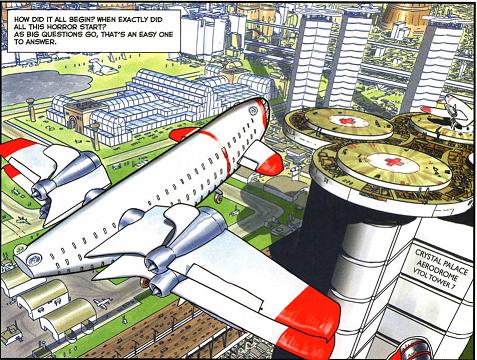
But these are quibbles. The main attraction is the world Edginton and D’Israeli have created, which is great. Googling around many reviews call it steampunk, but that’s wrong. This isn’t faux Victorean high tech, this is an alternate nineteenforties and the technology reflects this. As said, the space ships, aereoplanes and equipment could’ve all been designed by Frank Hampton for Dan Dare, sleek, streamlined but round forms as above, yet the various lorries and automobiles we see in the background from the bonnet up look like proper 1940ties British cars, save for the crawler legs instead of wheels. D’Israeli is very good at convincingly portraying this meld of retrofuturism with the almost organic look of the Martian tech incorporated in them.
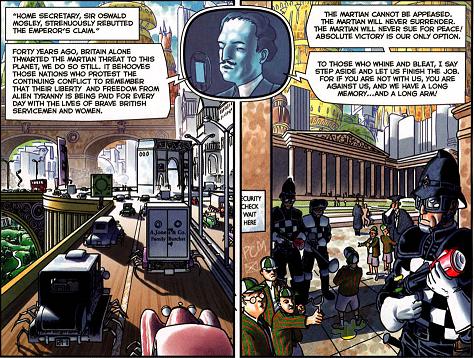
D’Israeli is also good at providing unobtrusive but telling background details and cameos, like the lorry with the “A. Jones & Co Family Butcher” logo above, which help shape and make real Charlotte’s world. Everywhere you look there are mundane examples of Martian tech having been incorporated in familiar machines, while the fashions and office furniture is still recognisably forties in look and feel. Once Charlotte gets underway to Mars, military technology dominates, with clanking big WWI style tanks and soldiers in spacesuits that could’ve been worn in the trenches along side the much cleaner looks of the spaceships and the strangeness and grandeur of the Martian ruins. The use of colour is also superb: D’Israeli apparantly did all this directly on the computer, according to the backpages and this must’ve helped the unity of colour and image. It doesn’t feel computerised though. His people are slightly cartoony, with great expressive faces, clean lines and no unnecessary detailing or shading. Somewhat reminded me of Bryan Talbot’s work on One Bad Rat though of course D’Israeli cleary has his own style, but in the way he uses colour and shape to pop out foreground figures from their background.
A satisfying book and the physical presentation of it fitted it perfectly: hardcover bound, slightly bigger than a standard American comic book with nice clean glossy white paper that make the colouring really stand out.